


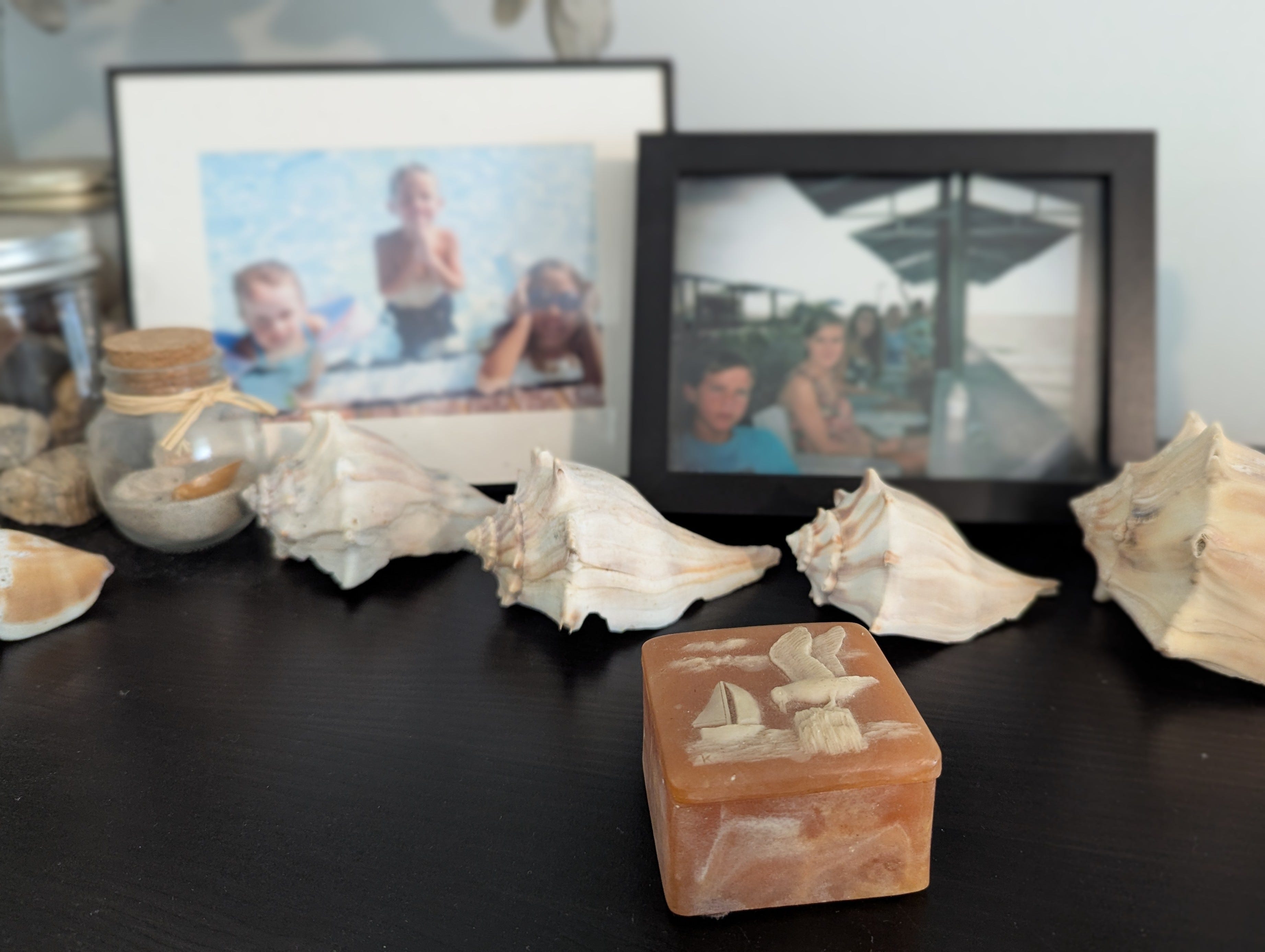
I don’t have many artifacts from my childhood—most have been lost at sea by innumerable moves, careless use, or purpose served. But there is one soapstone trinket box that I’ve miraculously managed to safeguard for thirty-some-odd years.
It’s small—no more than three inches by three inches by two inches. And fragile—a chip on the inside cover reveals a young Katrina’s mistake. And dainty—resembling the color of a marbled and soft setting sun. On its face, a nautical scene depicted in ivory-white: a seagull stretching its wings on a wooden post in the foreground, a sailboat tackling choppy waters in the background. I keep the trinket atop a dresser alongside photos of me and my four siblings and seashells collected from various beaches.
I must have been four or so when my dad’s dad gave it to me. I remember being told that Granddaddy brought it back from Hawaii just for me. Back then, I was an only child, and all I knew about Hawaii was that it was an island far away that you had to take a plane to. I knew flying cost a lot of money—money my family didn’t have, so I “better take care of it and cherish it.” And I did. It became an object that reminded me that I was loved—even in chaos.
Granddaddy died four years ago. I found out through a distant relative, who informed me via Facebook. At that time, I hadn’t spoken to my dad or granddad in over six years. After my 14-year-old brother took his life in 2015, our family castle—made of sand and broken shells—began to disintegrate under the weight of that ruinous tidal wave.
I can still vividly recall my mom’s phone call that ordinary Saturday morning when the wind shifted, signaling a disturbance in the atmosphere. At her words—“Are you sitting down? Is Erik home with you? It’s Preston…”—I lost all sense of control over my body. I left my body, tumbling in the undertow of despair, crashing onto the couch in our 500-square-foot apartment in Queens, then bobbing to the surface to sob in an Uber to LaGuardia airport. Eventually, I docked to that familiar shore where I met unfamiliar, vacant faces: the people that made me and my three sisters—12, 17, and 23.
We were at a Motel 6 in Pawleys Island, South Carolina, less than a mile from where it happened. It was then that I knew that my family could never go back to that three-bedroom condo. No, that place was no longer their home, but a graveyard of my brother’s existence, my parents’ identities, and my sisters’ innocence.
I remember how we stood there in that sad hotel room, staring blankly at one another like the fish in coolers on the piers down the road: lifeless, cold, gutted. Our wide, glassy eyes told the story of our shock: How could this happen? Why did this happen?
My parents’ 29-year marriage—if you could call it that—lasted three more years after my brother left. One charged night in the summer of 2018, my mother mustered the courage to kick my father out. Their subsequent, year-long separation was tumultuous—like a storm, ever-brewing, at sea, dragging me in, swallowing me whole, despite my distance and bracing in New York. At the time, I was teaching eighth-grade English in Woodside, Queens. My students were the same age as my dead brother, and every day, I saw his face, his body, and sometimes, his curls, in the boys that entered my room. Every day, I fought back a flood of tears with the tenacity of Captain Ahab from Moby Dick.
At the news of Granddaddy’s death, I felt a twinge of guilt for not saying a proper goodbye. After all, he really had nothing to do with the maelstrom that had formed and churned, creating a reality that didn’t feel like reality. In fact, his home on the Black River promptly became a lighthouse, a refuge, when our lives were blown to smithereens.
In September of 2019, my husband and I traveled to Hawaii for our friends’ wedding. Erik was a groomsman; I was a reader. The bride asked me to select the reading, trusting my judgment. I chose a passage from Paulo Coelho’s The Alchemist: “...he learned the most important of the language that all the world spoke—the language that everyone on earth was capable of understanding in their heart. It was love…It was the pure Language of the World. It required no explanation, just as the universe needs none as it travels through endless time.”
Now, 10 years later, my life appears dramatically different. My day-to-day interactions are calm. My husband and I are parents to two daughters—two golden suns—aged three and five. We live in a scenic town instead of a bustling metropolis. Lately, my 5-year-old has been asking big questions about life, such as when and why death happens. I’m often lost in thought, ruminating how I might answer her forthcoming questions about my brother, my father, and my grandfather—the one who gave me the soapstone trinket box I now treasure.
I won’t tell her that the object is only valued at $15.99 (according to eBay). I won’t describe the scene that unfolded on that very sad night when my mother discovered her one and only son—forever 14—in his closet. I won’t inform her about the level of pain one has to endure before making the decision to estrange your dad.
Instead, I’ll tell her that this soapstone trinket box came from my grandfather, who paid lots of money to fly to Hawaii and back and thought of me enough to buy me a gift to show that he loved and missed me.
She doesn’t need to know the rest—at least, not for now. For now, all she needs to know is that the love this object represents—the “pure Language of the World”—is not small, fragile, or dainty. It is big, strong, and mighty.
Katrina Donham writes about being a human, and she also writes about being a mother. You can find her words at Parents, Business Insider, and The Mother Chapter. She is also the author of the Substack publication, Human/Mother. She believes that the small things are the big things in life, and, boy, do they add up. Her writing covers philosophy, literature, psychology, parenthood, education, and science. When she’s not writing, she enjoys the sun on her face, the smell of the mountains, the taste of good coffee, the colors of nature, and the giggles of her girls.
Object-ives features flash nonfiction essays of 500-999 words on the possessions we can’t stop thinking about.
Recommended reading on possessions:
Ricki Lake was reconnected with personal photos she thought had been lost in the Palisades fire when a stranger found them being sold at a flea market
Rona Maynard on buying a basket her mother would have loved
“Other People’s Trash. & Treasure.” by Christene Barberich, A Tiny Apt.
“On overgifting” by Emily Grosvenor, I would do it differently
“Jewelry Box” by Edith Zimmerman, Drawing Links
“Searching for her mom’s lost punk legacy” by AJ MacDougall, NJ.com
“$30,000 for a Book? At Mystery Pier, Celebrities Can’t Get Enough,” by Seth Abramovitch, The Hollywood Reporter

Such a joy to have all of the object essays gathered here! Thank you for including me. We truly live in the Age of Stuff and it's maddening.
Such a powerful essay, which I'm sure will help some readers in their own healing processes. Thanks for writing it.