

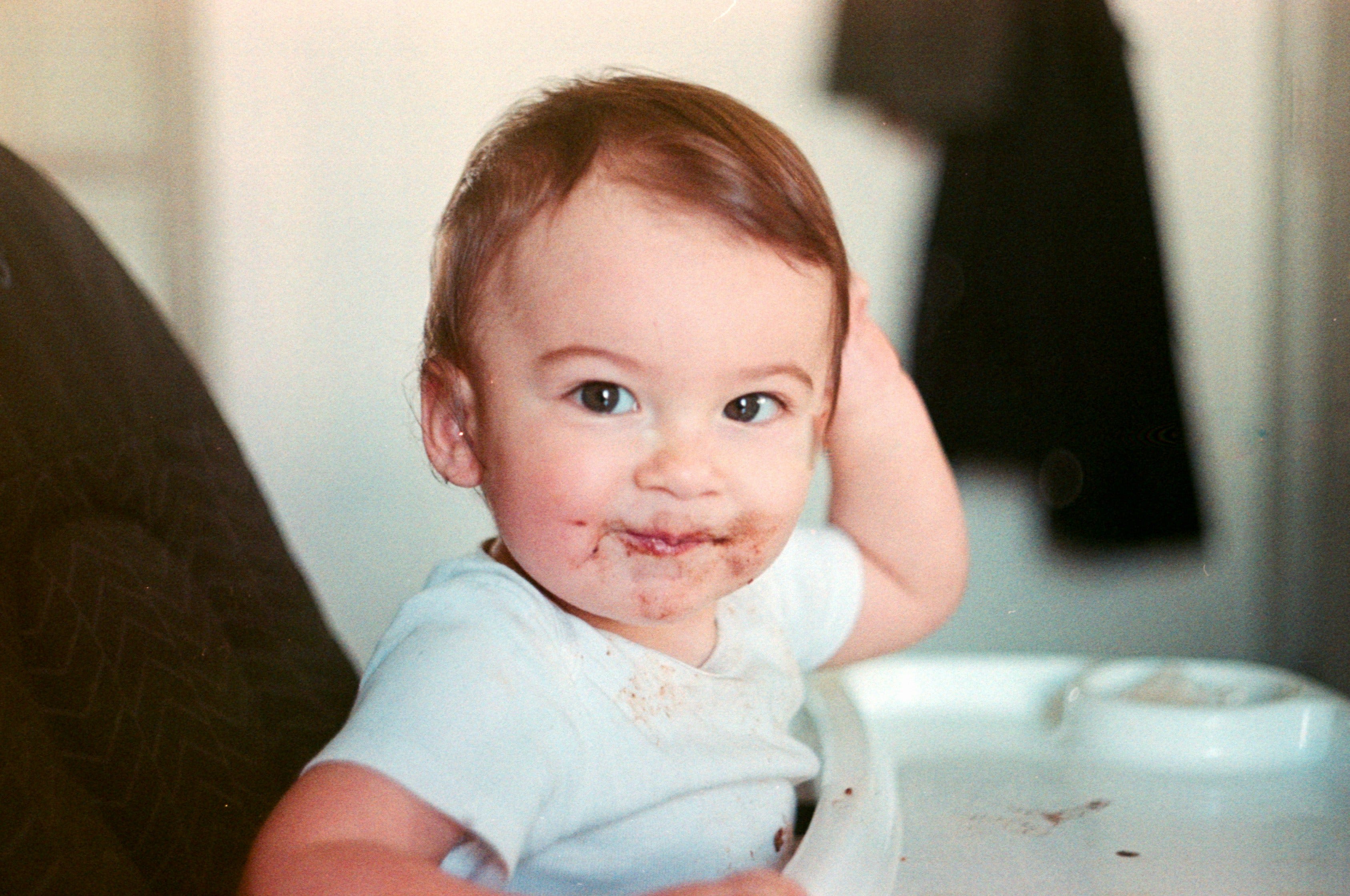
In the art of engraving, a “first bite” is defined as “the first etch or action of the acid upon the plate before the application of dragon’s blood.” Dragon’s blood is a protective powdered resin.
First bites are so tender. Smooth dollops of rice cereal, spongy bits of scrambled egg, mashed blobs of banana (the bonbon of baby fruits). Solid food, after months of milk solely from mom or infant formula, is the first delightful step to kick off a lifetime of culinary adventures.
It can happen when you’re an adult, too.
I don’t remember my first bite of solid food as a baby. My mom, apologetically, has said she doesn’t recall, either, but “it was probably something pureed from a store-bought jar. At that time, we learned whatever was in the jar was the safest.” In the 1970s, baby-food morals were clear: Gerber’s, prepackaged and sealed, for safety and convenience, or homemade, organic and mashed, for purity and love. It’s one of many false, bifurcated notions about healthy eating that mold our thoughts about nutrition.
Somewhere in the photographic archives of my infancy is a Polaroid of me with burnt-orange goo smeared on my cheeks. Whatever nutrients I’d turned into a face mask—sweet potatoes, maybe, or carrots—I was smiling. I’m relieved to know I didn’t always refuse food, even if much of the beta carotene didn’t make it into my mouth. Like most kids, after the eruption of teeth, I added first bites of other palate-expanding treats. I wasn’t an adventurous eater, content with choices from the comfort food groups: spaghetti, Cheerios, mac-and-cheese, PB&J, popsicles, chicken noodle soup, hot dogs.
Again, I don’t remember my first bites of any of those foods. As an adult, however, when I see my nieces and nephews eat similar foods for the first time, I wistfully hope that my eyes opened as wide as theirs do, or that I giggled or gasped like they do, and savored every chunk and drip.
Then, anorexia happened. My obsession with food and body started when I was 10. A relative told me, even though I was a normal size, that I would always need to watch my weight because I’d be unhappy if I “got big.” I was sitting on my bed, wearing green shorts. As I looked down at my legs, squished into my yellow striped bedspread, I thought for the first time, “My thighs are fat.” My body image went downhill from there.
I immediately turned self-conscious in bathing suits, tank tops and short skirts. I wanted to be light, graceful and willowy, with a long neck and ballet-dancer legs. Instead, I was Goldilocks with plain brown hair and a blah body: not too big, not too small, just average. Through my preteen, tween and adolescent years, I didn’t change what I ate or attempt to diet but felt guilty any time I put something in my mouth that wasn’t a vegetable, fruit, or water.
Food, no longer a delight, was a necessary burden that weighed on me—and my developing brain. Far from expanding my food choices as I grew older, tolerating a diet beyond noodles and ketchup, I swallowed every media message about nutritional wellness, usually tied to a process of elimination. I shunned anything deemed unhealthy by government fiat, research report (usually hyped out of proportion) or teen magazine: fat, cholesterol, carbohydrates, salt, red meat, any form of meat, eggs, potatoes, butter, margarine, fried anything, refined anything, sugar. Eventually, anything that tasted good I categorized as bad.
Eagerly anticipated first bites turned into no-sugar, fat-free, no-taste nibbles, and eventually no bites at all.
I was officially diagnosed with anorexia during my first year in college, for reasons that go beyond preoccupation with food and weight. Eating disorders are complex diseases rooted in psychological, spiritual, and biological (perhaps even genetic) causes. Trauma, low self-esteem, depression, anxiety, perfectionism, and difficulty expressing feelings or dealing with relationships are just a few factors that can lead to disordered eating. I had my share of those issues. The denial of food and taste served as a handy way to avoid feeling anything, and starvation became a form of addiction. I wanted to numb out on emptiness and fragility and boost my ego with size zero pants and pristine eating.
My diet regime was nothing at all—I chewed gum all day to distract myself from being ravenous—or a meager ration of bite-size shredded wheat cereal (no milk): 10 pieces for breakfast, 12 for lunch, 15 for dinner. No exceptions. Those miniature squares of fiber were so pure, fashioned from a single ingredient: whole wheat. They were a main-course treat after an appetizer of an apple and four carrot sticks.
In my third year of college, my body started shutting down, and after a great deal of support from friends, relatives, dietitians, therapists, doctors, and support groups, I decided to get more intense help. I took a leave of absence from school and checked myself into an eating disorder treatment center at a hospital in California, the first of 13 such stints over the next two decades.
Every single time, I had to relearn how to take, and truly taste, first bites—but without the benefit of a baby’s innocent mind. No longer could I be 6 months old and blissfully unaware of calories and grams of sugar. The voices in my head yowled, “This food is good; that food is bad,” etching even deeper grooves into my disordered brain that I had to erase. I ate many meals and snacks during my hospital stays, which lasted from 30 days to six months. The first bites were always the most difficult. And the most glorious.
I vividly remember my first meal at Treatment Center No. 1. A counselor led me to my doom into a tiny, plain room stuffed with a square table and seats for eight patients, a nurse, and a counselor. This was hospital food, served on plastic white trays with mauve covers. The other patients pulled off their tray covers and looked down, some in dismay. “It’s too much,” one patient said. “No food talk,” the nurse said kindly.
I pulled off my lid, quivering with anxiety and anticipation. My first full meal in years was . . . a grilled chicken breast with rice pilaf, a green salad, a piece of bread with a pat of butter, an orange, and a sprig of parsley that tried hard to look lively. Perhaps you’re picturing hospital food at its bland worst, but to me it was a feast.
Where would I begin? With the vegetables, of course. But this salad had dressing and cheese, which I couldn’t fathom eating at all, let alone together. I had no choice. The dietitian, hovering over me, said something encouraging, but also, “You have to eat.” I succumbed to clinician intimidation, but I also really, really wanted to eat something besides bland 100% whole wheat squares. The first bite of salad was an explosion of tangy vinegar, buttery oil, creamy cheese, and peppery greens. Then, the chicken. Tender, warm protein. A little salty. Juicy. Savory. Nourishing. Was this what I felt like as a baby tasting pureed chicken for the first time? I would never deny an infant this magnificent experience. Slowly, with those first bites, I began to learn how to treat myself with the compassion and kindness I would treat a child.
I’m not a mom, but I follow one on Instagram with an infant who’s starting to eat his first bites of solid food. He’s a Gerber-looking baby with innocent, round eyes, and a peach-fuzz head of reddish hair. His first solid food was a strawberry. His mom placed the ripe fruit on the plastic tray of his high chair and let him explore. “Don’t play with your food” doesn’t apply at this age, and perhaps never should. He grasped the strawberry with stubby fingers, but it kept slipping away. After grabbing a tenuous hold, he tried to stuff the berry in his mouth. His fledgling hand motor skills kicked in. The first taste was more of a lick, then finally, a bite. He opened his round eyes even wider, and smiled, his mouth stained with the spoils of juice and knowledge of his newfound grip strength.
Recently, he tried something even many adults probably haven’t tried: dragon fruit. After watching him, I tried a piece, too, thinking it might be sour. But as I cut into the prickly hot-pink fruit’s skin, it revealed white flesh with tiny black seeds, resembling a blanched kiwi, or chocolate chip ice cream. The fruit was mildly sweet, and soft. Slippery, but protective, perhaps like dragon’s blood.
The acid of anorexic thoughts still etches caustic grooves into my brain at times, in the form of knife-edged “eat this, not that” commentary that leaves no room for the squishy reality that food doesn’t have moral equivalency. Spaghetti, toast with jam, butter pecan ice cream: I’ve had first bites of them all, for the second time. I bleed nothing but joy.
Karen Lindell is a writer and editor from California who earned her M.A. at the Columbia University Graduate School of Journalism in 2025, concentrating in arts and culture. She’s currently senior editor at Palm Springs Life magazine and has been a staff or freelance writer for Slate, the Los Angeles Times, the Ventura County Star, Ojai Magazine, the American Library Association, the National Catholic Reporter and the Young Musicians Foundation. Her websites are karenlindell.com and authory.com/KarenLindell.
Beautiful writing. Are you in recovery? Or recovered?
Wishing you the savory, succulent joys of eating.....
Thank you for sharing this. Recovery stories are incredibly valuable because they show that progress doesn't always follow a conventional path. Finding an approach that makes eating feel safer and more manageable can be a huge step forward. I appreciate the honesty in your experience, and I think many readers will find encouragement in knowing that recovery can look different for everyone.