


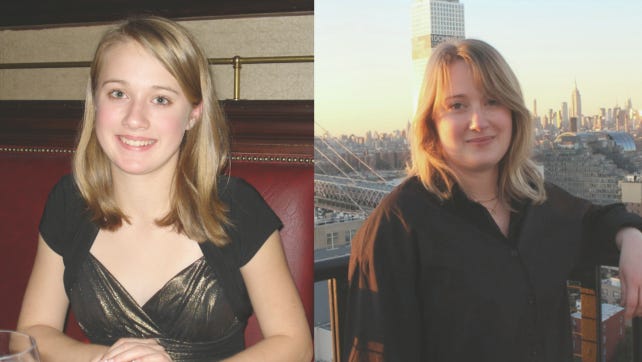
In 2006, when the hit Disney Channel series Hannah Montana premiered, I was a Bermuda shorts-wearing, boy-obsessed 12-year-old on the verge of puberty with a mouth full of braces. Like thousands of girls my age, I tuned in regularly to watch then-14-year-old Miley Cyrus navigate the fictional (and not-so-fictional, as it turned out) challenges of her pop star double life, marveling at how a quirky, accident-prone girl like me could transform into a beloved, glittering celebrity. If she could have “The Best of Both Worlds,” I thought, maybe so could I.
Recently, now as a cargo-pants-wearing lesbian on SSRIs, I decided to rewatch the show’s first season in anticipation of the Hannah Montana 20th Anniversary Special, which aired March 24 on Disney+ and Hulu.
Just as I’d hoped, the series welcomed my return like an old sweater worn in all the right places. The lyrics to “If We Were a Movie” and the “sweet doggy dog” lines of Robby Ray Stewart surfaced from my memory with ease, transporting me back to the bright green walls of my childhood bedroom as if I’d never left. At the same time, however, I noticed a dark truth wrestling in the show’s underbelly that I’d previously lacked the hindsight to see.
“The Best of Both Worlds doesn’t exist,” I thought to myself at the end of episode two. Something is inevitably always lost in between.
In kindergarten, my teacher, Mrs. Newman, asked my mom and me to come into school early one morning. “I’m worried she’s not engaging with the other students,” she said.
Seemingly unconcerned by the impact of her words, Mrs. Newman spoke as if I wasn’t there. I followed suit, sinking back into my chair, but I absorbed every word and concerned look she tossed my way. It became clear I had done something wrong.
“Do you think you could talk to your classmates today?” Mrs. Newman asked, finally including me in the discussion.
When school started, I peered about the classroom with a new awareness that I was being watched. I set my target on the girl next to me wearing a gray sweater with two little pink cats, but as I tried to work up the courage to speak, a stiff lump, one I would come to know well, anchored itself in my throat.
“I, um, like your sweater,” I sputtered. I felt the tension in my body release as she smiled, but the exchange left a sour taste in my mouth. Even then, a part of me must have known that becoming what others wanted of me would mean losing something of myself.
This scene repeated itself all through middle school and high school. Whenever a teacher called on me in class, my cheeks would turn bright red and my mouth would go dry, even if I knew the answer. During my audition for high school choir, my voice cracked and I didn’t get in. When I asked my crush to senior prom, he said no and told people it was because I was awkward. I avoided him on the elliptical in gym class after that, embarrassed because I believed he was right.
I wished many times during these years that I could invent a new version of myself the way that Miley created Hannah. I fantasized about becoming a bolder, more confident person who others admired instead of the quiet girl who embarrassed easily. But an internal force held me back from evolving past who I’d always been. When I tried to push against this force, it usually backfired. I’d say the wrong thing or inadvertently make myself a target for criticism. It’s sometimes better, I learned, to not say anything at all.
I sometimes wonder now if it weren’t for all the people—the teachers and classmates and coaches—who called attention to my quietness, if my social anxiety would have escalated the way it did. My mom says I was always quiet but not necessarily shy. “You had no problem talking when you wanted to,” she says. There’s a story she likes to tell of when I was four and refused to take the antibiotics prescribed to treat my strep throat. Exasperated by my resistance, she called a friend for back-up, who, when she arrived, gave me the option of the easy way or the hard way. “The hard way,” I answered to both her and my mom’s surprise. “You were very sweet, but you were also incredibly stubborn,” my mom says.
When I left for college, I vowed to no longer be the quiet girl, or to at least become a better version of who I’d been. At a big school three hours from my hometown in Pennsylvania, I seized every opportunity to reinvent myself. I even signed up for the crew team despite my lack of rowing experience and upper-body strength. But after one excursion where I continuously knocked the rest of the group off pace while struggling to maneuver an oar twice my size, I decided crew wasn’t for me.
I bonded with the girls in my dorm over shots of Burnett’s vodka before trekking three miles to a party off campus (there was no Uber then). Buzzing from the alcohol and excitement of newfound friendship, I found myself singing, even yelling, alongside them. Together, we laughed until there was no air left in our lungs. I remember looking around and thinking, “This is what I’ve been waiting for.”
By the end of senior year, my resume was filled with leadership positions and internships. I was a senior reporter at the student newspaper and a homecoming committee captain. I co-founded a student organization dedicated to covering global news and interned at a notable public relations firm outside Philadelphia. I was proud of my accomplishments, but most of all, I was proud of how far I’d come from the quiet, apprehensive girl I’d been before. I’d succeeded at becoming someone else, or at least I thought I had.
Six months post-graduation, the lump in my throat returned like a gobstopper lodged in my esophagus. I worked at a travel marketing firm in New York alongside a handful of sleek city women who embodied everything I’d wanted to be since I first visited the Big Apple at ten years old. These women were trendy yet practical in their low-heeled boots and blazers. I bought low-heeled boots and blazers while studying the effortless way they floated between conference rooms and each other’s desks. But no matter how much I wanted to be both like them and liked by them, I couldn’t stop fixating on all the ways I fell short.
As if no time had passed, I once again found myself trying to work up enough courage to tell the girl sitting across from me in the office that I liked her sweater. I rehearsed full monologues in my head before speaking out loud in meetings, only to still fumble my words. I scrutinized even the briefest of interactions for mishaps. Surely, I must have offended my boss during the three seconds we stood next to each other at the coffee machine. It was like high school speech class all over again. The only upside was that this time I didn’t break out in hives.
I became so afraid of saying something wrong that I resorted, again, to rarely saying anything at all. Whenever my coworkers swapped celebrity gossip or summer travel plans, I pretended to be an active participant by nodding along, hoping no one would notice my lack of actual contribution. The last thing I wanted was attention.
What I lacked in social charm, however, I made up for by working hard. When I absorbed the workload of two people on my team who’d left and were never replaced, I didn’t complain; I just worked harder, always with a smile on my face. As long as the work was good, no one could criticize the unfavorable parts of me, though I always wondered what they truly thought. “What riles you up?” a co-worker once asked me at a company happy hour. I could tell she wanted to get a reaction out of me, but I refused to unravel so easily.
In 2013, when Miley emerged on stage at the Video Music Awards with her newly cut blonde hair pulled back into two tiny space buns, admittedly, I wasn’t sure what to think. Maybe child stardom had gotten to her just as it had gotten to Lindsey Lohan and Amanda Bynes? But as far as I was concerned, her album Bangerz held up.
While rewatching Hannah Montana, I couldn’t help but recall the disapproving headlines and panic from middle-aged mothers, including my own, who sneered in disgust at the “new Miley.” Each episode filled me with dread. The young, bright-eyed Miley on my TV screen had no idea what was coming. Or did she? Had she expected the public to resist her transformation so fervently? Did she know that upon removing Hannah’s golden wig, so many would mourn who she used to be, even if this version had only ever been a fantasy?
This kind of rejection, I realized, is what I always feared. It’s the reason I felt compelled to hide for the better part of 20 years. It’s why I became a master at masking my anxiety, afraid that if I revealed it to those around me, they’d respond by saying they liked the other version of me better. In my twenties, I learned to conceal my worst parts: the maddening intensity of my self-doubt; the anxious, intrusive thoughts; the shame I felt for reverting to my child-like self, and the disappointment I carried for realizing I’d never outgrown her at all.
I can see now how I internalized my quiet nature as weakness and compartmentalized myself to control the image I projected. To my friends and family, I was a thriving 23-year-old living out my New York dream, exploring the city’s endless offerings, frequenting Broadway shows and drinking overpriced cocktails on the Lower East Side. To my coworkers, I was a reserved but dedicated employee who funneled all my energy into work and had no time for small talk at the water cooler. But in truth, I was entirely lost and unknowingly struggling with obsessive-compulsive disorder (OCD), which I was diagnosed with a few years later.
While rewatching the Hannah Montana series provoked an unexpected sense of dread, seeing Miley embrace her former Hannah persona (blonde hair and all) as the strong, successful person she is today in the anniversary special created space for me to appreciate my own growth. As much as I’ve changed, I know the quiet girl I was is still with me and always will be. Like Miley, I’ve made mistakes, but through this, have become more comfortable with who I am. I’ve learned to embrace the parts of myself I once judged and grant compassion toward my younger self. The Best of Both Worlds may not exist as I initially imagined and that’s okay. I’ve created my own version. It’s by no means perfect, but I’m proud to call it mine.

Kate Warrington is a queer Brooklyn-based writer whose work explores the intersections of identity and culture. Her writing has appeared in HuffPost, Pangyrus, Fruitslice, Querencia Press and She Explores Life, where she authored the column “Overthinking Everything,” about her experience with obsessive-compulsive disorder. She is currently working on a memoir about queer identity and OCD. Find her on Instagram @warrington_kate and at katewarrington.com.

Thanks to @Rachel Kramer Bussel for publishing this piece! Even if Hannah Montana turning 20 means I’m officially old 🫣
I felt so much here and related to the anixety. I felt just heartbroken reading this, from the description of the teacher's attitude toward you, to the prom crush, to other vulnerable moments. You have written this with such skill and precision. Thank you for sharing it!