


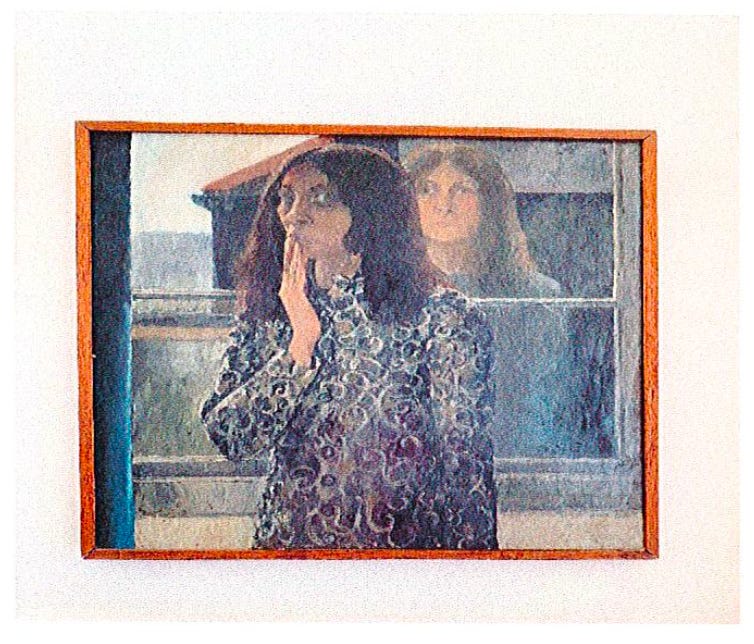
My mother died a year ago and such is the slow pace of probate, it’s only now that her estate is being released and my siblings and I are being called to collect what she left us. There we are, wandering through the house of our childhood, six floors of white stucco London packed with memories: the Babar and Celeste keyrings that sat on the playroom shelves, the nursery school paintings framed in the kitchen, the plastic photo cubes on top of the dining room cabinet with sides enough for all five of us.
I loved the blue glass architectural modal of revolving doors that was kept out of reach on the high glass shelves. I loved the kitchen table, a repurposed butcher’s block the bore the scars of knives falling. And what about the Corbusier chairs or Hitchens landscapes? The multitude of 18th century writing desks or ivory inlaid games table? The china dogs from our grandmother’s house that growled from the glass cabinet in the drawing room?
Chattels—the items chosen specifically by the dying for those who’ll carry on living—are singular in their message. I think you’ll love this necklace, says the surprise gift of the gold watch chain that used to belong to my mother’s father. Or This sculpture always reminded me of you says the machete of a mare and foal that once caught the sun on the windowsill of our weekend cottage. Or even, I know you always wanted this chair says the child’s velvet seat that took up a small corner of the landing.
What all chattels say, irrespective of value and meaning, is, When I was drawing up my last will and testament and sharing out my possessions, this is what I thought of when I thought of you. So, mum, wherever you are, a year gone and your homes emptied, what were you thinking when your eyes alighted on the two scariest paintings in your collection, and you decided they were for me? And why did you think I’d want them?
My mum’s departure was a fight to the death, socks in her fists to prevent her nails biting into the skin of her palms; she did not go gently. I sat by her bed in that last week, blessed and holy in its passing; she and I had reached a peaceful accord, whatever could not be discussed (and that was everything) dealt with between me and my therapist. She was leaving behind two houses packed to the gunnels with beautiful furniture, a great deal of it inherited down the long ancestral line of my dad who’d died 18 years earlier, and a gallery’s worth of art.
Both my parents were patrons of the arts, supporting students at two of the most prominent London art schools, City and Guilds and the Royal Academy, for decades, and our homes were filled with degree show work, some worth a great deal, others, not much at all, as well the pieces they’d invested in over the years and given them by friends. Of the many, many choices she could have made (Mum, I could have thrown a dart blindfold and hit something I loved,) she chose for me the two paintings I hated the most, and which had literally haunted my childhood. It’s almost funny.
Let me take you into them. Exhibit A: The Two Sisters (see above). It hung on the turn of the stairs in our London home, the stone treads providing the challenge of a leap and the banister something to swing off as I took the steps two at a time to get past their staring eyes. The sister in front (I made them sisters) holds her hand to her mouth while her gaze is fixed on the viewer. Her side-eye glance speaks of being caught mid-sentence saying something she mustn’t, which is both apt and ironic given the fine mist of Do Not Speak which drenched our home.
Does she know that another woman stands behind her beyond the window? Is that expressionless and faded other a version of the sister in the foreground, her shadow self, her actual flesh and blood, or just some identikit stalker who haunts her? Are they in cahoots? Does foreground woman even know that background woman is there? And why is she wearing my mother’s dress?
All this and more I would block out of my thinking on the multitude of times I took the stairs, going up worse than going down as at least when descending this final flight, the swing of my arm on the banister turned my back on the ghost figures. Did my mum know I hated this painting? Had I mentioned it, and in her latterly muddled thinking, she’d confused horror with love?
All things are possible, including a deep dark subconscious desire to remain vaguely unaware of who I was. The walls of my mother’s denial were thick. She lived in rooms allocated to prevent truth seeping in and ruining careful constructions. I, who have spent my professional literary life dismantling those walls, was the one person who did speak. Maybe this was a message. But had she known me at all, she would have known it would only drive me to speak more.
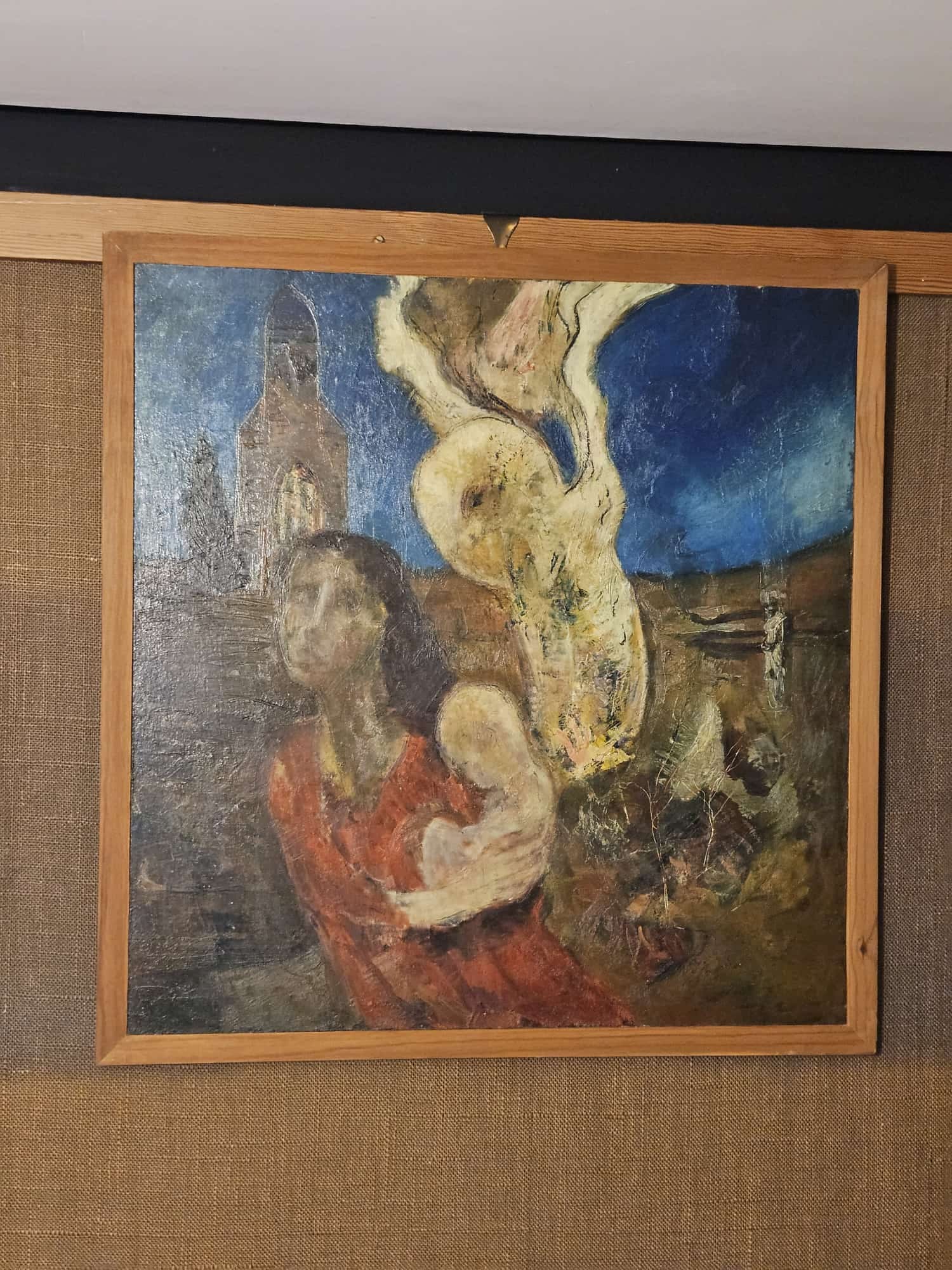
Exhibit B: Owl Steals Baby. Where do I begin? A huge, bird-like creature swoops upon a frightened woman, intent on whisking her child away. The creature is without emotion. The woman attempts to shield the child from the claws approaching, her expression hunted, sorrowful, exhausted and yet knowing. She doesn’t look surprised. She looks as if this cat and mouse (owl and baby) threat has been going on for a while; as if the creature has swooped at her across hill and plain, tormenting her again and again as she runs.
And what’s the deal with the church? Is the artist making a statement about God? Was my mother? Was this her way of telling me she loved me or another amusing attempt to scare the shit out of me? I don’t remember where the painting hung, but I can tell you, mum, that it is in my top ten list of Least Wanted Paintings Ever.
Shall we put the messages together? Do Not Speak + I Tried to Protect You, and now we’re getting somewhere. Granted, I’m making this up; I have no idea what she was thinking when her red pen hovered over the photocopied list of chattels and with shaky hand, she wrote Ellie next to these two disasters. Maybe it was a joke. Maybe she’d entirely lost her mind. It’s possible she was bored or tired and just wanted to get it over with. But pulling the thread of intent is more interesting, so let’s do that.
I’m a survivor of childhood sexual abuse; the perpetrator, a lodger, the fact something my mother and I never discussed. Or even acknowledged. My mother was a great one for hints and looks and cryptic asides, usually with the aid of some literary reference. You know what Pepys would have said in response to refusing a plate of spinach. No, mum, I don’t know what Samuel Pepys would have said, and I still don’t like spinach. Or Montaigne delivered with raised eyebrows and a knowing glance at no one in particular because no one knew what she was talking about.
So given that light, The Two Sisters and Owl Steals Baby are right in keeping. Here you are, darling; in my death I deliver another two cryptic crossword clues for you to figure out and decide that I loved you, which I know she did, and that I tried to protect you, which I know she didn’t. As if the entire thing was a Sunday morning puzzle, and not a life-ruining box of complex PTSD that I have had to unpack and made sense of. It’s hard not to feel that she didn’t care. It’s easy to surmise that her complex desire to stay in the dark trumped everything. I know that throughout almost all of my 54 years with her, she neither saw nor heard me, and these two paintings sum that up. But luckily for both of us, her legacy of message wasn’t the end.
The day before she died, I was sitting by her bed as usual. She’d entered the no-speaks era of leaving: eyes closed, breathing feint and erratic, nails becoming blue, life dancing away and only a pulse in her neck to show for it. With a suddenness that made me jump, she opened her eyes and looked directly at me, sat up, took my face in her hands, and kissed me on the forehead, drew back, looked me in the eyes again, kissed me again and just as suddenly was gone, returned to the no-man’s-land of corridors and tunnels and maybe a light at the end of it.
Mouth open, jaw slack, breathing erratic and feint once more; had it happened? But every pulse of my nervous system said that it had; my mother had seen me. She’d already chosen her chattels, already with shaky hand signed my name beside scary paintings 1 and 2, too late to change what I didn’t know was coming.
But does it matter now? Not really. Not in the coming months when her will was read and our email inboxes became choked with documents of material message. In her closing hours my mother discovered one more thing she owned: the ability to see, to recognize, to acknowledge the person before her, and this split-second awareness she gave to me. It’s all a child ever wants from a parent; it is the most valuable of gifts. It throws all else into shadow.
In the year that’s passed, I’ve walked about our childhood homes, free to put a sticky label on things I want irrespective of her choosing, but I’ve found I want very little. The Babar and Celeste key rings. My nursery painting. The kitchen table’s too big for my kitchen. My niece will give a home to the Corbusier chairs. And the paintings? As I said, no thanks, mum. Joke or message, you can keep them.
Eleanor Anstruther was educated at Westminster School, but dropped out of university, to travel the world where she was lost and found for twelve years. When she inherited a farm in southern England, she set up a commune and began to write. Her debut, A Perfect Explanation (Salt Books), was a finalist for the Desmond Eliot Prize & Not The Booker. Fallout (Empress Editions), a punk-hearted coming of age set at the iconic women's protest camp of Greenham Common in 1980s England, will explode into the world April 21st. Pre-order now. She now lives not quietly at all between London, Surrey, and the south of France. Find her on Substack at The Literary Obsessive.
You took whatever these paintings were—joke or gift—and made it into something of your own, material for your writing. I love that so much. Thanks for a good read.
Lord have mercy: such mind-bogglingly gorgeous, hilarious, heart-wrenching, stunning writing on a subject no one has dared yet touch until now. My mother died five months ago, and I am at this moment going through the pieces of her life; the paintings, the hideous and massive goatskin table from 1981, the few pieces of gold that she didn’t sell. The most valuable thing was what I didn’t know I wanted: my grandmother’s high school autograph book from 1917 and in it tucked a letter from her illicit boyfriend stationed in France, in a trench. The gift of being seen, though — literally; figuratively — is a stunning one, rendered here so beautifully. Grateful for your words.