


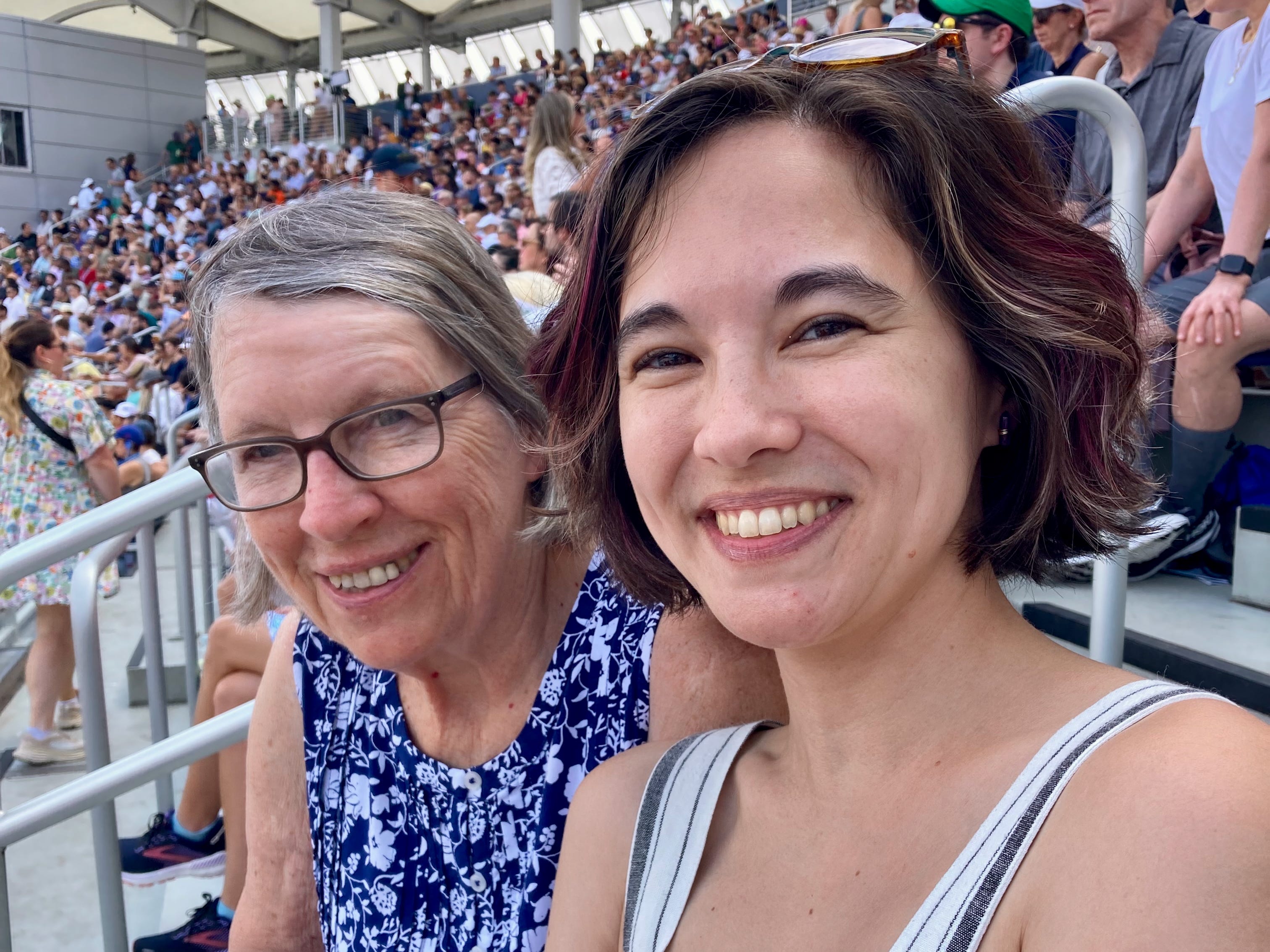
“I don’t know if this is going to work, Mom,” I said.
We were at the US Open in New York City in September 2023, waiting in line to get into Arthur Ashe stadium. We had tickets for Louis Armstrong, not Ashe, but my mom was convinced that we’d be able to get in. “I promise, I did this with Dad a few years ago,” she said.
The person scanning tickets was having a lengthy conversation with the group in front of us, and I became increasingly skeptical that her plan would work. Even my mom was losing certainty. “Well, if we don’t get in, they’ll just think we’re a couple of brazen hussies for trying!” she said. My mom has always had a way with words.
In the end, the brazen hussies did get into Ashe, pleased that pushing our luck had gotten us a peek at the main stage. We oohed and aahed as rising young star Carlos Alcaraz played the veteran Brit Dan Evans, admiring Alcaraz’s signature drop shots and blazing speed on the court.
My mom grew up watching tennis with her mom in Ireland on a grainy black-and-white TV, and I grew up watching tennis with her in the 90s and 2000s on the Connecticut shoreline, cheering on Pete Sampras and Steffi Graf to Roger Federer and the Williams sisters.
When I was away at college and Federer, my all-time favorite, lost the 2008 Wimbledon final to his rival Rafael Nadal, my mom called me once the match was over. “Are you okay?” she asked. Only she could understand my heartbreak, as a fellow fan who’d spent countless hours with me watching Federer glide across the court. Our shared obsession with tennis put us on the same wavelength, whether we were together or apart.
Since I’d moved back to the East coast in 2018, my mom and I had gone to the US Open together several times, an end-of-summer ritual that I always looked forward to.
But I didn’t know if we’d be going back in 2024.
In October 2023, my mom had brain surgery. A recent MRI scan had revealed that she had a meningioma in the frontal lobe of her brain, a visible bump on the front of her head that had sat there for many years. It was a benign tumor that, if it grew large enough, could start pressing on parts of her brain and cause serious problems.
She decided that she wanted surgery to remove it. We knew the procedure entailed some risk—it was brain surgery, after all—but that in all likelihood, things would be fine, and she could be fully recovered in six to eight weeks.
I was at work the day of her surgery while my dad and brother were with her at the hospital. I texted her first thing in the morning: Thinking of you, sending lots of love. I checked my phone for updates all day, the only thing I could do to feel like I had any illusion of control over the situation while telling myself that everything was going to be fine.
Later in the morning, my brother sent an update. The doctors said the surgery had been successful. They had removed the entire tumor. Everything had gone smoothly.
I FaceTimed my family as soon as I could. My mom looked weak, her head heavily bandaged, tubes snaking across the hospital bed. She barely seemed to register my face on the screen and could only respond with one-word answers. Despite the reports of success from the doctors, my mom wasn’t my mom.
Worried and eager to do something to help, I drove to Connecticut that weekend. Normally, my mom would be the first one to greet me at the door, giving me a kiss and a hug before peppering me with questions and filling me in on the goings-on in our small town. Now, she stayed seated on the couch and only gave me a muted “Hello” when I walked into the living room and leaned down to embrace her. I was alarmed by how quiet she was, how little she had to say.
The stark change was hard to see. I was grateful that she was alive and walking around, but her doctors couldn’t give us any real answers on when she would recover from the effects of the surgery. This wasn’t the brazen hussy I’d gone to the US Open with only the summer before, and I was terrified that she’d never come back.
For the next several months, progress felt slow. She started talking more, but still only a sentence or two at a time. I couldn’t tell what was going on inside of her. At Christmas, her favorite holiday, a time when she typically would have been baking something delicious every day and corralling us all for freezing walks on the beach, I asked her how she was feeling. She replied, almost as a matter of fact, “Well, I’m not jumping for joy.”
Finally, things started to take a positive turn in March 2024. Watching the UConn basketball teams carries my mom through the winter every year, and she texted me paw print and basketball emojis after each of the teams’ wins through the NCAA tournament. She smiled more often on our weekly family video chats. We traded updates on the tennis tournaments leading up to the French Open, both of us rooting for the new stars Alcaraz and Jannik Sinner as well as the return of our beloved Nadal (I’d forgiven him for his Wimbledon win by then).
In July, I visited Connecticut for a few days to see in person that she was doing better, to make sure that she was truly back to herself. It also happened to be the first week of Wimbledon, so we binge-watched tennis matches together, sweating through a heat wave while the players in England dealt with chilly rain delays.
“Alcaraz is off his oats!” my mom said as we watched him battle American Frances Tiafoe in a tight five-set match, his level dipping from his usual superhuman abilities.
“Like a horse?” I asked. She still manages to pull out colorful expressions I’ve never heard before, even after 35 years of my existence. We laughed. The brazen hussy was back.
A couple months later over Labor Day weekend, we returned to the US Open once again. Just like the previous year, we buzzed from court to court, spotting the new hotshot Jack Draper on Grandstand and lining up to see American Tommy Paul keep a talented young Canadian, Gabriel Diallo, at bay.
As we walked back to our car on the warm summer night, I thanked my mom for taking me again this year. I didn’t have to say how much more precious it felt, how much of a relief and a joy it was to spend the day with her after not knowing if we’d be able to do this again. She waved me off, replying, “It’s a pleasure to go with someone who loves it as much as I do.”
She should know. After all, I learned to love it from her.
Akemi Ueda is a writer and high school English teacher living in the Boston area. She completed the year-long Essay Incubator course in 2024 at Grub Street in Boston and has a Master’s in English Literature from Stanford University. Her work has been published in Mochi Magazine.

I'm glad everything worked out for both your mom and you. It must have been a terrifying experience for all concerned.
I love the connection through sports. Your story brought me to tears! I’m so glad the brazen hussy is back ❤️