


Like Lindy West, I have a polyamory memoir out. Unlike Lindy West, I am a total nobody.
Like West, I am a millennial woman who wrote a book about her experiences transitioning from a monogamous marriage to an open one. Like West, my story was published by a Big Five publisher. Like West, I consider myself a feminist, and where I’m from, people would definitely consider me fat. But that’s where our similarities seem to end.
Unlike West, I changed all the names in my book except my own, in order to keep the people I care about—my husband, daughter, (then) boyfriend, plus a few close friends and former lovers—out of the public eye.
Unlike West, I’m not the center of controversy. In fact, you’ve probably never heard of me or my memoir. That’s because my book was never published in the United States. And while I’m guessing you, dear reader, are American, I am not.
Outside the American bubble: a different polyamory origin story
I’m from a world out there where the Sexual Revolution never happened and probably never will. Where feminist blogs didn’t set the Internet on fire or toss match after match into a generational gas tank of feminine rage. Where polyamory is unspeakably taboo and could never be described as common.
I was born and raised in the Philippines, a staunchly Catholic nation of 121 million people, the last country in the world apart from Vatican City where divorce remains illegal. The angry Gen X/millennial feminist voice of my generation was Jessica Zafra; instead of Jezebel, I read her column Twisted. If you haven’t heard of them, that’s okay. I had no idea who Lindy West was, either—until a few weeks ago.
As West’s name began to trickle into my consciousness via Threads, a friend sent me an Instagram reel by Dan Savage. In it, Savage dives into the buzz around West’s new memoir, Adult Braces, by questioning opinion writer Emma Camp, who wrote: “Almost always, when a straight couple opens up their relationship, it’s because the male partner is using the polyamorous label to launder his desire to cheat.” Sure, Savage says, it seems so in “the memoirs that get published,” naming three titles written by white American women. (“Why are these authors ‘almost always’ from Brooklyn?” wonders a commenter). He declares, “The next poly memoir should be written by a man” to “balance the scales.”
Interesting, I thought. Savage takes “memoirs that get published” to mean “memoirs published in the U.S.” This assumes that mainstream publishing has exhaustively covered women’s perspectives on polyamory, and that the only perspectives that remain excluded are those of men.
Um, hi.
I’m a brown, queer, Filipina-Indian author of an open marriage memoir. My book, Ask Me: A Memoir of Daring to Love Differently was published in 2025 by Viking Books/Penguin Random House UK in the United Kingdom and Commonwealth, and has been translated into Dutch, German, and soon into Albanian. This year, my book was longlisted for the Women’s Prize for Non-fiction in the UK, alongside the likes of Arundhati Roy and Lea Ypi.
In my story, the wife (that’s me) incites the shift from monogamy to an open marriage. Nobody becomes polyamorous (or bisexual) overnight. It’s four years before a boyfriend appears on the scene. No one is in a throuple. No partners are involved in publicity. The husband doesn’t crash out publicly over coverage of his wife’s book. In fact, the husband is pretty great. Readers love him. As do I.
Due to a frustrating quirk of territorial rights, not getting picked up by a U.S. publisher means my book isn’t available for distribution in the Philippines, which is considered under U.S. territory (ahh, colonialism, the gift that keeps on giving!).
Despite this, the press I’ve received in my home country has drawn ire from people who accuse me of having traded my Filipino values for Western ones. But the idea that polyamory is only practiced by white Western folks comes from the prevalence of published polyamory memoirs by white Western folks, especially by white women from the U.S. This in turn cements the white American experience as the experience of polyamory that exists and widely held to be true.
What about women, authors, people like me? Shouldn’t our voices, experiences and stories count, too?
From a six-way auction to 31 rejections
In September 2023, my agent Jo in London and her co-agent Deborah in New York went out on submission simultaneously with my memoir. Within 24 hours, my book had multiple offers from UK publishers, and was in a six-way auction by the end of the week. The same book was rejected by 31 editors in the U.S.
I remember the frustration in Deborah’s voice as we spoke on the phone. She told me she was “stunned” and “disappointed” by what she was hearing from editors: that no one seemed willing to take a risk on a non-American story by a non-American author. Also, she was told, Open marriages are old news. Everyone is doing them. Several editors already had a polyamory book on the list; one was enough. No one really wants to read about open marriages anymore, they said.
So I was surprised to hear about the new memoir that was stirring up controversy about polyamory in the U.S. I thought nobody wanted to read about open marriages anymore? I thought this was old news?
Clearly, people still want to read about open marriages—and gossip about them, except when it’s literary we call it discourse. But the majority of readers want to hear from voices they know. Publishers bank on this. If they do bet on an open marriage memoir, they want it to be from a certain type of author: one with a name and a platform, who will sell books. A sure bet. Like Lindy West.
West worked hard for her platform, and her hard graft deserves respect. Publishing simply did what publishing does: made a business decision in favor of lower perceived risk and greater perceived return. Polyamory memoir by a millennial feminist icon with a massive platform, or polyamory memoir by a nobody? It’s a no-brainer, even for me.
An unknown author like me needs only one person to see their potential. But that champion has to be capable of transmitting what they see—that spark of something special—on to others. In my 18-odd months in the waiting room from acquisition to publication, I saw how many times that spark of excitement caught on for my book. A whole chain of sparks catching becomes people feeling things, which moves them to make things happen. Seeing it changed something in me; I feel lucky and grateful that it happened to me. How could I begrudge any author the same?
As authors whose memoirs touch upon the same topic, Lindy West and I are at the same party—we’re just talking to people in different corners of the room. It’s a huge party, full of life and chatter and movement, with plenty of nooks to explore, and I know I can only reach so far with what I’ve got. I still can’t believe I’m here, still having the time of my life, even though I need to step out for a breath of fresh air every now and then. Just enough to slow my heartbeat and cool my sweat, until I hear a new tune calling me in to dance.
I intend to stay until I wear my dancing shoes out. And I hope you’ll wander over to my corner of the party sometime. You might just like it here.
Publicity, crashouts, and what my open marriage taught me about boundaries
From where I sit, the controversy over West’s memoir is like hearing a fight break out in one corner of the party. You’re not entirely sure what it’s about, but it’s loud and noisy and almost drowns out the music. You’re glad you’re not at the center of it and hope that whoever it is will make it out okay.
Online, West’s life choices have been ripped apart, her loved ones criticized, and old social media posts dug up and dissected. A seasoned catastrophizer, I could easily picture myself drowning in the same online vitriol West faced as a woman speaking openly of sexuality and questioning norms around love, commitment, and femininity.
I understood I would be judged for my choices by people who didn’t agree with them. I knew I could always shut off the laptop or put away my phone. But mostly, I worried about the people I loved. They didn’t write this book; I did.
I worried that trolls would find my husband and (then) boyfriend on social media and harass them online; that my daughter, about to enter high school, would be bullied by her peers; that my ex’s conservative Irish relatives would ice him out or make life difficult for him (not that they needed my book to do that, but that’s another story).
Neither my publisher nor I could stop media outlets from sensationalizing my story for clickbait, because sex sells. But opening my marriage had taught me something important: that I could understand my fears, discuss them with all involved (in this case, my partners and publisher), and set boundaries around them. I know from experience that boundaries help make the leap into uncharted territory a little less scary, and give me agency in a situation where so many factors lie beyond my control.
My publisher organized private media training to help me navigate interviews, live radio, and TV appearances. A friend helped me archive over a thousand Instagram posts featuring the clearly recognizable faces of my child, husband, and ex. I wiped their real names from Instagram captions and Substack posts. Most importantly, I categorically declined all press requests to include my partners in photo shoots and interviews.
“Your book stands on its own. Your writing speaks for itself,” my husband said. “Why do they need a man’s voice to legitimize a woman’s story?” I love him for that.
When West’s husband, musician Ahamefule Olou, sent a scathing email to Slate journalist Scaachi Koul for her profile of West, the public crashout made me glad to have decided on these boundaries in advance. I may have missed out on publicity, but I know I can stand firm about what’s important to me, and that the people who are truly behind me have always got my back.
Perhaps national media doesn’t have quite the grip on mass attention as it used to. Perhaps my corner of the party over here is a little quieter, a little less angry, a little less invested in parasocial relationships with online personalities. The online noise was nothing I couldn’t switch off or unplug from at the end of the day to return to my offline life, a life and people I loved. I could laugh off comments like “filthy beasts” (The Daily Mail) and “hot horrible garbage’ (Goodreads) by joking about turning them into merch. Side note: If I ever get published in the U.S., “Banned in Florida” will look really cool on a baseball cap.
Following the release of her memoir and the press that followed, West postponed tour dates indefinitely, with online speculation that publicity blowback played a role. Meanwhile, despite the proximity of my memoir to my life and that of my family, our lives have gone on undisturbed, uncontroversial, maybe even wholesome. My teen and her friends’ online lives revolve around K-pop and skincare, not Mom’s interviews in the Times of London and The Daily Mail (that’s for old people). Two of her primary school teachers follow me on Instagram. A class mom sent me a wonderfully warm message after devouring my book in two days, and several of my neighbors have read it. The only way I could really blow up my Dutch neighborhood Whatsapp chat group is to leave the trash out on the wrong day.
I can’t wish for controversy or believe that it’s directly related to my success, when I have peace, which directly underpins my sanity. Peace in which I can live a life worth writing about. Peace that creates the conditions I need as a memoirist: to process the events of my life and write—the next book, the next essay, the ideas I explore on my Substack.
This is writing I live for—writing that happens in the quiet, away from scrutiny and hot takes and crashouts. What nurtures and protects my writing, nourishes and protects me, too.
More than a headline, the quiet parts matter
From the coverage I’ve read, Adult Braces is about more than just polyamory—it’s about identity, the aftermath of public success, and the disillusionment and disorientation that happens when “living the dream” becomes all too real. In her Slate profile by Koul, West says she “worked harder on this than anything I’ve ever written,” and seems aware that polyamory might overshadow the other themes she set out to explore. Things that aren’t as prurient or salacious, that won’t draw as many clicks or drive as much traffic as polyamory or throuples.
And honestly, I get it. Because while I’m comfortable calling the book I wrote an open marriage memoir or a polyamory memoir, it covers much more than that. It’s also about marriage, migration, and motherhood, and how life changes can cause seismic shifts in our identities and relationships. It’s about realizing that the woman I was becoming was different from the girl I’d learned to be, and that I could trust the man I loved to love her, too. And it’s about realizing, with some relief and plenty of joy, that daring to live and love differently really can work out in the end.
My polyamory might be a clickbait headline, but to me it’s one identity woven into the fabric of a life of many colors, threaded through with mistakes and messes, pleasure and desire, but also with tenderness and joy.
Maybe it’s like the way that one Substack post you pour your heart and soul into gets the least number of likes and restacks—the quiet parts may not skyrocket us into controversy, but they’re the parts we fold our treasures into: our joy, our love, our wounds, our humanity. All we can do is wrap them in words chosen with care, before we share them with others in the fragile hope that what we have to offer will be received with kindness.
And Lindy, girl. You don’t know me, but this nobody sees you. If you’re reading this, call me.

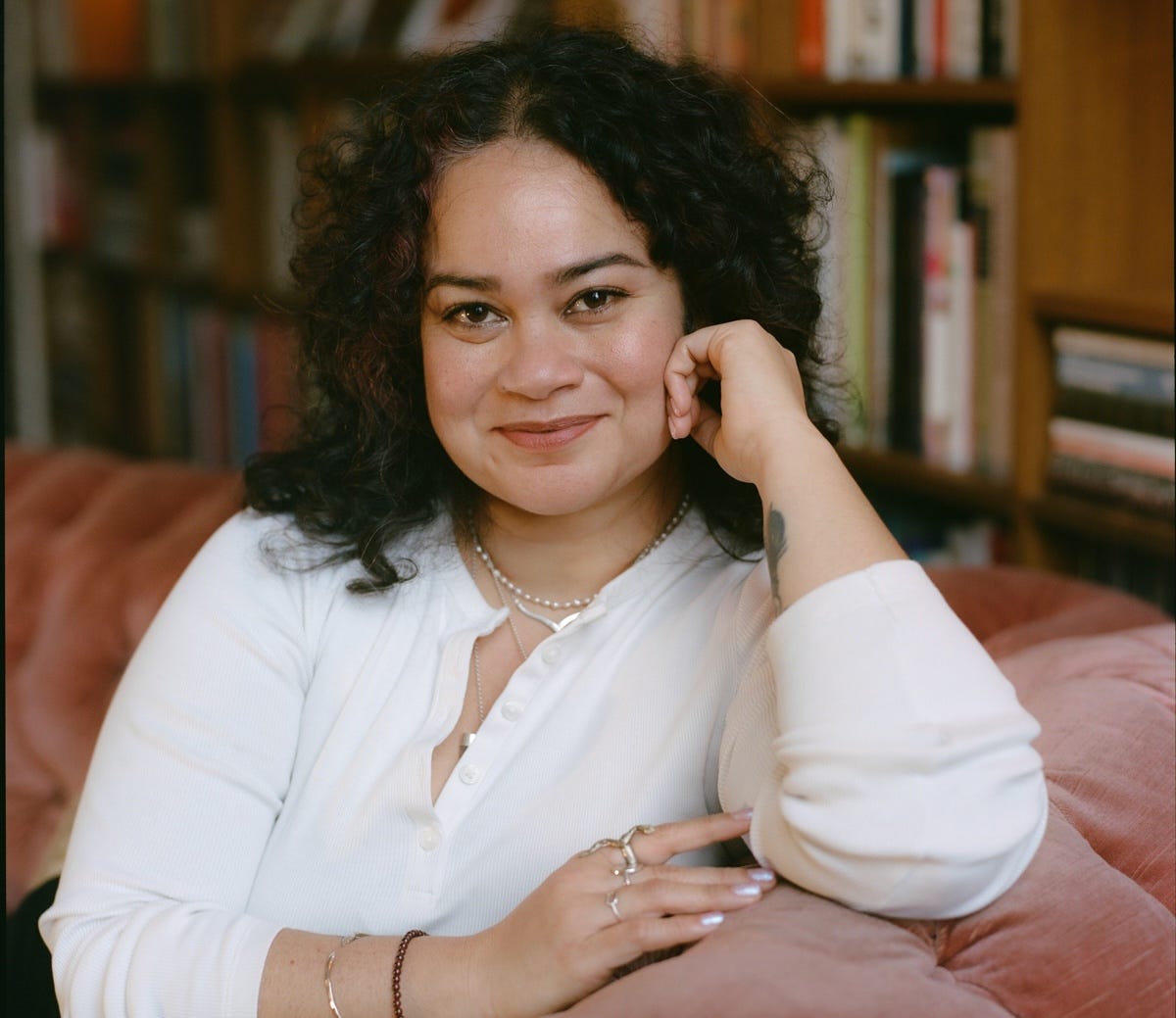
Deepa Paul is the author of Ask Me: A Memoir of Daring to Love Differently (Viking Books UK), longlisted for the 2026 Women’s Prize for Non-fiction.
Gillian Anderson describes Ask Me as “stunningly vulnerable and poetic… if this doesn’t change your perspective on relationships, nothing will.”
Deepa has written for Seventeen Magazine Philippines, The Philippine Star, Philippine Daily Inquirer and Singapore Women’s Weekly, with essays in Vogue Australia, RED, Cheex, Gal-Dem, Rappler and more.
Born in Manila, she lives in Amsterdam with her husband, daughter, and black cat, and writes Letters by Deepa on Substack. Find her on Instagram as @storiesbydeepa.
You go girl! And thank you for the timely reminder that the US doesn't have the monopoly on non-monogamy and how it is expressed.
I've never heard of West but yours is the memoir I've cued up to read. Best wishes to you.