


My first musical memory is my dad leaning against our wall unit clad in a white undershirt and a black durag listening to Earth, Wind & Fire on a JVC record player. He was mesmerized by the sounds of their album That’s the Way of the World. The groove. The horn section. The sway of the percussion. Anytime I hear their music I still think of him.
The music that influenced my childhood was layered into my memory like careful brick and mortar. My mom’s love of Prince, and the 1980s R&B of Shalimar, Klymaxx, and Club Nouveau. My grandma playing the gospel music of Andrae Crouch, Edwin Hawkins, and James Cleveland on the piano at her church. My mom buying my first LPs, Kid N Play’s 2 Hype and Michael Jackson’s Bad, and my first cassette, Arrested Development’s 3 Years, 5 Months and 2 Days in the Life Of…
I come from Pentecostal Holiness church people. This meant there was a strong divide between secular and sacred. This also meant if you decided to be secular you were best hiding that from anyone you went to church with. For most of my time in elementary school and the beginning of my time in middle school, my mom was enjoying her newly divorced life from my dad, who had been a church minister. We went to church every now and then, but it wasn’t a regular part of our lives. My mom danced at reggae clubs. She went to Prince concerts. She listened to Tremaine Hawkins sing gospel songs about change and goin’ up yonder. By the time we moved to San Antonio, Texas in my sixth-grade year, my mom felt drawn back to her faith and the church.
This was the year of TLC’s Ooooooohhh…On the TLC Tip and SWV’s It’s About Time. A time when I read Right On Magazine and cut out of its pages the photos of my favorite artists, but this didn’t last long. After my mom found a church to join, I decided to join the faith too and become a part of the church community. After several sermons about guarding my heart and watching what I took into my spirit and not being like “the world.” I decided to give up my secular music that before then I had never thought of as secular.
I joined the ranks of Christian teenagers in the 1990s who threw away their CDs and cassettes, some even going as far as burning their secular music items in a bonfire in hopes they might be freed from sin. I took down my posters and magazine cutouts of my favorite artists to show my commitment to my faith. I traded SWV’s R&B vocals for Yolanda Adams and TLC for Hezekiah Walker and The Love Fellowship Crusade Choir.
While my friends were listening to Dr. Dre’s The Chronic, I was singing the soprano part to John P. Kee’s gospel song “Never Shall Forget.” While my classmates were listening to Digital Underground and Naughty by Nature, I was trying my very best to not be naughty…by nature. I even tried to become a Christian rapper, rapping to the instrumental to Total and Biggie’s “Can’t You See.” I didn’t know anything about the real song and had no idea it had lyrics and a hook until the other kids in my youth group started to sing and rap the real lyrics. Bless my church girl heart.
In 1996, the gates of hip hop heaven opened to me with the release of Bone Thugs-N-Harmony’s album E. 1999 Eternal, which featured a song I still know most of the words and mumbles to, “Tha Crossroads.” It may not have been the exact same heaven my church was preaching about but it was a heaven for thugs gone too soon and for Uncle Charles. That year I went from my Christian high school to a public school. My new friends wanted to know what I thought about The Roots and Nas and Jay-Z. They wanted to know if I listened to Outkast. They wanted to know if I’d heard Aaliyah, if I knew about Missy Elliot, if I watched TRL and 106 & Park. I had so much music to catch up on! I nodded like I knew what they meant, but no one brought up Kirk Franklin so I didn’t have much to add to the conversation. I studied current hip hop, rock and R&B like I would be tested on the answers. I listened to De La Soul, Blackstreet, R.E.M., Busta Rhymes, Nirvana, and The Fugees.
In my new public school, there were rap freestyle ciphers accompanied by beatboxing or fist and flat hand beat making on the cafeteria table. I did a deep dive into women rappers as if I was organizing my own Women in Hip Hop class: Lauryn Hill, Left Eye, Lady of Rage, Boss. I revisited the music of Queen Latifah, MC Lyte and Roxanne Shante that I’d heard as a little girl.
There was the homecoming dance where we heard the intricate percussion of Aaliyah’s “One in a Million” for the first time. The debut music video of a headwrapped new singer, Erykah Badu, whose songs I hoped to be deep enough to understand and watching Missy Elliott’s video for “The Rain (Supa Dupa Fly)” where she turned a trash bag into haute couture. The night of my 1998 high school graduation, I slow danced with my crush to Usher’s “Nice and Slow” at our class graduation party and realized my church girl self still didn’t know how to grind or what should or could be poking through as Next’s “Too Close” played immediately after.
That summer, I moved to Atlanta for my freshman year at Spelman College. I brought with me from Texas a love of 8Ball and MJG, a strong appreciation for DJ Screw, and heavy use of the word “crunk.” By then Outkast’s Aquemini and Lauryn Hill’s The Miseducation of Lauryn Hill were wafting out of car windows and dorm rooms as steamy as the Georgia summer heat. I remembered I was a sheltered church girl, afraid that college would cause me to walk a tightrope over hell with gasoline drawers on, so I stuck with what I knew best. I joined a campus ministry, prayed for my soul and the soul of my campus to be saved, and I threw away all my secular music again, including The Miseducation on cassette. I joined a church and traded Outkast for Fred Hammond, listening to Pages of Life as if my soul depended on it. I listened to ETW’s Christian rap. I listened to Kurt Carr and lifted my hands in the sanctuary. I listened to WOW Gospel and insulated myself from “the world” in hopes that it would help me survive college, carrying all the weight an eldest daughter carries when she feels like she’s carrying the hopes of her family, her church, and her siblings on her back.
I remained in campus ministry through college and college ministry through my first couple of years out of school. I started performing poetry in white evangelical church spaces as a recent college grad. I listened to Jaci Velásquez, Jars of Clay, and the WOW CCM compilation CDs. By my late twenties, I had experienced my first church breakup, having to leave a church I loved because of a church scandal involving a lying pastor with unknowing congregants as casualties. I got my first corporate job that year and went to my first happy hour even though I was afraid to have a drink after being told about the sins of drunkenness. I went to the club even though I was scared I’d see an orgy there. I went on dates and tried really hard not to expect one date would lead to marriage. I saw the power of what a really good deejay could do to a dancefloor.
I heard so much music I didn’t know. I stood there watching the people next to me singing the lyrics to Journey’s “Don’t Stop Believin’” and rapping the lyrics to Jay-Z’s “Public Announcement.” I returned to the music I threw away and to the roots of the music I’d separated myself from, to jazz, to blues, to rock, to hip hop. I did a deep dive into all of the Erykah Badu I’d missed, the Maxwell I thought I couldn’t listen to because it might inspire fornication. I started collecting vinyl of Stevie Wonder, John Coltrane, Chaka Khan, Sade.
I listened to music when I got ready for work, when I was in my car headed to a party with my friends, to set the mood for a date. I chose Michael Jackson’s “Off the Wall” as my theme song because not only were the groove and the songwriting immaculate but I also needed the reminder I didn’t have to be a wallflower on the dancefloor or in my life. I could have a life full of fantastic horn sections and 808 base that made my rib cage rattle. I could make a mixtape for a man I had a crush on and I could know he felt the same when I received a mixtape back.
I decided then I’d never throw my music away again. Throwing away my music is sometimes like throwing away a part of me, who I was when I loved that artist, when I loved that album, when I couldn’t stop singing that song. These days if I decide to remove an artist’s catalog from my music library, physical and online, it’s for thoughtful reasons, for things they stand for that I can’t abide by, not because someone else told me it’s what I better do for God to love me or like me or consider me worthy. Sometimes what is secular is sacred and sometimes what people have deemed sacred is really secular. Sometimes the sacred and secular blend together in a way they can’t be separated.
Good music is there so you can sing about leaves on the trees. It’s there so you remember how much your heart is breaking when you have a breakup. So you remember what it feels like to fall in love, to have good sex, to travel, to escape, to be sad, to be angry, to leave home, to find home again.
If my life were a compilation album it would be really weird and varied to listen to: Beyoncé, Bonnie Raitt, Black Sheep, Red Hot Chili Peppers, Fred Hammond, Walter Hawkins, Cardi B, Quad City DJs, Nirvana, The Clark Sisters, Paul Simon, Black Thought, Rapsody, and Corinne Bailey Rae. I am a mosaic of all of the music I ever left and now I keep as much of it as I want to.
Join us July 28 at 8:30 p.m. for a Substack Live Q&A with Amena Brown on how she merged her church girl and secular selves; click here to get a reminder. Watch in the Substack app or on desktop.

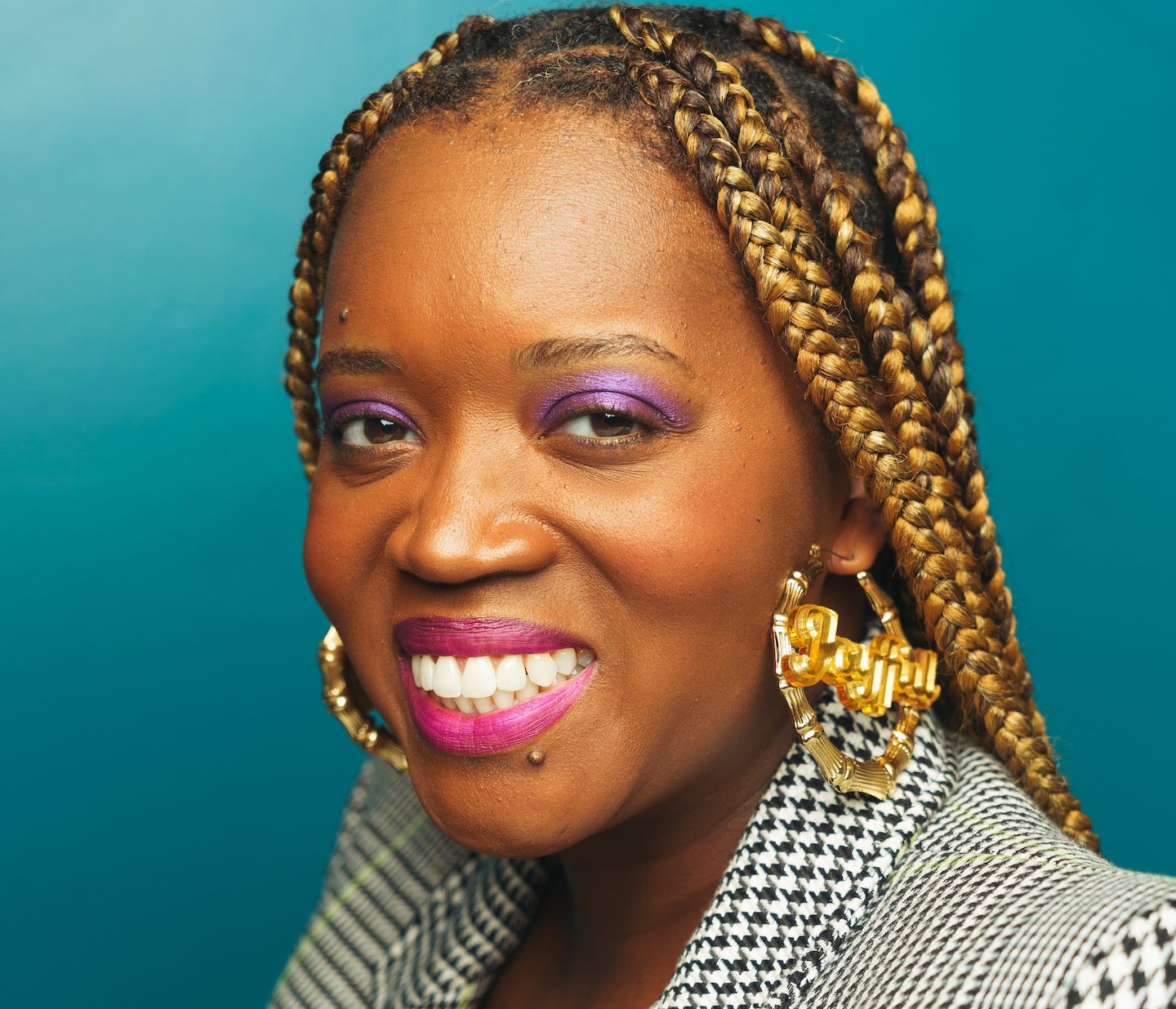
Amena Brown is a spoken word poet, author, and performing artist whose work interweaves keep-it-real storytelling, rhyme and humor. A proud graduate of Spelman College and previous poetic partner for Tracee Ellis Ross’ natural hair brand, PATTERN Beauty, Amena is the author of five spoken word albums and three non-fiction books. Her new book of comedic essays, Never Tell a Black Girl How to Black Girl, debuts June 2026 and is available at your favorite bookseller. As a stage performer, Amena takes arenas, theaters, and performance venues and turns them into living rooms where the audience and her readers can make themselves at home. She lives in Atlanta, Georgia with her husband DJ Opdiggy and their dog Kane.

Growing up with music is a gift that lasts forever. My dad loved all things classical. My mother was a jazz aficionado: Brubeck, Davis, Coltrane, Basie, and other greats. One second grade school trip in Des Moines, Iowa was to hear a symphony. The U of IA brought an electric mix to campus: Armstrong, Ramsey Lewis, The Supremes.... LA was a musical paradise, Smokey, Sinatra, Baez, Dylan, Carley Simon, America, and more, more, more.
Out here in the Hamptons it's been Tina Turner, Richie Havens, Dr. John, Paul Simon, Ray Charles, Leon Russell, Astrud Gilberto....Life without music is incomprehensible.
These are some great music selections!
As a very religious person myself, I try to keep swearing and sexual innuendos out of my music since music speaks directly to the soul in a way words and pictures can’t. I love how you describe your life journey through music. Thank you for sharing!