


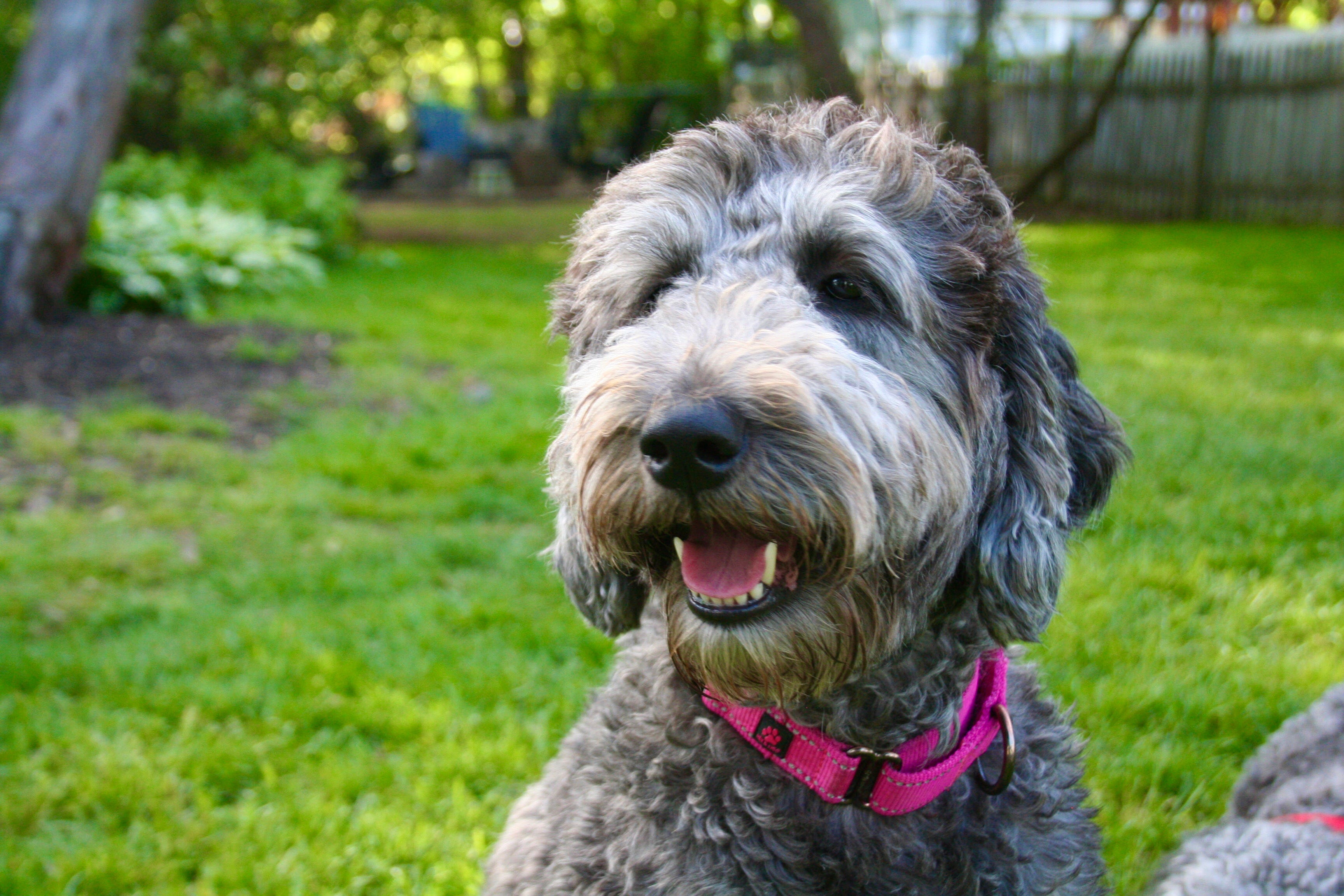
At the veterinary hospital, I learn how to be your mother. All around it is hot and July, and the air bends and thickens; the white vets’ office is glowing. How strange, this square building at the edge of town. How odd to think it’ll heal you.
Both of us have had a myriad of health scares in the past couple of years. Last February, I discovered a cyst in my ovaries. It made my period irregular for months; every pair of underwear was spotted with blood. To combat the pain, I downed ibuprofen, and in time, I healed.
In June, the cyst on your thigh was found to be malignant. You got surgery, and for weeks, you wore a cone around your head to prevent you from gnawing at the stitchwork. The cone was obtrusive; I watched you struggle up the stairs. In time, you stopped eating.
Pulling into the lot, I tell you to “be good.” I don’t expect you to understand. If that were possible then we would have been spared several chaotic evening walks. My father might not have had to go to court and account for your misbehavior—secret rage. Part of me wants you to understand the grief you’ve given me, if only to make your life easier.
So I say, “Be good,” and you stare back, round-eyed, peeking from behind overgrown curls. Wagging your tail, you look like you are smiling, and I’m suddenly overcome with love for you.
It’s true; you are good. In the waiting room, you weave between my legs and sit. You don’t bark at the wrinkly, presumptuous pug side-eyeing you. Finally, the ponytailed nurse with the large rectangular glasses calls us in. You look at me before we go; I think my mother will be very proud of you.
I don’t remember what the fight was about, but even then, I don’t think it mattered.
7:50 in the morning in early February, and we were pouring coffee in silence. Actually, I was pouring coffee; my mother was cutting back on her caffeine consumption, stirring a hot matcha. My father was still asleep on the couch, arm hanging over the side. My brother had left for school. The dogs were outside; I could hear you chasing each other through the frosted grass.
My mother and I brushed shoulders. We refused to apologize.
I’ve always been told that my mother and I look the same, but I never saw it until I became a woman. As a baby, I looked more like my father—round-faced, serious expression. Now I have long hair with hidden whites, like hers. The skin on my fingers is raw from picking, like hers. When we are angry, like we were then, our brows furrow in the same way.
In the car, the silent treatment persisted. I usually enjoyed our shared commute; it was the only time of day we were actually alone together. We liked discussing our upcoming workdays and angst over the political climate. This particular morning, however, we listened to the radio, hosting a sort-of-famous podcast. I didn’t care for it, but I also couldn’t change it, as that would’ve required me to move.
Looking out the window, I wondered if this was the most distant my mother and I had ever been. When I was a child, and older people told me that my young adult years were for fighting with her, I chose not to believe it. I was content to think that I’d run into her arms, crawl into her bed, and ask to be spooned for the rest of my life. Suddenly I was nineteen and found this unthinkable.
The car stopped at a red light. The woman on the radio laughed.
“As a mom,” she told her cohost, “I think we ought to leave our children be. Don’t do everything for them, you know? Let them figure it out for themselves.”
I stared at the bold lettering at the front of a CVS. My mother cleared her throat.
Asked, “Do you think that’s true?”
“I don’t know.”
We arrived at my workplace, a Catholic prep school. I left the car, entered the cold.
Underneath a portrait of the Virgin Mary, I scrolled around an empty Google document and wondered if I was being unfair. I knew, at that moment, my mother was sitting at her own desk at the local college, where she would be working for eight hours. Then she’d come home and scarf down reheated rice before driving to my grandmother’s rehab center. There, she’d sit by the blue hospital bed, occasionally grabbing yogurt or helping her own mother to the toilet. Sometimes I forget how many things she takes care of. And yet, completely aware of this fact, I was still angry. I wanted to be angry forever.
We ended up apologizing later that evening, in the car. My mother told me that she hated it when we fought, and she pulled me into her chest. I allowed it but didn’t reciprocate. Through the gaps in her arms, I looked up at our house.
You were waiting by the window.
The vets make you stand on a metal table, and you bow your head. It dips below your shoulder blades, which have grown more gaunt since the last time we were here. You look older and smaller, hiding behind yourself.
“She hasn’t been eating,” I say for the third time.
I wish you didn’t look so sad. You’re usually happy-faced; you have an energy I’ve only seen matched by toddlers. And like a human child, it gets you into trouble.
I remember being angry with you in August, on the corner of Highland Avenue. You had lost your mind, barking and pulling at your leash until the palms of my hands were burning. A man started yelling at me; I wanted to scream back at him, tell him you’d never bite. But how could I? You looked so cruel.
I scolded you that night, begged you, somehow, to control your rage. You were curled up at the end of my bed, nose tucked under your leg, and I realized you didn’t know why you were so angry.
Now, I forget ever being upset with you, and I want to tell the vets that you’ve never been this still. Secretly, you’re fiery, athletic. If you had it your way, you wouldn’t wear a leash; you’d take off and lunge down Parker Avenue, exhausting your legs completely. This version of you—emaciated, with your head down—isn’t real.
“She’s not usually like this. She hasn’t been eating.”
They nod and continue, running their hands over pink cysts, their fingers buried in curls. All I can do is stand at your side, rubbing your ears and the bridge of your nose, gently murmuring, “I love you, baby girl. I love you so much.”
The day after Valentine’s Day, I was rushed to NYU Langone Hospital, ten minutes from Bay Ridge. I laid on a wheeled bed with an IV in my arm, and around me, people were having the worst days of their lives. [1] N, my boyfriend, was there, sitting right next to a bin of urine-soaked towels, staring at a text thread titled “Scarlett Updates.”
“We r ready to come,” my mother had messaged him. “Just tell us when.”
I had been staying at his Brooklyn apartment for the past few days. I liked this place, stowed away, above the Citibank, because there, I pretended I was an adult. At the kitchen table, I drank white wine while N smoked on the roof. I took the R into Manhattan; a girlfriend of mine costumed an off-Broadway show. I had sex on a twin-sized mattress on the floor and fell asleep wearing nothing. I didn’t bother my mother.
Days had passed since the fight, and we were speaking pleasantly again. I texted her photos of the city from the view of the apartment window; she responded that they were beautiful. I knew that our rift wasn’t resolved, but my next semester was about to begin, and confrontation wasn’t worth it; the best course of action was to keep things surface-level until I left for Vermont. I couldn’t predict what was about to happen.
We don’t know what caused it. I felt normal in the morning. We had gotten breakfast at this lovely diner at the far end of the block, taken a stroll around the suburban neighborhood. Only after we’d gotten back to the apartment, my stomach began to seize, and within the hour, I was keeled over the bathroom toilet. Then, a missed train, a phone call, an assessment, an ambulance ride.
Leaning over the rim of my bed, knuckles dry, N asked, “Do you want me to tell them to come?” The family text thread was still open on this phone.
Truthfully, I didn’t want my parents there. I didn’t want them to see the IV injection site, or the bed, or the red in my face. Every emotional vulnerability inside of me had become tangible. The thought of my family witnessing these things made me want to pull my skin off.
I am not usually like this. I am secretly full of rage.
Then I looked at N, face wrought with worry, and I surrendered.
“You can call.”
Over the next hour, I received a CT scan, shed tears during an ultrasound. I was injected with an unknown dosage of morphine, and in my inebriated state, I thought of my mother.
She arrived at the hospital at 6:20, after fighting Jersey-NYC weekend traffic. Finally, I saw her, moving through the congested hallway, past the rolling beds and the urine towels. I saw her black hair with the silver strands, her rectangular glasses, and her hands, covered in cuts and scratch marks.
My mother was here, and I wasn’t worried anymore.
Suddenly I was not at the hospital. Instead, I was a kid, standing in her bedroom doorframe. The hallway light spilled in, and I could see half her face gently painted in it. Her glasses were folded on the side table. I told her I was scared. Drowsy and wordless, she moved over, and I crawled into the empty space, warmed by her body, and fell asleep to the sound of the cars.
We sat for hours, holding hands, while the doctor prepared my ultrasound results. We watched the racing nurses and listened to the sound of a small baby crying. Staring into the action, I thought of my grandmother’s rehab center, and I wondered if, for my mother, hospital settings had begun to feel routine. Then I was hit with a wave of nausea and vomited into a plastic bag.
Lifting my head, I told her I was scared. She nodded, running her roughed-up thumb over the back of my hand. She knew.
In the car, I wait for the vets to complete your X-ray. The operation is going to be expensive; we’ll be down $800 by the time it’s done. Still, the family agrees that it’s worth the loss. It’s for you, after all.
Reclined in the driver’s seat, I’m listening to a Libby recording of Watership Down. The book was an N recommendation; he appreciated the mastery of the storytelling, the timelessness of the prose. He gets angry with me whenever I refer to the rabbit characters as “cute.”
“It’s demeaning,” he says, folding his arms. I laugh and apologize for how I’ve offended them.
I’ve always loved animal stories; there’s something so universal about them. One of my first writing pieces was a picture book titled Nighttime Little Doggie, which followed a mother farm dog and her puppy, seeking out a comfortable place to sleep. It had a distinct rhythm. The mother would say:
“Nighttime little doggie, time to go to sleep.”
And the puppy would respond:
“Wait a second, Mommy, I want to sleep with sheep.” The two of them would then scurry to another corner of the barn, puppy in front, mother following, and the dialogue pattern would repeat in some slightly altered way.
I was seven when I wrote this book, and I didn’t think much of it. My parents, however, referenced it with frequency. They scanned the illustrations, formatted the whole thing on Adobe InDesign. “It’s funny,” my father told me, “You just wanted to write about dogs, I’m sure, but you actually started to write about motherhood.” I sat at the kitchen table and thought this over, scanning the printout of my book for hints of what he was talking about.
What is motherhood? Sure, it’s the act of keeping a child alive, but what more? I have never raised my own child, of course, but neither has the brand-new mother, wrapped in blankets, holding her peanut-sized baby for the very first time. What does she do?
Well, here are some things my own mother has taught me:
1. To mother is to give up bedspace.
2. To mother is to hold secret rage.
3. To mother is to forgive.
4. To mother is to care for your own mother.
5. To mother is to drive into Brooklyn so you can hold your daughter’s hand while she tells you she is sorry.
They release you from the X-ray 45 minutes later. Upon seeing you, I’m overcome with unconditional love, and soon I’m on my knees, in front of everyone in this tiny veterinary waiting room, holding you, loving you.
We arrived home from the Brooklyn hospital at 10 p.m., and the family dispersed into their different rooms, except my mother, who sat at the end of the couch where I slept. An ovarian cyst, the ultrasound revealed.
She gave me her sweatpants. On a wooden stool, she also left a glass of water, a sleeve of saltines, and a bottle of ibuprofen. These three gifts sat next to her folded glasses. Quietly, she murmured, “I love you.”
I said, “I love you too.” She went upstairs then.
The evening was cold. I could hear February against the window. Inside the living room, however, everything was orange, and out of the corner of my eye, I could see you.
My dying dog daughter. Gray curls, Oreo cookie eyes. Locally infamous for losing your mind. You, with the cysts on your body and fury in your heart, born from unknown places. Wet nose, dry paws, matted belly fur. My baby.
You approached me slowly; you knew there was something wrong. For a moment, we looked at each other’s faces and saw our shared bodily pain. And then you climbed up, cradled your curly self in the gaps of me. Your sick body next to my sick body. I held you like this for a very long time.

Scarlett Sarang Choi is a Korean writer based in New Jersey. Her writing can be found in Make Noise Today’s “Letters To” exhibition, Syris the Zine, and Orion Literary. She is also one of three recipients of the 2026 Ben Belitt Undergraduate Writing Prize. Outside of writing, her album, “Liminal Space,” is on all streaming platforms, and she is the editor of the independent literary magazine, “Broken Record.”

Gorgeous! In going to read it again!
This was a beautifully braided story. And as a mother, daughter, and dog mom myself, I felt every little bit of it. Thank you.