


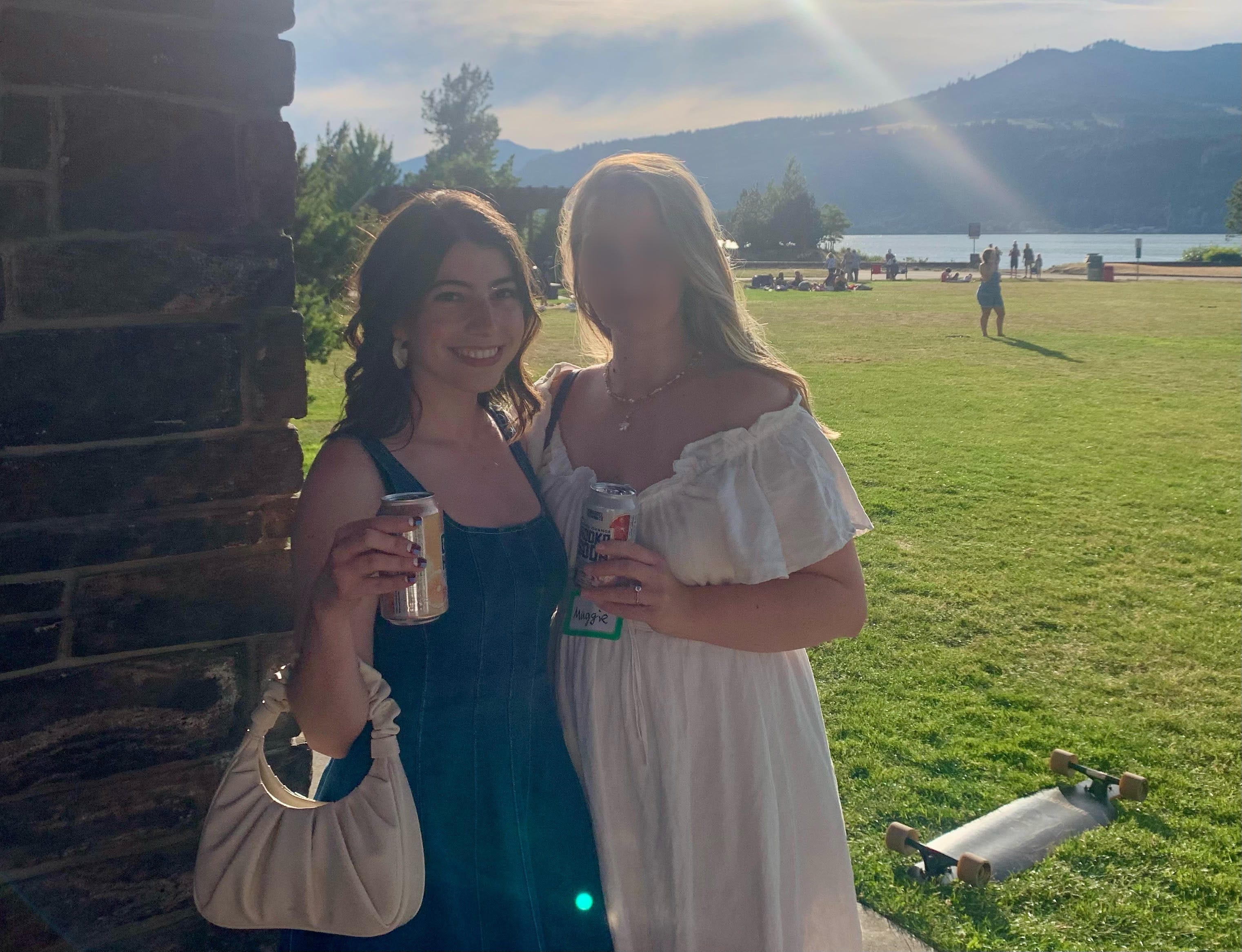
In high school most people stopped worrying about social hierarchies and SAT scores the minute the tassel brushed the left side of their face, but my preoccupation lingered. The academic aspect went well enough for me to get into my college of choice, but the social element continued to haunt me through four years of higher learning, numerous prestigious internships, six years at what many would describe as a dream job, and nights spent brushing shoulders with A-list celebrities at parties and film festivals. I knew what people saw on paper. I saw it too, but it never felt like enough. All I wanted was external validation from everyone I’d perceived to have misjudged me through those four acne and anxiety-ridden years. Is that so much to ask?
When my 10-year reunion drew near, I texted one of my closest friends from high school, Laney. “Are you going??” I asked. Seven hours later, she selected the “haha” button in response.
Though I’ve developed friendships since high school, I don’t think anyone can ever know me as intimately as my hometown friends did. They watched me cry—nay, sob—when The O.C.’s Marissa Cooper died in Ryan Atwood’s arms. (I wore black for a week.) We bought our French silk pie Blizzards from the Dairy Queen drive-through, parked in the lot, and sang the Glee cast version of “Bohemian Rhapsody” until someone told us to stop. These are people who tried (and failed) to help me insert my first tampon. “You can do it!” they cheered through the door as I toyed with the applicator. They see my scars through my clothes.
Laney, who lives an hour away from home in Portland, reluctantly agreed to come with her husband, Pete.
As I soon learned, this momentous evening, the subject of many a film and bottle episode, would be “casual,” taking place at a local park to which alumni were expected to bring their own: drinks, food, lawn games, and seating. They couldn’t even kick us some folding chairs? A mere picnic blanket for the class of 2012?
Still, I harbored dreams of an evening that would craft neat bows from the dozens of untethered threads swimming through my head. I’d have a few drinks and show everyone that I was no longer the awkward prude whose prom dress was unintentionally steampunk. My clothes, shoes, hair, skin, nails, and overall demeanor would communicate the same curated message: I’ve made it (no thanks to you).
When my boyfriend and I checked in at the Best Western Plus Hood River Inn, the only vacancy in my touristy hometown, I understood how the chain could get away with charging $350 per night. While very beige, this wasn’t the soulless corporate retreat I assumed I’d be visiting. Our second-floor room opened onto a balcony overlooking the glittering river that had long attracted water sports enthusiasts from across the globe. Fun fact: Hood River, Oregon, is the Windsurfing Capital of the World. Neon sails floated through our periphery, beads of color dotting the horizon like a Seurat painting. Through this lens, of a surprisingly satisfied Best Western Plus guest, I began to see the town I grew up in divorced from the two decades I spent there. The cynical teen counting down the days until she could start her new life in New York was now a city-dwelling adult who could appreciate things like nature and zero humidity.
Was there anything that even connected me to the girl my classmates would remember? (Aside from our shared desire for their love and approval, of course.) My social anxiety was still present, but I’d since found effective ways of hiding it. Really, the word “reunion” was misleading. This wasn’t a return to the familiar; it was a meeting of strangers who, if pressed, could probably give directions to the Hood River Valley High School gymnasium.
With four hours to go, we decided to start the party early with the canned cocktails we’d bought for the event. Laney and I discussed the actual mechanics of high school—the weekend walks to the Safeway food court, punctuated by a pint of Ben & Jerry’s; the girls we’d branded bitches before we’d shared a conversation; the boys we’d hopelessly loved from afar.
My boyfriend, Jesse, whom I’d dragged across the country for additional moral support, was patient with my neuroses. “I’m looking forward to cornhole,” he joked, squeezing my hand. This trip hadn’t been easy on our relationship. We fought bitterly from the moment we touched down in Portland—about money, my expectations for the reunion, travel logistics. This was my first clue that the past and present versions of myself were incompatible.
With a trunk overflowing with alcohol, we made our way to the park. Note: Hood River is among few towns in the U.S. without open container laws—another point in its favor. We pulled up 45 minutes late and claimed a space in a lot with rock-filled trenches positioned between each row of cars. As we approached the park, scanning the grassy expanse for large groups of 28-year-olds playing lawn games, we realized we’d miscalculated the turnout for the event in question. In the distance, we saw roughly 20 people gathered around a pavilion, a bouquet of balloons identifying the crowd as our destination.
Low double digits is a laughably small turnout for a class of nearly 300, even in year three of a pandemic, but the funniest part was that about 95% of graduates still live in state; a good portion never even left Hood River.
The situation grew bleaker. Not only was the crowd small, but it was composed almost entirely of popular kids (who, judging by social media, still saw each other often). Another victory lap for the rare set of adults who look fondly on their high school years.
As expected, everyone observed the casual dress code but me. T-shirts and shorts were the uniform of choice; one particularly relaxed guest even swapped a tee for a bikini top. I accessorized my tailored denim dress with a tiny off-white purse Megan Fox sometimes carries.
Holy shit, I’m in high school again, I thought to myself. I’m out of place, out of fashion, and still no one seems to notice that I’m here. But I wasn’t going to be that girl—not tonight. I grabbed a canned cocktail and made the rounds.
“Hello!” I greeted an FPP (former popular person–though I think of popularity as less of a circumstance than an enduring personality trait). She appeared surprised, though not unwelcoming.
“Isabel,” she replied brightly. “Back from New York!” Was there an air of condescension, or was I just projecting? “Still writing?”
“Yes! Well, no…Not exactly. I was a writer, for a magazine, and it just got really complicated…” Shut up! No one cares! I was losing my window. “What are you up to?”
This FPP fronted a band in Portland. This FPP worked in marketing in Seattle. This FPP was getting her New Zealand citizenship. This FPP was in med school. And this FPP went wee, wee, wee, wee, all the way back to living at home.
As I engaged in pleasantries, I realized I’d never really spoken to any of the people present. I’d built up narratives about them—how they acted, what they thought—and in five minutes of conversation I could label most of these calculations false. These were nice people. Maybe we would’ve been friends had we smoked on the beach sophomore year; maybe we would’ve dated had I taken a shot of Patron from their parents’ liquor cabinet at a homecoming after-party. It wasn’t even the relationships I was upset to have missed out on. Despite the pleasantness of these chit-chats, I could tell most of us didn’t share a lot of common ground. The thing I found haunting was that it took 10 years to figure this out.
“Mark is cool,” Jesse told me as we met to grab another drink. He’d begun to make connections independently.
“Who the hell is Mark?”
“He’s a budtender in town.”
“A what?”
Jesse cocked his head toward a clump of men sporting Hawaiian shirts and beanies.
“You would find the stoners,” I said, laughing. “Babe, they were so not cool.”
“Ouch,” he replied, miming a knife in the heart.
Another FPP arrived to the class of 2012’s grassy knoll with an entourage in tow: both her parents, a few friends, and her partner, plus a baby held to her chest. I was mesmerized by the baby. In fact, I don’t think I even stopped to say hi to the FPP in question; I simply beelined toward her tiny offspring, his fist encircling my index finger. “I said ‘I don’t care, I’m bringing my baby!’” she told me in regard to the reunion’s 21+ age limit, and I suddenly felt that yes, her baby should be allowed to watch her former classmates binge-drink.
“I always knew you’d go places with your writing,” she said to me as I locked eyes with her baby. “And look at you, writing in New York City.” This was exactly what I’d wanted to hear from my classmates, and yet I didn’t even know what to say. I nodded and smiled, cowed by the fact that I hadn’t called myself a writer since I’d left my job six months prior. She had misjudged me, just not in the way I’d expected.
Things were going well and I felt more comfortable than I expected (thank you, Smirnoff). Lulled into a false confidence, I decided to take a shot.
Like a scene break in a film, suddenly it’s dark and I’m walking to the car. Then, even more suddenly, the ground disappears beneath me and I’m thrown against a jagged bed of rocks, my boyfriend and Mark pulling my dead weight from the ditch in front of our car as I explain, “I fell.”
I limped the rest of my way to our rental car. Once I sat down and clicked my seatbelt into place, I realized I didn’t have my phone. Jesse got out to check the ditch but came back empty handed.
Then, a new scene: I stood at the bar at River City (known as River Shitty). I asked for a vodka tonic and looked around for a hidden camera when the bartender told me it was $6. “Can you believe this?” I gestured around the bar. “$6 and it isn’t even happy hour!” Seeking a familiar face, I greeted a childhood friend, a popular guy I hadn’t spoken to since I was maybe 6. We engaged in routine small talk before a hoarse cry cut in from the other side of the bar.
“ISABEL!” a voice erupted. “GO TO YOUR BOYFRIEND!” I looked over to see Laney’s husband, Pete, alone and red-faced. He pushed through the crowd to approach us.
“WHERE’S ISABEL’S PHONE?” he screamed at my acquaintance, stumbling closer. When my fellow alum failed to respond to this line of questioning, Pete lunged forward, gripping him by the shoulders. Bystanders pulled him back before things could escalate. I felt like I’d fallen asleep and woken up in a 90s teen drama.
Another classmate emerged from the buzzing crowd. “What’s going on??” she asked me.
I choked out a laugh. “I have no idea.”
I fell asleep content and woke up for poolside yoga with an uncharacteristic smile on my face. We enjoyed a slow flow on the deck alongside some of the same middle-aged moms I’d grown up with, arching our bodies as one into a simple downward dog, reverting to a resting child’s pose often. The smile never faded.
“That went so well,” I told my boyfriend as we sat down for breakfast the next morning at the hotel restaurant. “I really didn’t drink very much.”
Jesse looked at me like he’d seen a ghost. “You were the drunkest person there.”
Surely he was mistaken. “What are you talking about?” I asked.
“You flirted with everyone there, in front of me; you broke a case of beer and started manically laughing; you lost your phone and fell in a ditch.”
“No, I didn’t,” I insisted. My heart began to race. “I don’t remember any of that, aside from the ditch.” My body remembered the ditch vividly. My thigh nursed a three-inch bruise, both my knees felt sore, and my elbow bore a scrape; in fact, I had trouble walking. The leather sandals I’d bought for the reunion were dinged and torn, my pale blue pedicure chipped.
“I have my phone,” I said, holding it in my hand.
“Yes, I found it on the floorboards of the car.”
“What happened with Pete?”
“I asked him to help me find your phone and he became convinced that guy at the bar stole it.”
Evidently, I wasn’t the only person who’d been overserved. (Can you overserve yourself?)
But the most confusing part was that I didn’t feel hungover. I felt great, actually.
“Babe,” my boyfriend deadpanned, “you’re still drunk.” He shook his head into his omelet.
The color drained from my face. No.
As I have since learned, it is possible to blackout in the middle of a drinking experience and regain memory partway through. I imagine the chances of such a scenario increase when you skip dinner and then decide to take shots with your seventh-grade boyfriend.
My crutch, alcohol, went from giving me a boost to knocking my feet out from under me, sometimes literally. But maybe that’s what I needed all along. I always wondered what my high school experience would have been like if I’d loosened up, grabbed a drink or two, and here was the answer: BAD. I’d been just as out of place at the reunion as I’d felt throughout high school.
A brutal hangover eventually took its grip on my head and stomach. As the day went on, my ability to walk grew tenuous. The lightness I’d felt upon waking soured into a familiar malaise: regret. I was paying the toll for an evening I didn’t even remember. My plan to prove how evolved I was had backfired horribly. The only thing I’d proven was that I had a weird obsession with babies and at best a drinking problem. If anyone left the party thinking about me at all, it was probably about how they dodged a bullet by avoiding me in high school.
This outcome was always a possibility. There was a high chance from the start that I’d embarrass myself beyond redemption. Why did I expect to be the exception? Looking at me now, bruised and aching, “exceptional” was the last word to come to mind.
When I checked out of the Best Western Plus, my bank statement omitted the “Plus.” At the end of the day, it was just a Best Western.

Isabel Jones is a writer and editor living in Brooklyn with her husband, two cats, and a dog. Her work has appeared in InStyle and Cosmopolitan.
