


“Come on, kids!” I chirped, eyeing the container’s faded baby blue paint, “who wants to climb up with me?”
I placed my foot in a divot and pulled myself to the top.
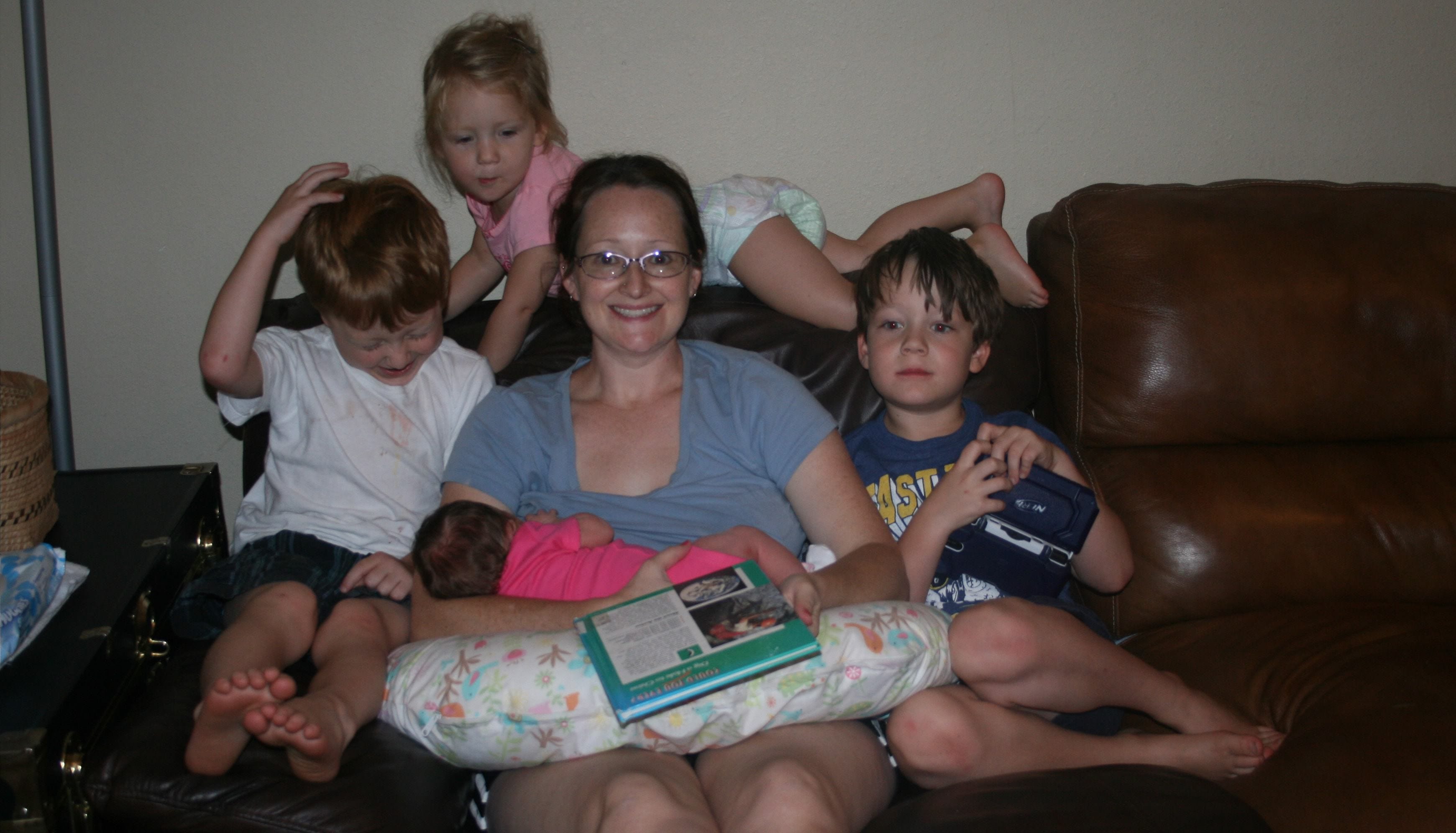
Before that moment, I had no idea what this fraught experience would feel like. This wasn’t real dumpster diving, into a trash dumpster. There wouldn’t be rotting food scraps, poopy diapers, and other pungent items. This was only a recycling dumpster for paper products. But would it be full to the brim and we could just position ourselves on top of the papers to dig through? Or would it be partially empty, and we’d have to jump inside? If we did jump inside, how would we get back out? I was pretty sure Ethan and Benji, ages 7 and 5, would be up for searching in the dumpster with me, but I wasn’t sure what Fiona, age 2 and a half, would do. Lucy, a month old, would hopefully sleep in her car seat, which I’d move under a shady spot.
But none of these unknowns stopped me from attempting this mission. I was going to dumpster dive, and I was going to Save. Our. Family. Money. It’s hard to explain the thrill I get when I save money on a purchase. Instead of bragging about how much I paid for something, or showing off a Gucci bag or designer shoe, I enjoy bragging about how little I paid. “This? Oh, I got it from Craigslist for $15.”
It’s like a contest I’m always having with sellers to see how cheaply I can acquire things. And I love to win.
There wasn’t one simple thousand-dollar answer to my family’s current problems. My husband Reid was already working his ass off as a college philosophy instructor at Auburn University in Alabama. He taught four classes per semester and tried to research and write in between. This new money-saving venture, in addition to my part-time job two mornings a week at a children’s drop-off program, was one thing I could do. I could dumpster dive at the paper recycling center, find thrown-away newspapers, salvage the coupons from inside them, and start paying less for groceries.
At the couponing 101 class I’d taken last month for $20, which we’d easily make back once I got the hang of couponing, the teacher, Jackie, explained how it worked. She taught us how to follow sale cycles and use coupons on top of the sales. Our town had a local paper, but it didn’t include many coupons, if any. But Atlanta, Georgia, the closest big city to Auburn, distributed its papers to smaller cities in the area, and the Atlanta Sunday paper included a whole coupon booklet. It was 2013, and Atlanta’s paper would cost you about $3 from the coin-operated newspaper dispenser at the gas station.
Jackie said to get the coupon booklet from inside the paper and hold onto it. It wouldn’t be worth it to cut the coupons out and use them right away. Items didn’t typically go on sale the same week that there was a coupon for the item in that week’s paper. But in a week or two, grocery stores would have sales on those items, the coupons could be used on top of the sale, and you’d pay less for the name-brand item than for the store-brand item.
But it still didn’t help a ton unless you had multiple sets of the coupons. Then, if an item was on sale, say two for $10, and you have two coupons for a dollar off each item, you pay even less.
This is where the dumpster came in. Jackie had talked about ways to get more newspapers cheaply. You could ask your neighbors for theirs, but none of my neighbors got the Atlanta paper. You could ask your co-workers to bring you theirs on Mondays, but none of Reid’s coworkers got the paper either. You could ask the guy at Starbucks reading the paper if he minded if you took the coupons, but I never went to Starbucks, nor could I count on finding an old guy reading the Atlanta newspaper at a Starbucks if I did go. Jackie said she even knew someone who went to her city’s recycling center and found tons of discarded coupons. That idea caught my ear. Yes, I could do that!
Auburn’s recycling center sat at the end of a gravel road and was just a set of dumpsters; if I remember correctly, one for paper and cardboard, one for aluminum, and one for glass.
So here I was standing in front of a blue dumpster for paper recycling, and I knew my life was about to change for the better. In fact, I was eager to show how badass and committed I was to my family.
As it turned out, the dumpster was nearly full to the top. My oldest boy and I climbed up into it. Benji and Fiona wandered around the empty parking area looking for rocks and sticks. Baby Lucy slept soundly in the shade of the August heat.
I picked up piles of cardboard. I filtered through stacks of paper. Ethan and I probably spent thirty minutes sifting through the items. I’m sure I climbed down once or twice to get Fiona her sippy cup or help hoist Benji up to the dumpster because he wanted to help too. I found a couple of newspapers from the Sunday before, but no coupons with them. In the end, I’d only found two coupon booklets, and one of them already had a couple of coupons cut out.
Where were the droves of coupon booklets Jackie’s friend had recovered? The average income of an Auburn University student’s family was $150,000 a year, so I couldn’t imagine those families were taking the coupons. Most of my friends were stay-at-home moms too and saved where they could, but they only occasionally couponed. And even though the neighborhood we lived in was mostly populated by lower-income families like ours, I didn’t know any neighbors who did much couponing. Auburn was half-populated by wealthy families; the other half were white-collar workers or were scraping by like us. But it still felt like most of the families we knew were rich compared to ours.
I sighed. Perhaps the explanation for the lack of coupons was as simple as the fact that people were not big on recycling and had tossed their papers in the trash.
I drove the 25 minutes home feeling defeated, my visions of coming home with a stack of 20 coupon booklets, dashed.
For me to work a full-time job wasn’t worth what we’d have to pay for childcare. Paying roughly three-quarters of my income and netting only one quarter of my pay after deducting childcare fees didn’t hold enough merit for either myself or Reid.
Years before, I’d tried and failed at a few multi-level marketing businesses: the pink one that sells makeup and skin care, one of the essential oil lines, and a costume jewelry business based in Utah.
Before Lucy was born, I’d had three part-time jobs, totaling seventeen hours. At about six weeks postpartum, I would only go back to one of those jobs working Wednesday and Friday mornings at a children’s drop-off program at a church where I could bring my own children for free.
That was all I could do for now work-wise. There wasn’t even a place in Auburn, or the neighboring town of Opelika, where I could donate plasma. I’d checked.
I would be broken-hearted to leave my children. In spite of the hard parts, I loved being a mother. It was more fulfilling as a life calling than anything I could dream up. It made more sense for me to find part-time work that I could do without having to leave the kids.
I could save money in other ways, but if going to the length of dumpster diving for coupons didn’t help, in addition to all the other money-saving things I was doing, in addition to my job, in addition to saying no to many things that we would have liked to do, I was at an absolute loss for how to make things better.
I would go home and I would tell Reid about my failed venture in the dumpster, and he would probably say, “You went dumpster diving? You’re already working hard enough taking care of our kids. You don’t need to stress about money so much.”
But I did worry about it. He wasn’t as worried as I thought he should be, so I needed to stress enough for both of us. Maybe I was just better at attention to detail and budgeting, so I noticed the finances more. Or perhaps he didn’t want me to worry because it made him feel like he wasn’t doing a good enough job being a provider. I’m not sure either of us recognized the irony that while we were both embracing traditional values and male and female roles, I was the one stressing about how to save our family. Or maybe Reid was stressing about how to save our family in his own way: working his job as best he could and going on the job market every fall to look for better-paying positions.
About a year and a half later, things were no different. In early March of 2015, Reid needed a new phone since his old one had broken. I checked our bank account and saw that we had $659 in checking.
How did that even happen? I wondered, near tears.
It was the fifth of the month, and we needed to pay the landlord $750 for rent by the end of the week. I moved the last $433 from the savings account into the checking account. But how would we make it till Reid’s next paycheck? What would we do the following month when rent was due?
That evening, after a grocery run without the kids, I sat in the parking lot, staring at a new Korean karaoke place that had just opened. A couple of friends and I had speculated that because the karaoke rooms were private with no windows, soundproof, and rented by the hour, it was actually an undercover brothel. I’m embarrassed to admit this now. If I had done any research, I would have discovered that private soundproof rooms are perfectly typical of Korean karaoke.
But with my prejudices and lack of knowledge, I sat in my car, in front of the supposed undercover prostitution ring, wondering if they might hire me as a sex worker. Even if I could somehow confirm that it was really a brothel, would I just sashay in and say, “Listen, I know what this establishment really is, but don’t worry; I’m not a cop. I was wondering if you’re hiring any more ‘servers’”? I only considered this for a few minutes before driving away. But I wondered if I could find paid sex work elsewhere. Back at home, after kids were in bed, a quick search on a website’s local group revealed that, while there were sex things I wouldn’t do even for money, there were plenty of women looking for “fuck buddies” who were willing to do those things, and much more, for free.
In the end, I abandoned the idea of sex work. Maybe because it seemed too difficult to get into the business. Maybe it was my purity culture background or my suspicion that no one would want to pay to have sex with my mom-bod anyway. Maybe it was my terror at the idea of getting caught doing something illegal and being thrown in jail. Or probably a combination of all of the above. Anyway, I decided it wasn’t for me.
That night, after I’d stared at the karaoke bar, and after I learned the term fuck buddy from my online research, I lay in bed considering selling an organ. I’d have to be dead to sell a heart or liver, but…I had two working kidneys! Maybe there was someone out there who desperately needed a kidney and would pay top dollar for one of mine.
How does one even infiltrate the black market for organ selling? I wondered.
Then I had the horrifying thought that while I was under anesthesia, the illegal organ remover guy might just take both my kidneys, and my liver, and any other usable organ and leave me bleeding out on the gurney. The thought made me shiver under the covers.
In the dark, I glanced over at Reid, wondering if he was awake too with his mind spinning. But no, he was fast asleep.

Hope Elizabeth Kidd lives in New York City with her husband and six children. She holds an MFA in creative writing from the City College of New York. She enjoys writing about motherhood, mental health, and her childhood in Zimbabwe, and is working on a memoir about living in NYC with a large family.
Publications include MUTHA magazine, Halfway Down the Stairs, and the Manifest Station. For two years, she worked as an editor on Promethean, City College’s literary journal, and she now co-hosts the monthly reading series Must Love Memoir. You can catch her on Instagram at @hopeelizabethwrites.
