


The sharp, familiar outlines of anorexia and bulimia came into view when I met T. I was 52 years old, two years separated from my husband of 25 years, and still grieving the sudden death of my mother. T. wasn’t the cause of the resurgence of this decades-long disease. He didn’t create the cliff that I had been hurtling toward—but he certainly encouraged me to jump.
We met on a dating app. I was dating for the first time in decades, as an older person, which triggered a whole new set of insecurities. I felt as if I was living in an old body that no longer told the story about myself I wanted to tell. I wanted to feel younger, fresher, as if I wasn’t hauling the weight of a lifetime of trauma. I found it difficult to step into or see the courage and strength I’d worked so hard to develop.
I couldn’t imagine how anyone would find me physically attractive. I couldn’t imagine how I would connect with another man on the level at which my ex-husband D. (the father of our two children) and I had connected. I couldn’t imagine a man looking at my stretched belly that had carried two pregnancies to birth and one miscarriage and find it anything other than repulsive. I didn’t know how I would ever rebuild a life of love and stability and joy and connection like the one I’d experienced with D. and our children.
The stories I told myself were tired and written, in part, by my eating disorder voice. The problem is, while I had battled disordered eating throughout my adult life and had swerved solidly into some murky territory over the years, sometimes starving myself and other times purging, I worked hard to hide it from everyone, including myself.
When I met T., a retired firefighter who had invested early in Seattle real estate and was therefore able to live a life of relative leisure at that point, I was taken by his physical presence. I am barely 5’1’‘. He was 6’3’‘, with graying blond hair, and a sly smile. He was strong and smart and funny as hell. He could pick me up and toss me around like a stuffed animal. We found familiarity over our shared childhoods in New York and New Jersey, the sarcasm we loved to lob, and that both of us moved to Seattle in the nineties during the height of the grunge era.
Initially, he made me feel beautiful and desired. He wanted to delete his dating profile a week after meeting me; two weeks in, he told me he could see us married. He invited me to his beach house—an A-frame cabin separated from the ocean shore by a small thicket of woods—a month into our relationship.
Sitting on the back porch one evening, drinking wine, I joked, “I wish someone would pay me to sit on this porch, gazing at the trees, smelling the saltwater air.”
He replied, “Well, if we got married you could quit your job and just do this. So, in a way you could.” I smirked and said nothing in response.
I had no idea what I was doing but the dopamine was spiking, and it was addictive. Rather quickly, he opened up to me about his life, his family, and his background.
It’s easy for me to berate myself now. Why didn’t I pay attention to the red flags? Among the most glaring was the anger he felt for most of the people who had helped shape his life, from his parents to his college-aged son to his son’s mother, and his former colleagues in the fire department. No one was safe from his contempt. But I thought I could change him—a cliché of epic proportions.
Predictably, he started to unleash his bitterness at me as well. One morning at breakfast, in a restaurant near the beach house where we had spent the weekend together, he asked, “Do you want your 22-year-old body back?”
I shot back, “Of course not. I love my body now.”
But he pressed on and suggested I “could lose ten pounds and look even more beautiful.”
I was primed and ready. The eating disorder grew from there, propagating and germinating its seeds, rooting and preparing to ripen inside me.
First, I stopped eating dinner. That was a typical disordered eating behavior I’d employed a few times over the years. I ran every day, in rain or shine, sickness or health, another disordered behavior that had infiltrated my adult life under the guise of exercise for health. This wasn’t exercise to feel good, to feel strong, to care for myself. I had one goal: to lose weight. One glaring clue was the obsessive-compulsive thoughts—the only thing that mattered day to day was exercising. I simply couldn’t miss it.
I started to count calories, calculating every morsel that touched my lips. I refused dinner invitations and began to check myself in the mirror relentlessly. Each day became a twisted game. I “won” by going to bed hungry, buzzing with deprivation. It was exhilarating. And gutting.
Eventually I broke up with T., walking away with memories of evenings spent in his hot tub, arguments as we walked his old Australian shepherd, and his nonsensical tantrums that would erupt whenever I’d reveal the slightest vulnerability.
But the biggest thing I left with was a raging eating disorder.
I immediately slid into another relationship with B. within a month. While B. was kinder and gentler, he battled his own demons. I spent a few months pretending this relationship was what I wanted. He also asked me to marry him. “Let’s go to Vegas! I’ve never met anyone like you,” he pressed. I said no many times. I simply wanted distraction, and he provided it. I floated through my days dissociated and fell deeper into denial that I had a problem.
My adult kids—my son E. and my daughter A.— came to visit Seattle from Brooklyn, where they lived at the time, and while they didn’t yet know I had an eating disorder they sensed my just-under-the-skin deep discomfort. They knew something was wrong. They may not have been able to define it, but they knew my essence was being slowly smothered by something. I had lost too much weight. I was barely eating. I made excuses all the time for why I wasn’t eating breakfast, lunch, or dinner.
My skin felt like the itchiest of wool blankets. I wanted to fly away and beg for forgiveness at the same time. My brain buzzed with alarms that told me when to exercise, what to eat, and when to stop eating. My ever-shrinking body made me feel a certain kind of fleeting power, but my tolerance for anyone and everyone waned sharply. I was quick to anger; it was the only emotion I seemed to be able to feel.
I lived alone, so the metamorphosis wasn’t as obvious. I stopped seeing most people except for B. But I had a large community of friends and a committed family who knew me well. A few months after my kids visited, I took a trip to Brooklyn to see my brother and his family, my kids, and their partners.
It turned out to be the first stop on the intervention highway. At the end of the trip, in my brother’s apartment, he told me we needed to talk.
“Are you okay? You look really gaunt. Like, something is wrong. We’re all worried about you,” he pleaded.
As I packed to head home the next morning, I silently wondered whether I could just flee then and there. His worry was overwhelming. My brother and I are very close. When he pulled me aside that evening, it had been five years since our mother died in a car accident. I didn’t want to cause more concern.
I launched into my automatic response, honed over years of people-pleasing: “I feel great. I’m totally okay. I swear. Really, I promise.”
I did think I was fine. Or, more accurately, my eating disorder brain told me I was fine, and I chose to believe it. I thought to myself, I’m the most beautiful and healthy I’ve ever been. Sure, I didn’t have the physical strength to close the trunk of my car. I couldn’t get up in the middle of the night to pee without feeling dizzy and lightheaded, grasping the edge of the mattress so I didn’t fall.
But look at me, I thought, ‘am a physical specimen. I can run for miles a day. I’m a nonprofit executive, helping to direct a multimillion-dollar human services organization. I’m a published writer. I jump out of airplanes and rappel down waterfalls. I hike mountains. I write poetry, goddammit.
My brother didn’t buy my empty explanation and plastic smile. He was already talking to my son and my daughter, my ex-husband, and my closest friends, to figure out how to address what they all saw. I wasn’t well, and I needed help.
I flew home to Seattle thinking I’d bought myself more time to…what? Starve myself? Lock myself away in the prison of this powerful mental illness? Isolate my body, heart, and mind from anyone and everyone who loved me?
I resumed my starving and purging and compulsive exercising back home.
But two weeks later my ex-husband pulled me aside at a bar where we gathered to watch a friend’s band play and confronted me: “I’m—no, we—are all scared. I want you to know I’ve talked to the kids and your brother, and we need you to get help. You’re not eating. You avoid everyone in your life. Please. Don’t tell me everything is okay.” Sitting side by side, on stools, the bartender mere feet away, I was humiliated and caught off guard. I tried to fight it.
“What?! I’m totally okay. I swear. I truly promise you. I’m fine,” I lied. I felt exposed, like those dreams where you find yourself naked at work or in school. Why is everyone making such a big deal out of this? He may as well have told me he believed the moon was made of cheese. I was shocked and didn’t know how to process any of this confrontation. I had kept this a secret for so long. My house was burning.
None of my tricks, none of my lies, were working any longer. D. said they found a place where I could get help. I lied and told him I’d call to find out more. I didn’t.
My boyfriend B. came over to the house one evening to make dinner and watch a film. He was a good cook but I, of course, would make an excuse, as always, for why I wouldn’t eat the food he’d made. I wasn’t feeling well. I had eaten late. Or else I would pick at the food on the plate, pretending to eat and then spitting it out in my napkin as surreptitiously as possible. Halfway through the movie, he turned to me and said, “Hey, let’s go to Mexico City. I’ve never been there, and I’ve always wanted to go.”
Why not? I thought. I decidedly chose not to answer myself.
We landed in Mexico City in August 2023. Mexico City is a high-altitude city. If you’re not used to it, it’s best to take a few days to acclimate your body by hydrating well, limiting alcohol intake and strenuous activity. Me? I could hardly wait to put my gear on and go for a run the day we arrived. After the run, we spent the rest of the day exploring the area around our Airbnb without drinking nearly enough water. That evening, we made dinner (which I didn’t eat), drank wine, and watched a movie. I did exactly everything I shouldn’t have done. And when I walked downstairs to our bedroom that night, I felt woozy and lightheaded and flopped into bed. B. stayed upstairs to clean up.
Almost immediately, nausea overtook me. I remember standing up to walk to the bathroom. The next thing I recall I was on the cold tiled floor, B. standing over me, frantically asking if I was okay. I was too shaky to walk so he picked me up and carried me to bed.
The next morning, I awoke to a massive, red, and very painful bump on my forehead. I tried to lift my head to find the world spinning off its axis. I had to be carried into a taxi and taken to see a doctor at a nearby clinic who told me I had a mild concussion. I sent a lighthearted text to my family group chat (“Ha! I fainted last night. I’m so silly. I have a concussion but I’m fine!”). No one got the joke.
My kids each called me one after the other. My son was furious. He’d had enough and he told me there was nothing funny about fainting. My daughter called me crying. They each implored me to get help. While they didn’t have all the details (not eating + over-exercising + drinking in a high-altitude city = fainting), they knew I wasn’t well. They knew the eating disorder was the fuel for this episode.
Something broke inside of me that day. I laid in bed, thousands of miles from home, listening to each of my children practically beg me to stop hurting myself. These were the humans I grew inside me, the ones whose eyes I gazed into moments after pushing them from my body and with whom I fell in love in a way that’s impossible to put into words. These are the people I would die for if it meant saving them.
And they were asking me now to save myself.
I flew home the following week and called the treatment center. I took leave from my job and, with the help of my community of friends and family, entered a two-month partial hospitalization program. My kids and my brother attended virtual family therapy with me every week. My ex-husband and closest friends worked from my house to stay with my senior dog and take her for walks. They attended Zoom sessions organized by the treatment center to help them learn more about eating disorders.
I made it through each day peeling back one more layer of pain and grief, bearing loving and compassionate witness to the experiences of those who were in the program with me, so that I could see myself within the same orbit of love.
I opened to the possibility that having an eating disorder—even in my fifties—wasn’t shameful. I allowed myself to feel strengthened by my courage to be as vulnerable as I could be and to admit to everyone, including myself, that I was sick.
That was two and a half years ago.
I started writing about my experiences to understand myself and this decades-long disease. I reached out to other women in midlife who have struggled with eating disorders and am collecting their stories as well. It can be hard to find the self-love you need to get through trauma like this but somehow, we often find it for others. Let me hold you so that I can hold myself, I often think.
T. reached out a couple of months ago, out of the blue, saying he wished he had been more sensitive when we were together, apologizing for what he said to me about my body back then and asking if he could see me. I waited a few days, wondering if I wanted to respond. I finally emailed him in response: “I appreciate the email and the kind thoughts. Seeing each other isn’t a good idea. You hurt me while we were together, and I’m now in a strong place. I don’t want to jeopardize my health. I wish you a good life, T.”
Recovery from an eating disorder is a bumpy road and while I wish I could wrap this up in a neat bow, I have slowly understood that this is and will be a lifelong process.
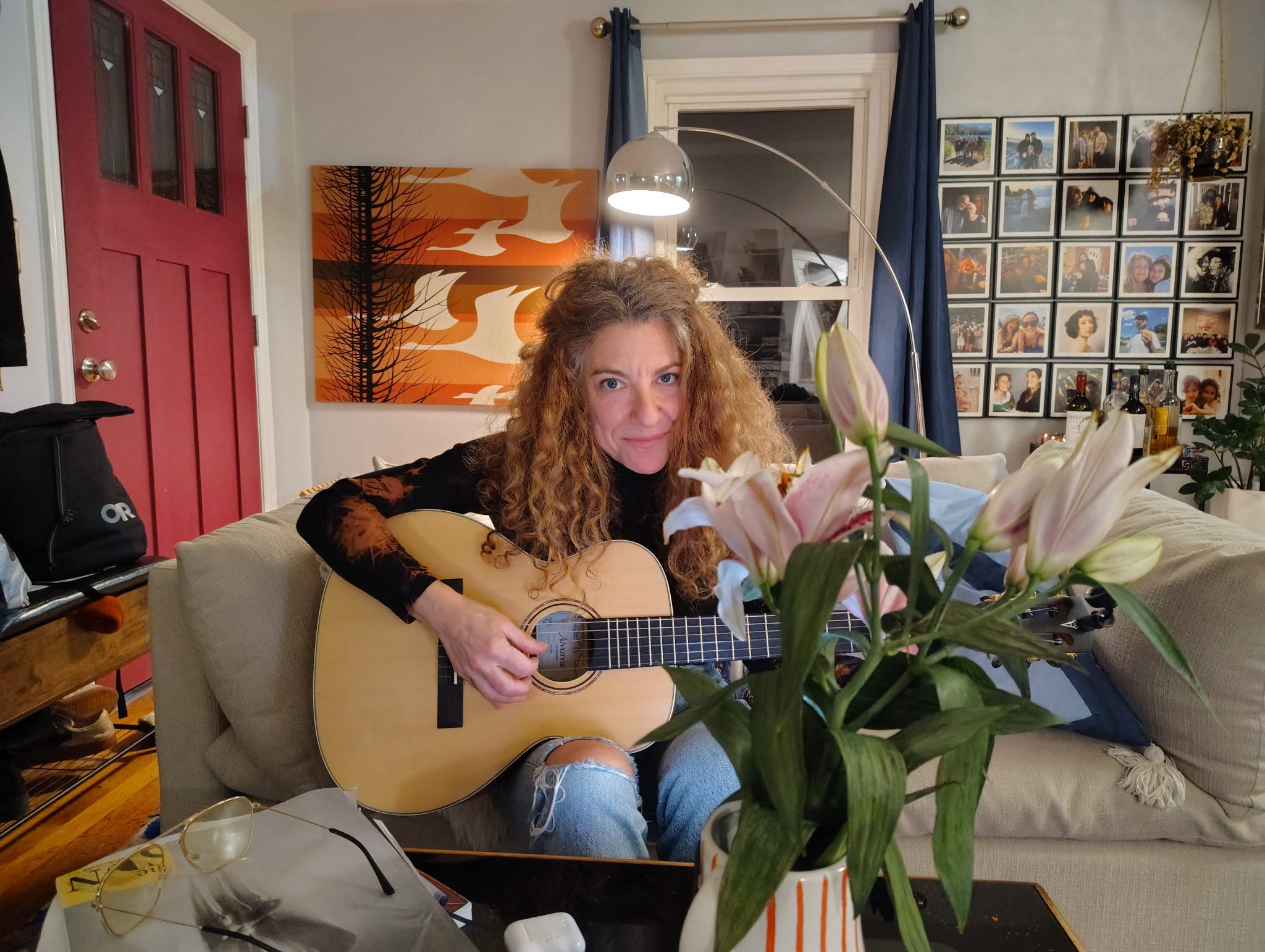
My eating disorders aren’t just about my relationship to food or to my body; they’re about my relationship to myself. So, I sit here, on my couch, and write this essay as a love letter to myself and to those I love. I find strength in this love. Love for the woman I was when I was deep in the grips of anorexia and bulimia. For my children, my friends, and family who put themselves in belly of the beast to pull me out. For the little girl who was harmed by parents who didn’t understand how to metabolize their own body issues. This is a love letter, also to those who struggle in the throes of active eating disorders and for those who are in recovery. Most of all, this is a love letter to the woman I am today: messy, vulnerable, unique, courageous, and stubborn as hell.
Amie Newman is a writer, advocate, and former journalist who has spent decades leading mission‑driven nonprofits focused on justice, women’s health, and community well‑being. Her work blends personal storytelling with a deep understanding of how politics, cultural expectations, patriarchy, and family history shape women’s relationships with their bodies. She is currently editing This Is Not Your Mother’s Eating Disorder and developing a documentary exploring the realities of eating disorders in adulthood. She invites women to share their stories, ideas, and collaborations with her at amienewman.com, in an effort to build community around truth‑telling, instigating, embodiment, and collective healing.
Eating Disorder Resources:
National Eating Disorders Association

Amie, absolutely beautiful piece. I hear you. I see you. I get it. My ED expressed itself lots of different ways over my entire lifetime. And I've done all the kinds, but my primary ED is about sedating my feelings with food. I don't do that anymore, and have utilized tools like therapy, 12-step. I opted out of bariatric surgery because I knew that until I got to the root of my disease, (which was most definitely Complex PTSD, coupled with a dysfunctional culture we all live in) I'd be the best at losing all the weight post-surgery, but I'd also be one of those people who gained it all back and then-some, and I told the surgeon as much. And yes, I did end up opting into the GLP-1s in combination with my other tools. Not about getting skinny, but of availing myself of an entire toolkit for recovery. The whole experience has given me the life I've always wanted to live, and I'm thriving, finally. It's about 9 days until my 65th birthday, and I'm happier than I've ever been. And I'm still a fat woman. And I'm okay with that. I'm healthy, and I love myself. Looking at the dysfunction that instilled the behavior has been the thing that set me free. So glad to meet you today! xo
So happy that you finally got help.
My younger sister, Renee, suffered for years. As a teen she had a fabulous body, in perfect proportion. I don't know what triggered her lifelong struggle with anorexia and bulimia. She moved to CA while I was in college and we didn't meet up again until I moved to LA in the early seventies to secure a teaching job. At that time she was OK, I think. We lost touch again when she married and moved to AZ and I moved back to NY. I saw her a few times at Christmas after my parents retired to San Diego in the 90's. I was shocked when I saw her. She was skin and bones, weighed about 90 lbs, and had new teeth, as hers had rotted away for vomiting after eating. (TG I didn't observe this first hand). Everyone, but me, said nothing about her transformation. When I questioned our mother she said, "Renee eats all the time when she's here." DUH. I don't believe she ever sought help. A few years ago she went to the ER for pain, was shot up with morphine, went into a coma, and was declared brain dead. What a horrible end for a smart, beautiful woman who had worked her way from receptionist to production manager in a top LA advertising firm.
My other sister and I made the decision to "pull the plug" and donate her body to science.