


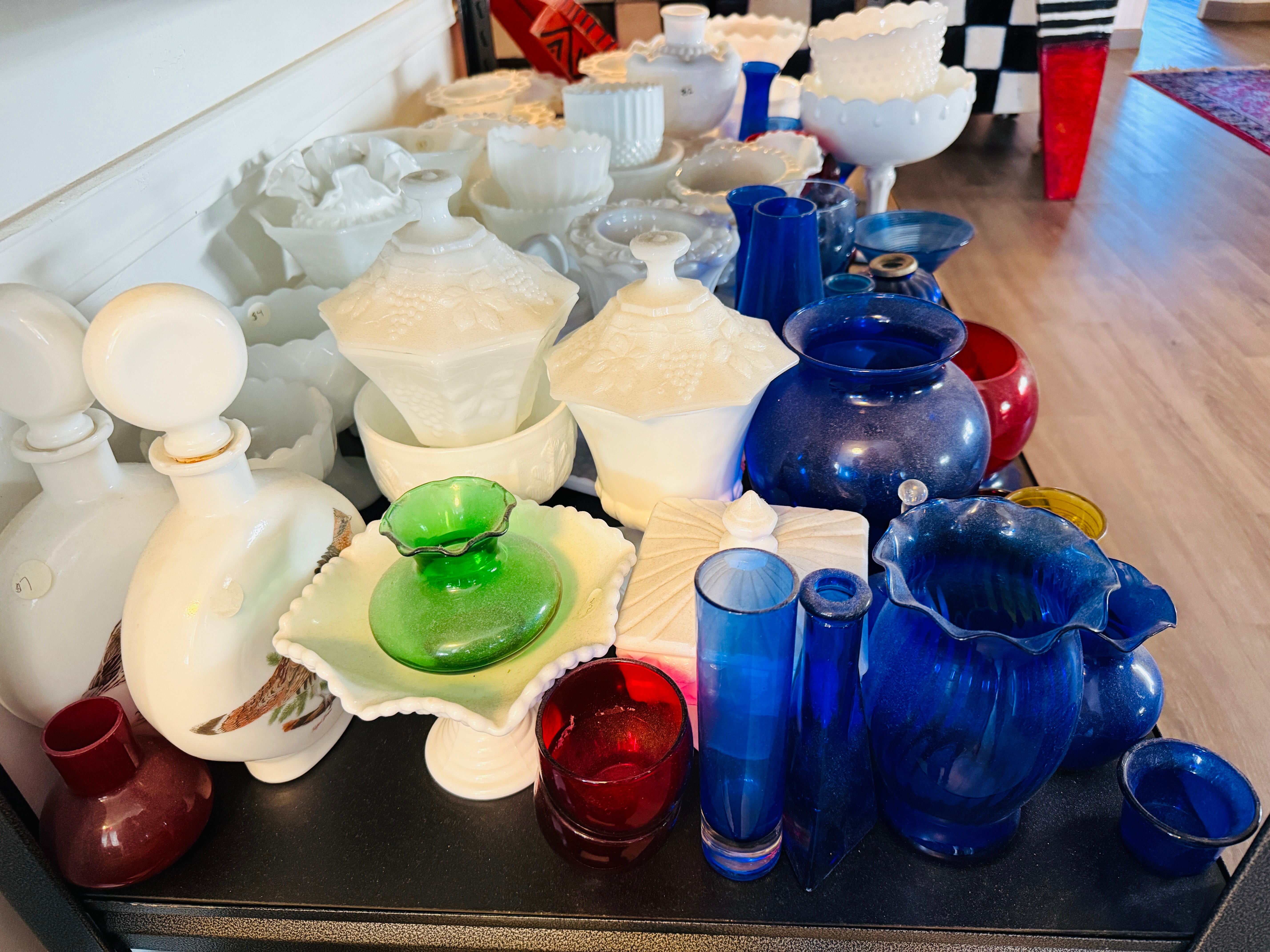
I wish I could say I collect milk glass, but I don’t. I’m the keeper of someone else’s collection—a dead woman’s life work that I rescued from an estate sale almost twenty years ago.
The Blue Woman, as I think of her, lived in a house completely immersed in blue: blue carpet, blue couch, blue curtains. But it was her milk glass that caught my attention—hundreds of white pieces scattered throughout her home, filling a large area with shelves upon shelves. I’d never seen milk glass before that Sunday, but after buying her impossibly comfortable marine-blue couch, I couldn’t stop thinking about those pieces.
Milk glass—also known as opal glass—is an opaque white glass that resembles milk or porcelain. First made in Venice in the 16th century, it became wildly popular during the Victorian era as an affordable alternative to expensive Chinese porcelain that even George and Martha Washington collected. Production waned during the Great Depression but surged after World War II, when companies like Westmoreland, Fenton, Imperial Glass, and Anchor Hocking mass-produced it as wedding and shower gifts during the 1950s and 1960s, its white color symbolizing purity.
When I returned to the estate sale around 3 p.m., near closing time, the collection was still there. The sellers told me about the woman, about her most-prized possession, about all the hours she’d devoted to traveling the country, finding each piece. Something shifted in me. It hurt deeply that her life’s work was being sold separately—each vase, each candy dish priced individually—when she had scoured the earth to bring them together as a family.
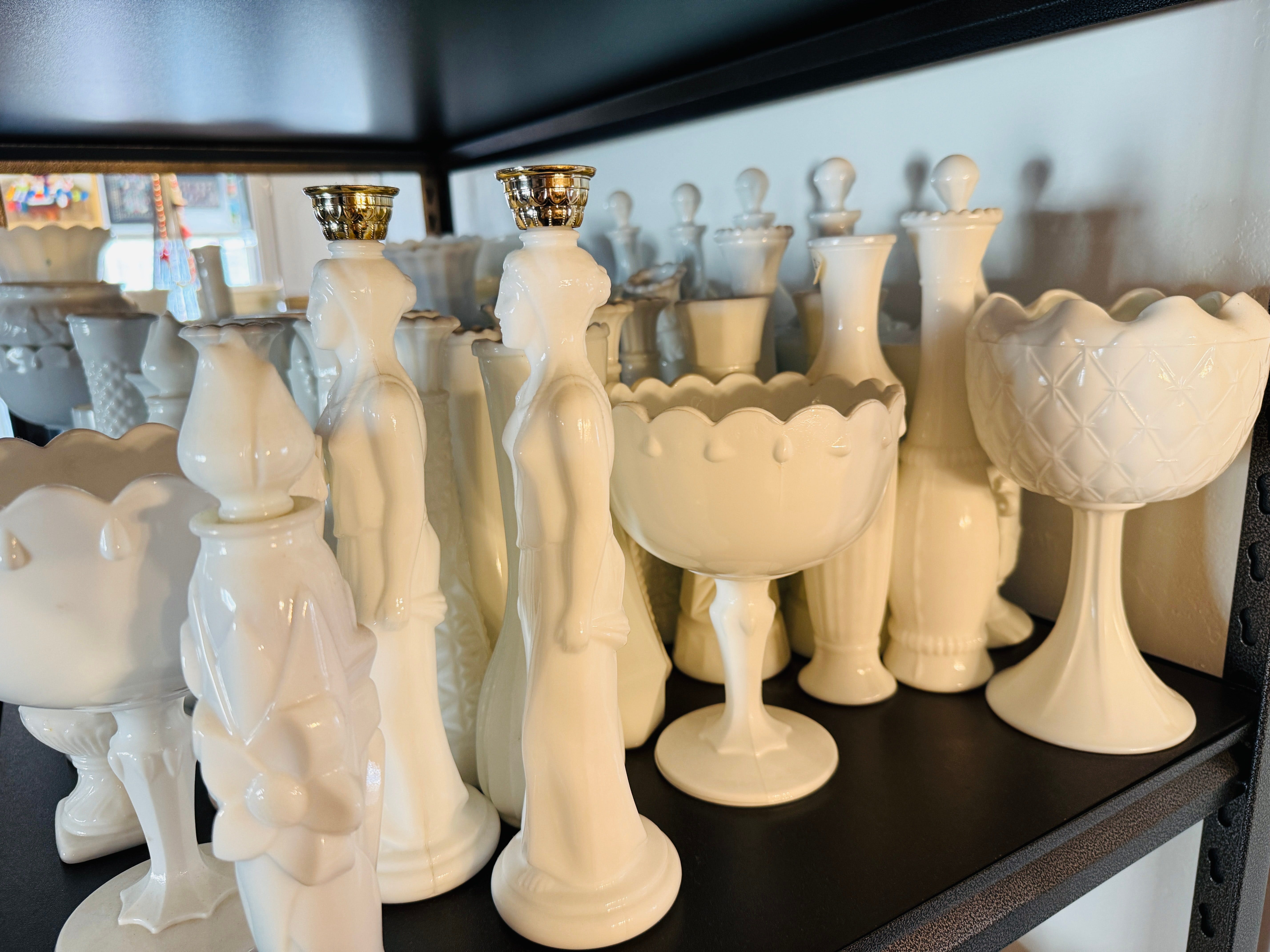
I stood there, studying the shelves. Small bowls with lace edge patterns—intricate, openwork borders. Medium pieces with the raised Paneled Grape pattern, grapevine motifs climbing up their sides. Large sturdy vases. Candy dishes with the hobnail pattern—raised bumps like tiny nails that Fenton introduced in 1939 and became synonymous with milk glass design. Serving platters with scalloped, ruffled edges.
“I’d like to buy every piece of milk glass in the house,” I said. “How much?”
The sellers looked at each other, then back at me.
“Are you sure?” they asked. “It’s a lot. You’ll need a lot of room too.”
I paused. I thought about what I was doing. I didn’t collect milk glass. I’d never even heard of it before. But standing there, I felt connected to this woman I’d never met.
“I’m certain,” I said. “I want everything.”
We negotiated. I didn’t care about the price. I don’t recall how much we settled on, maybe $300, maybe $800, maybe even much more. I just wanted this woman to rest in her grave, knowing her collection went to someone who cares.
I made a promise that day: I would keep the collection together. I vowed to cherish it as the woman had. I vowed to cherish it as the woman had.
I grew up in a Holocaust survivor family. When my family came to America by ship, they came with nothing—no relics, no nostalgic items. I never had anything from my great-grandparents or even my grandparents. I longed to touch things they’d handled, to wear jewelry they once wore, to stab fried potatoes with forks their saliva once touched. My connection to others’ collections goes back to this deep desire for treasures to pass on to my two sons. If I couldn’t inherit them through my family, maybe I could purchase them.
The sellers told me to come back in several hours. They’d need at least that much time to box up the collection. When I returned, I loaded thirty bursting boxes of white and blue milk glass into my Lincoln Navigator, making multiple trips back and forth between the blue house and my car.
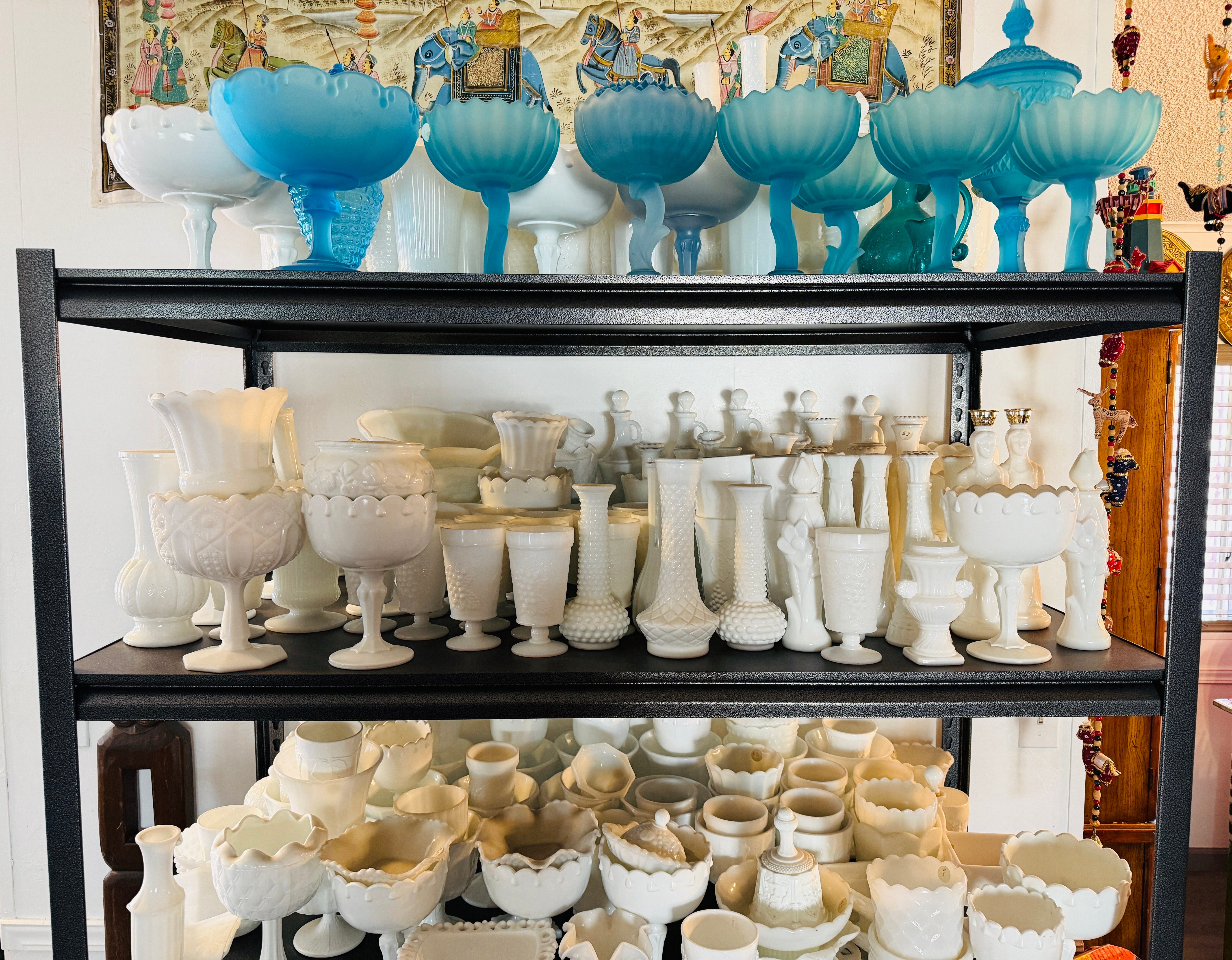
My husband and kids didn’t understand when I arrived home. Milk glass was Americana. We had no connection to this piece of American culture, something so far from our roots. But over several days, I unpacked every piece at my kitchen sink, washing away decades of dust, drying each with a soft cloth, my fingers tracing the hobnail patterns. I carried them individually to my great room and displayed them on red-painted shelves against cathedral ceilings stretching thirty feet high, admiring the shiny white bowls, candy dishes, and wine glasses.
Four years later, I got divorced. I moved into much smaller homes, but I packed, lugged, and unpacked my milk glass collection every time, despite it not fitting and taking up much-needed space. At one point, I even offered the collection on Facebook to a good home, free, of course, but no one responded. When I had unstable housing a few times after my kids were grown, I rented a storage unit to protect the glass rather than abandon it.
Several years ago, I bought a trailer, my first real home since the divorce. I pulled the milk glass from storage and paid movers to bring the heavy boxes to my tiny space. It’s here with me now, not displayed beautifully like it once was on those red shelves, but every piece is still with me. All parts remain one big happy family. No siblings have been separated.
In recent years, I’ve immersed myself in the world of milk glass collectors. I discovered the National Milk Glass Collectors Society and joined several milk glass groups on Facebook where collectors share their finds and knowledge. I plan to attend the Society’s annual convention—maybe not this year, but one year, yes.
Milk glass is my due inheritance, what I should have had from my ancestors if the Holocaust had never happened. I’m fiercely protective of it, as I am of the woman I bought it from. We adopted each other. She adopted me as her milk glass granddaughter, and I adopted her as my American grandmother who could collect.
Dr. Tamara MC (she/her) is a writer published in over 90 outlets, including The New York Times, Newsweek, and HuffPost. The granddaughter of Holocaust survivors, she explores themes of inheritance, loss, and what we choose to keep. She has received fellowships from Bread Loaf and grants from the Arizona Commission on the Arts. Her book Poetry for English Language Learning is forthcoming from University of New Mexico Press (2026). Find her at www.tamaramc.com | @tamaramcphd
Object-ives features flash nonfiction essays of 500-999 words on the possessions we can’t stop thinking about.
Recommended reading on possessions:
“The Last Ornament” by Ciara McElroy, The Keepthings
“Decluttering Advice for Artists” by Jo Blaker, Scribbles in the Sky
“9-year-old Ohio boy collecting hundreds of bears for patients at children’s hospital,” WHIOTV
“Antique Collectors of a Younger Vintage” by Emma Orlow, The New York Times
“‘Like hitting a lotto ticket.’ Why sports memorabilia collectors pursue chase cards,” by Anthony Solorzano, Los Angeles Times

Tamara, this essay and the framing of adopting a family heirloom really moved me. Well done.
I love that you saved another woman's legacy, as well as the connection to your family and the inability to have belongings to pass down due to the Holocaust. Beautiful.