


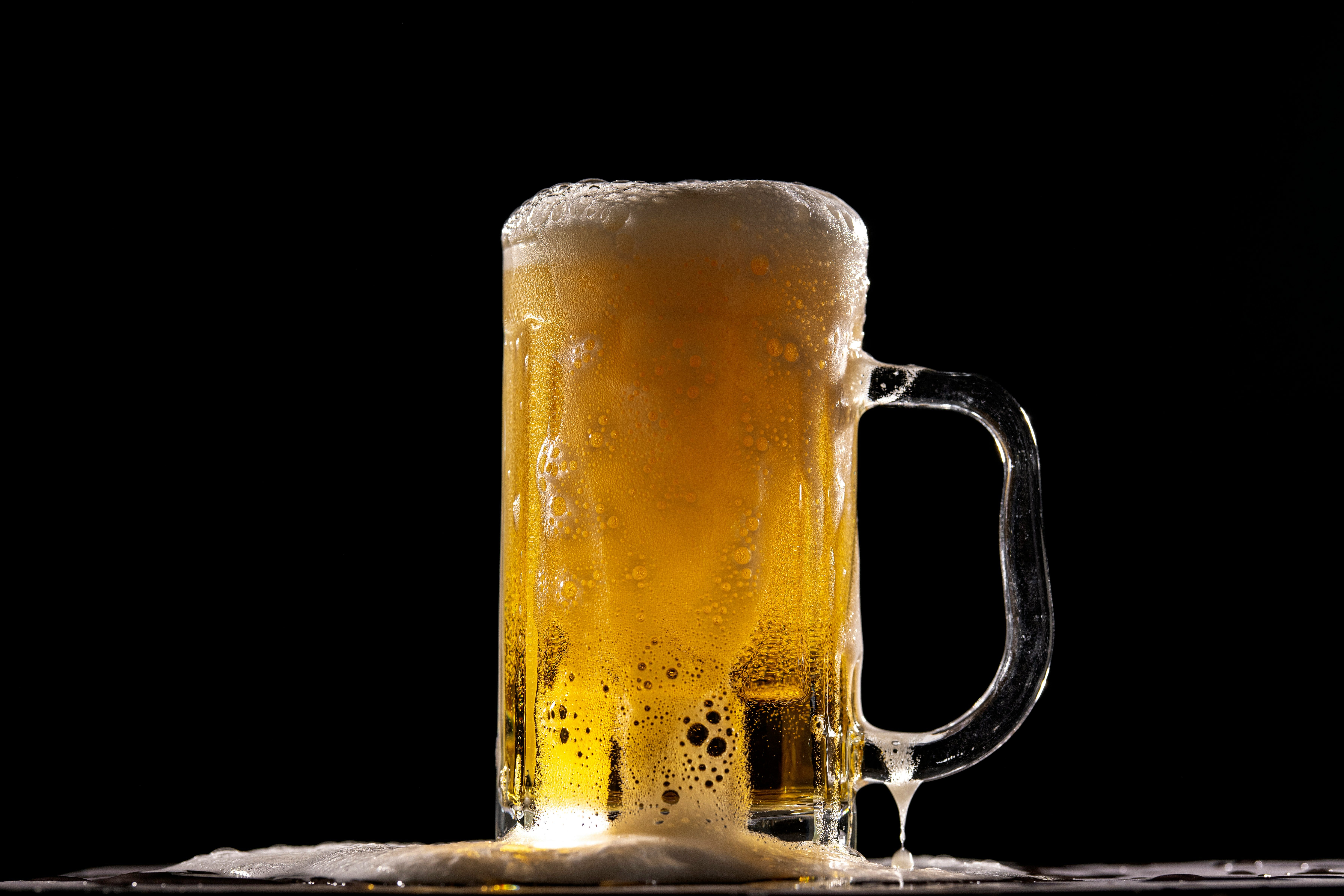
Bill’s first brand that I remember was a Schlitz tallboy. In the time before everyone recycled, the loud cans would roll out of the trash in our kitchen. As a child I assumed the name was onomatopoeic since “Schlitz” sounded a lot like the air escaping a can when it’s popped open. There’d be one dripping with condensation on the table next to my father’s recliner (he always used a coaster) while he watched Perry Mason or read Popular Mechanics. On rare occasions I’d be allowed a taste and would wince when the bitterness touched my tongue.
He’d have beer with dinner or after getting home from his second-shift factory job, noshing on leftovers pulled from the fridge. He had a large frame and a beer belly, which I punched playfully for laughs, and if he was ever drunk, it wasn’t the kind of drunk that you perceive as a threat when you’re a kid. He’d get boisterous, maybe a little rude, at family cookouts. His breath would give off a spongy odor of peanuts and mildew. But there was never any violence—not toward me, not overheard from the other room.
In his fifties, having lived on salty snacks and processed foods, Bill was diagnosed with congestive heart failure. Doctors told him that his only hope was a heart transplant. He was healthy enough in other respects to qualify for the waiting list. So his name went on the list and we waited.
I was in high school then, realizing with some cynicism that I could join the ranks of those radioactive kids who had lost a parent to death. By chance, a young man in Maine who had the same blood type as my father slammed his motorcycle into a tree. Early one morning, a phone call came.
It may have been to deflect from the subject of her own medical needs that, when my father fell ill, my mother became a strict enforcer of the protocol dictating his care. She was in no fine shape herself—a smoker since her teens, she developed arteriosclerosis in her forties. She was already a semi-expert on the medications that Bill would be taking because she took a lot of them, too. The transplant offered my father a second chance at life, one made possible by the grace of fortune and extraordinary medical science; it wasn’t going to be thrown away.
While my father wasn’t about to contradict this sentiment, he was also not allowed any say in how the rules would be applied. Of the new regimen that he had to follow, my mother lasered her focus onto one: absolutely no booze. The anti-rejection meds that my father had to take didn’t require that he do away with beer completely, but if the alcohol contributed to the demise of his first heart, she wasn’t about to let it do the same to his new one.
If Bill wanted to resist, he wasn’t going to find an ally in our household. I was a teenager, my older brother emotionally challenged, and my mother firm in her convictions. He would never convince anyone that the tradeoff of extended life for forfeiture of a vice was not a worthy swap.
A phenomenon that interests me when I see it is how the relationship between a parent and a child realigns once the child becomes an adult. The younger becomes more aware of, and sympathetic to, the elder’s fears and hypocrisies. The elder may come to see the younger as something closer to an equal, less needful of discipline—no managing of curfews—but still wanting of guidance. Some become friends; others carry resentments and grow apart as the younger asserts their will.
When I went to college, my mother became the screen through which news about my father was shared. She accompanied him to doctor’s appointments and gave me the updates; when she handed him the phone, she would lurk close, and he wasn’t left with much to say.
He asked me once, when she was out of earshot, if I drank at school. During Bill’s dry spell, the brands had changed; Schlitz had been acquired by Pabst and became hard to find. Wary of forging a connection, I tried to strike a balance between honesty and distance in my response. The beer at school was discount, watery, guzzled unglamorously, and spilled on carpets while we played asshole or other games that made us drink faster because we weren’t doing it to savor the taste. The campus was pinned between two highways and any city culture was far away. Men and women stumbled over furniture, tried with no subtlety to hook up, and embarrassed themselves when they failed.
His pub was called the Four Winds. In the years before the transplant, after he had gone out for a few hours on a Sunday afternoon, Bill would come back with the Sunday Boston Globe and a bag of Andy Capp’s Hot Fries (for me). My mother, as a matter of investigation, would ask if he ran into anyone he knew. That’s how she’d know he had been at the Winds.
Whether out of pride, denial, or something else, we never described my father’s drinking as alcoholism. As we knew it, alcoholism brought ugly scenes, explosive arguments, injuries, insults, and disgrace. My father’s drinking was a steady mechanism, one that my mother quietly detested and rarely joined him in partaking. (When she drank, her choice was white zinfandel.)
After the transplant, Bill knew there would be questions about any time spent unaccounted for, so there wouldn’t be any more excursions to the Winds. It was then, while home watching TV in our basement, that I heard the pop of a can come from behind the door to his workshop. Later, I poked around and found a case of Budweiser concealed in the bulkhead.
Rather than confront my father, I decided to tell my mother what I had found. I don’t know what good I thought it would do. Perhaps lingering resentments from growing up as a teenager with sick parents led me to choose a path that sought to wound. I had convinced myself that it was my mother who needed support, though I was beginning to question whether her disapproval of Bill’s drinking was entirely due to concerns about his health. She seemed to view it more as an emotional affair, a choice to love his vice more than his family. (Her own health issues didn’t stop her from returning to cigarettes, and her son picking up the habit at college didn’t help.)
She confronted him, letting him know that I was the one who discovered the stash. From my mother’s telling, there were tears and agitation—which was notable, since the only time I had ever seen my father cry was at my grandmother’s funeral.
The beer disappeared, or else it was relocated to a more secret spot. In time I moved away from home, quit smoking, got a job, and met my future wife. My own drinking choices evolved, gravitating first to wine, later to a cocktail before dinner, as though discernment of taste separated me from my father and gave my own habit a legitimacy that his somehow lacked.
I also found at this stage of my life that I wanted to work with words. Writing papers and stories seemed to be the only activity that justified my time at college. Words gave me a weapon to sort through what didn’t make sense. Through the grace of geography and serendipity I settled into a job as a lexicographer, where I wrote entries for dictionaries like the one that our family stored under Bill’s side table, the one on which his Schlitz tallboy stood.
“Harry, how about a quick one?” asks Earl Angstrom to his son on the second page of John Updike’s Rabbit Redux (1971). The men have left their work at a printing plant and are stopping for a drink before heading home. Earl’s drink is a Schlitz; Harry, either out of affectation or that same desire for separation, opts for a daiquiri. Earl gives updates about Harry’s mother, who has Parkinson’s, and broaches the subject that Harry’s wife may be having an affair.
My eye pauses at such scenes and how the parent-adult child companionship is treated. “Working together ten years,” Updike writes, “they have grown into the love they would have had in Harry’s childhood, had not his mother loomed so large between them.”
My mother loomed large between my father and me, but our relationship was also hamstrung by the lack of a common interest. We didn’t fish or play golf. We didn’t mess around with cars. Bill wasn’t a sports fan, and he never learned about the internet. (I never showed my parents the internet.) I put my energies into reading, writing, and making art; Bill puttered around his basement workshop, tinkered with small woodworking projects, and volunteered at the food pantry. We didn’t have a third space when we could talk about things in confidence, whether as men, adults, or people looking for an escape. Neither of us sought one.
At some point, the adult child sees what the elder does not, or at least what they won’t acknowledge. While my father was full of grace for his extended life, I could tell that he felt babied by my mother, treated like a project, and diminished. But even with maturing insight I couldn’t bring myself to try to alter that dynamic even as I wised up to its contradictions.
I never questioned my mother’s approach, which was guided by her own deep fear of mortality and being alone but granted no mercy for my father’s agency. I didn’t question then what I think about now, in retrospect, something that I suspect more people my age ask themselves as they take on eldercare: How much value is there in protecting someone’s health for the sake of being alive, versus that of enjoying life and all of the thrills and dangers it affords?
Another parent-child bonding-over-a-drink scene occurs in Dorothy Baker’s Cassandra at the Wedding (1962), when the title character, a Berkeley grad student, returns home for the title event (for her twin sister). Cassandra sits at the kitchen bar in her family home while her father fixes her an adult beverage. The circumstances in this one don’t align as well with my scenario, but I’m still drawn to it, perhaps because Cassandra savors the moment as it occurs:
“Lovely,” I said, and it did seem lovely, suddenly, the whole idea, getting here, being in this house where I knew everything so well, the wastebaskets and the paintings and the herringbone wood on the ceiling; my sister out there breaking her lungs in the pool waiting for me, and me inside about to have a drink with our father.
The drink is a brandy and soda—“a civilized choice,” Cassandra’s father remarks, because it’s what he’s drinking, too. He’s a retired professor of philosophy, and the banter they share is witty and erudite—adults genuinely glad to be in each other’s company, not so concerned with the push and pull that often occurs between generations. (The push and pull occurs in an extreme way later in the novel when Cassandra attempts suicide in her childhood bedroom.)
After I moved away, visiting home rarely presented such chill moments. My mother’s anxiety set the tone. Pill bottles and medical literature cluttered the space. I’d get reports about Bill’s appointments and lab results, which depressed me even when the news was positive. We’d go out for dinner in a chain restaurant, and I’d labor to steer the conversation toward any subject other than aging and illness. I’d order a Blue Moon or a Sam Adams and not think about what import that held for Bill, left to be content with an iced tea or ginger ale.
For some reason, not upsetting my mother took precedence over allowing my father just a little slack. In the initial years after the transplant, this might have been sensible. (Transplanted hearts, at least in the nineties, tended to give out early or chug on for a while.) But as he got older, our family clung to a custom that was less about protecting Bill and more about protecting expectations. To disrupt that custom would mean breaking a code. As the son who saw what his parents did not, I couldn’t muster the will to be the disruptor.
On one occasion, I brought my partner home and our family—a party of six comprising my parents, my partner, my brother, his fiancée, and myself—went out to dinner at a slightly more upscale restaurant, what passed as fancy but not challenging with its menu. In the hum of the dining room, with the waitress standing over us, Dad asked if he could have a beer. It wasn’t clear which one of us he was asking. I watched my mother pause. Then, before she could answer, I said out loud across the table, “Have a beer.”
He ordered the same as me, one of the higher-end craft brews that had entered the market. We watched as he took the first sip. Then we went back to our menus and talked about other things.
But we never got to have one together, just Bill and me.
The biggest thrill near the end of Bill’s life was when, in spite of his declining health, he and my mother drove across the state to see our house. My wife and I bought it the year before he died. Like a true dad, he was very interested in the integrity of the structure down to the pipes and wiring, and he ran down some homeowner’s tips, like knowing where to find the shutoffs to the outdoor taps so the pipes don’t freeze over winter. I think of him when I turn them on and off every year.
I don’t see my hometown much anymore, but on one occasion I thought about peeking into the Four Winds to see if any echo of Bill remained there—say, a wall gallery of past generations of regulars. But the business has changed hands and been remodeled since Bill’s time, now more of a lunch spot than a watering hole.
Had I lived closer, and had I the nerve to take charge, I might have blocked out time for us to slip away for an afternoon draft, father and son. I would’ve asked Bill if he wanted to go back to the Four Winds or try out somewhere new. We’d talk about small things, maybe discover we did have a common interest, one that had been there the whole time.

Neil Serven’s stories and essays have appeared in Washington Square, Post Road, The Pinch, Monkeybicycle, Ploughshares online, Greensboro Review, and the Cincinnati Review’s MiCRo series. He lives in Greenfield, Massachusetts.

My mom also had heart failure and then a transplant (also from a motorist). She didn’t drink but the babying and child becoming the parent and the parent wanting to remain the parent is so beautifully described and resonated deeply with me. Thank you for writing.
It's so easy to have regret when looking back at one's life with one's parents. I remember having anticipatory regret when mine were still alive! You write beautifully here of the continuous negotiation between one's own developing identity, and the concern for both your father and your mother as they aged.