


“I’m sorry you have to demean yourself like that,” she said.
It was 2020 and I was working as a cashier in a supermarket in Utah. For almost 20 years, I had been a college teacher and organizer in New York City, while this acquaintance had been a journalist. A run of bad luck and worse timing had sent me to the unemployment line and then to the supermarket to make ends meet. When my acquaintance found out that I was working in a store, she was appalled. “The American dream is dead,” she said, trying to console me.
The comment rankled. “Demeaning” was not a word that I would have used to describe my situation. Would I have preferred to be working somewhere else? Sure. I spent my days off from the supermarket trying to forge a path back to the world of desks and laptops and not having to ask permission to take a couple of hours off to run an errand. The journalist was saying that working in food retail was demeaning to me in particular because I deserved better. I had drawn a different conclusion from my story. But it wasn’t until my acquaintance’s comment that I realized what it was.
I saw things differently in part because of my background. In the small Idaho town where I grew up, you might aspire to be a schoolteacher, a nurse, or a small business owner, but there was nothing demeaning about working in a supermarket. In middle school, my best friend’s mom was a cashier. I never once considered that I ought to judge her, much less feel sorry for her. Almost everyone I knew did hardscrabble work that kept the community afloat. My grandfather installed tile roofs on houses, my mom taught junior high school English, and my dad had mopped floors in a grocery store before cashing in his GI Bill, getting a degree, and becoming a school librarian. There was no way I was going to feel sorry for myself for working in a supermarket.
My acquaintance’s comment troubled me because she wasn’t defending the dignity of retail workers. She was saying that such jobs were beneath people like “us.”
That’s not the only reason her words stayed with me. I had to admit that she wasn’t entirely wrong. Retail work was demeaning. My colleagues and I earned shamefully low wages, under $15 an hour the year that I was on the job. Signs of food insecurity were impossible to miss. One cashier came through my checkout line on his lunch break to buy a burrito, but his credit card declined. “I guess I can’t eat today,” he said. The 79-year-old who couldn’t afford to retire, and had budgeted herself only two dollars a day for lunch. One long-time cashier waited a few minutes after his shift had ended to clock out, boosting his pay by as much as ten dollars a week. “That’s at least two meals,” he told me.
My coworkers were hardly alone. A 2022 report showed that three-quarters of employees at Kroger, the second-largest grocery company, didn’t get enough to eat. One out of seven workers said they relied on food aid programs. As the journalist Errol Schweizer wrote, “To be food insecure and to work in grocery stores is quite normal in America.” Workers go hungry while retailers are flush with cash. Between 2019-2024, 100 low-wage companies spent over half a trillion dollars on stock buybacks. If struggling to keep food on the table while your employer is shoveling money to shareholders isn’t “demeaning,” then I don’t know what is.
Another retail industry indignity is lack of access to healthcare. One cashier at my store had a painful toothache that she couldn’t afford to treat. For a while, she ate ice cream for dinner while waiting for a spot to open up at a free clinic. An employee in his sixties who’d had a stroke and had to spend months recovering at home lost his company health insurance. One day, he came into the store with his arm in a sling. He told me that he was racking up medical debt. “If I can’t come back to the job soon,” he said, “I might as well be dead.” Another cashier had a back injury from a prior job as a home health aide. Standing behind her register for hours was so agonizing that she grunted and winced through every transaction. The situation was demeaning for her and sometimes for her customers who felt ignored and mistreated by a surly cashier. Supermarket work was as bad as my acquaintance had implied, just not in the way she had meant it.
Her dismay at my situation also forced me to reflect on my own attitudes and desires. Despite my admiration for the people I grew up with, I’d never intended to be one of them. I spent my adolescence and young adulthood plotting my escape like an Idaho Andy Dufresne digging a tunnel from his cell to the outside. I resisted my religious community’s conservative expectations for women. While no one would have judged me for working in a supermarket, failing to become a traditional homemaker came with a level of social opprobrium that I couldn’t bear. Before I had the language for it, I wanted to be what the writer Barbara Ehrenreich called a “salaried mental worker,” perhaps a lawyer or a professor. Mostly, I wanted to see the world, read and write, and wear business casual instead of a nametag and a smock.
After college, I maxed out some credit cards and moved to New York City where I assumed “salaried mental worker” jobs were as plentiful as the lightbulbs in Times Square. The first years were a grind. I waited tables and struggled to make rent. From the wrong part of the country and with no connections, I didn’t have much to go on. It didn’t help that people who drove across the George Washington Bridge with a suitcase and a dream were a dime a dozen.
What I did have in spades was a near religious belief in education as a path to upward mobility. That was another legacy of my hometown, where a college degree was widely assumed to be a ticket to the upper middle class. A bachelor’s may have failed to catapult me into a salaried job. But a Ph.D. would surely do the trick. Mostly unaware of the distinction between the Ivy Leagues, private universities, and public colleges, I enrolled in the English department at the public City University of New York. Along the way, I taught composition classes to earn money. Student loans filled the gap. I was in debt, but it felt like a step up from waiting tables.
I graduated in the aftermath of a meltdown in the home mortgage market, which led to a global financial crisis. Academic positions had never been plentiful but by 2010, they had dried up. After a grueling three-year search for a professorship, I turned to gig labor. In addition to teaching, I temped as an administrative assistant for lawyers and financiers. I didn’t know then that I had entered into a period of “pink collar” work that would lead me to the service industry.
Around 2012, I turned to activism in part to distract myself from my bleak employment prospects and from the student loan bills that were coming due. I cofounded a union for people in debt. The Debt Collective helped for-profit college students lobby the government and creditors for loan relief. (Our efforts paid off. By 2022, billions of dollars in loans were cancelled.) We also lobbied for polices that would end student debt for good, such as free public college and mass loan cancellation. For a few years, I earned a decent salary. I thought I had dodged a bullet. I had made my own job, following an entrepreneurial ethic that said hard work pays off.
Reader, it did not pay off. It was difficult to impossible to raise money for the organization. Once the philanthropic spigot ran dry, I knew that I had come to the end of the road. In 2020, I moved to Utah to be near family and to make a new start in middle age. But few employers were hiring during the pandemic. I sent resumé after resumé into the void, rarely hearing even a “thanks but no thanks” from the schools and city agencies where I’d applied.
One day, I was shopping at a chain supermarket a few blocks from my apartment when the old blue collar work ethic kicked in. The store employed dozens of people who punched a clock so that their neighbors could buy groceries during a public health emergency. Why shouldn’t I join them? Sure, I would have preferred a job that paid more and didn’t put me at risk of having my breath choked off by a virus. But wouldn’t everyone?
By the time I quit the job 13 months later, I was so determined to share what I had learned that I wrote a book. My store had been far more than just a place to buy groceries. It was a community institution where people accessed resources of all kinds. Customers logged into the Wi-Fi network while waiting in line, or they plugged their phones into outlets while using the restroom. Some left their bicycles near the checkout counters while they browsed the aisles, knowing that employees would keep an eye out. Locals moving out of their apartments came to the store in search of boxes. A Girl Scout troop sold cookies in the lobby.
I was also surprised to learn that customer service could be a genuine pleasure. One shopper stopped me in the aisle to ask which brand of granola to get from the dozen on display. I whispered, like I was sharing a secret, “You don’t want any of these brands.” At the bakery, I handed him a box of house-made granola. “This is the good stuff,” I said. The customer whispered back to me, sharing in the secret: “Thanks for the tip.” We laughed like old friends.
Staffers aided people with physical limitations, assuring that they could shop like anyone else. My colleagues and I accompanied customers in wheelchairs through the aisles, helping them reach items on high shelves. One day, an elderly woman became disoriented at the register. “I can’t find the exit,” she said. The customer lived in an apartment building two blocks away. She gripped my arm as I walked her to the door. “It’s terrible to be 92 and half blind,” she said. I complimented her for shopping without assistance and made sure she made it home.
This was the world of hard, underpaid labor mixed with friendliness and even compassion that I was immersed in when my acquaintance said she was sorry for me. I didn’t want her pity because I knew that there was nothing inherently demeaning about working in a supermarket. Employers had made it that way to enrich themselves at our expense. Cashiering let me in on the secret that cashiering is an important job in society, even if society doesn’t know it.


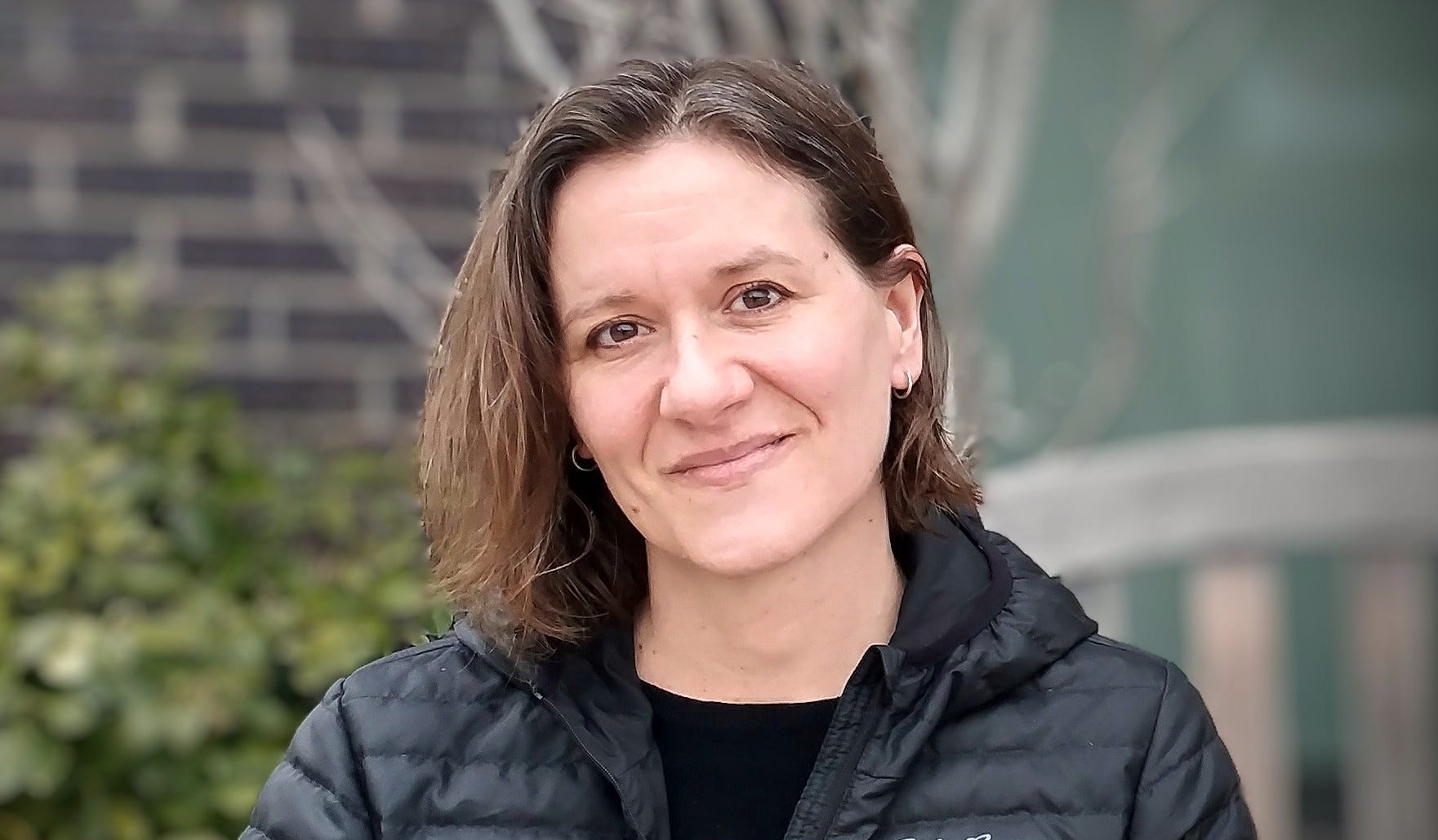
Ann Larson is the author of the memoir Cleanup on Aisle Five: Essential Work, Poverty Wages, and the View from Behind the Supermarket Register, a cofounder of the Debt Collective, and a fellow with the Economic Hardship Reporting Project. Ann’s writing on education, debt, and low-wage work has appeared in The New Republic, The Chronicle of Higher Education, Fast Company, and The Nation, among other publications.

Thank you, Ann. I hope your published book opens doors for more working class people who are interested in writing (like me!). Your experience reminded me of being raised my an immigrant parent, and the culture of Hawaii, where, when they ask, "Where did you graduate?" they mean high school, not college, where holding a job, no matter what it is, is not judged as demeaning.
To be honest, I love the idea of working at a grocery store because you must get discounts, right? But the brutality of being overeducated and underpaid is what the American dream has turned into.
Ann - I bristled before starting your piece and I immediately went into preemptive defensive mode.
Instead, I loved it. Your writing has the warmth of someone you’d want to be friends with. (I just pre-ordered your book. Looking forward to it!)