


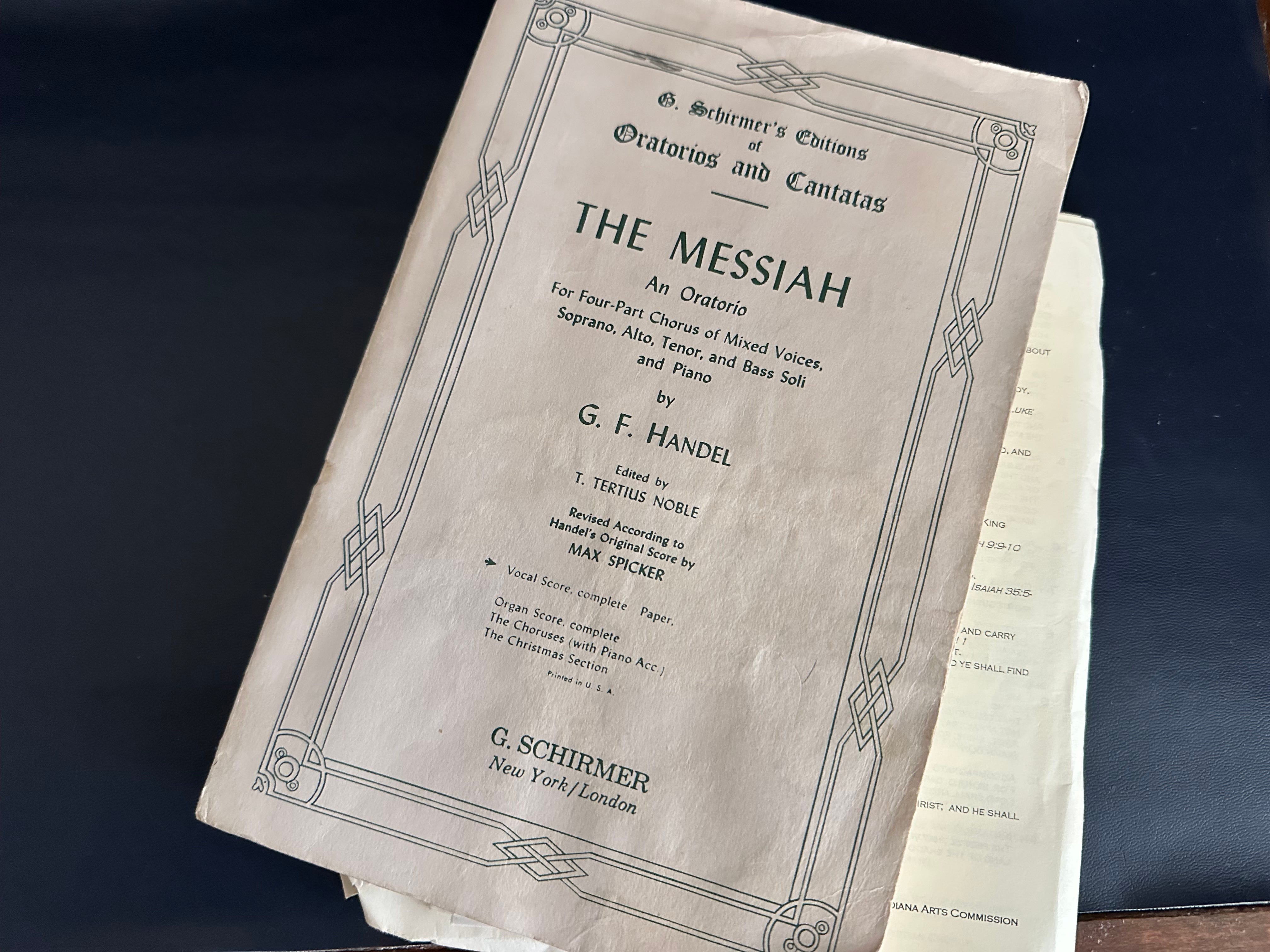
I was in college when my roommate and I discovered something called the Sing-Along Messiah. The idea is simple: George Frederic Handel wrote an English language oratorio called The Messiah, which has a very famous and very beautiful chorus called the Hallelujah Chorus. This uplifting chorus is one among many in the musical work, and churches and choirs around the country had begun inviting any old body—regardless of singing ability—to join in the beautiful choral singing. Whether you are a believer or not, the music transcended the time in which it was written. We thrilled at joining in this beloved piece of music, trying to trill our voices up and down the octaves as we sang with the rest of the audience: forever and ever, hallelujah, hallelujah!
We sent away for free tickets (back then there was no internet so no way to order online; you had to write a letter to get a ticket) and were giddy with excitement when we got them in the mail. The event always sold out, and we had missed getting tickets the year before. The sing-along took place in a local church that had hired professional singers to sing the solos and would rely on people like us for the choral parts.
Roomie and I didn’t really know what we were doing that first time, but we did buy scores that were available for sale in the lobby. I paid $20 for my copy which was a lot of money for a college student in the eighties. We decided we were altos and stood together at the back of the church tentatively singing and trying to follow the complicated measures. My memory is that she was better at reading the music and keeping in tune than I ever was, but thankfully, no one called anyone out for getting lost or singing off-key. That night, we may have tip-toed over to the soprano section depending on which part we liked better.
The singing exhilarated us, and for the few years we lived in that city, we made it an annual event. Singing along to the oratorio gave us great joy and remained a bond between us. I would often stick the program from the evening into my score book, or maybe the sacred ticket to the event, or a Christmas card that had come in the mail that day. There’s an envelope tucked in there with our old street address on it.
That roommate and I, sadly, parted ways. I sometimes feel embarrassed for not keeping in touch or understanding how to mitigate growing unease with each other. Had the friendship continued I have no doubt she would be a profound part of my current life, each championing the other through the milestones and heartbreak as we had started to in the nascent days of our relationship in that shared dorm room. As Yeats said in his famous poem, the center cannot not hold, and so it was for our closeness.
But even though the friendship ended, I kept the music. It has moved everywhere with me. The town I ended up settling in holds a sing-along Messiah every year with no tickets needed. I simply show up in the appointed place with my score and a donation for the local food bank.
I’ve kept all the mementos placed into the pages of my score book, using it almost like a scrapbook. When I sit in the pews, embedded in the alto section—always around people who really know how to sing—I love to look through the ephemera I’ve collected. I remember my old roommate, standing with me at the doors of that church, tentatively trying to figure out where we fit in, joyously, awkwardly singing that famous chorus. Leaving the church together arm in arm, lightheaded from singing sacred music, wrapped in cold winter weather, and maybe even a little holiday spirit.
I wonder if she too has kept her Messiah score and if she uses it as a portal back in time to visit me in the doorway of that church, rolling her eyes at my inability to match pitches with the alto section, letting the music surround us in its ancient tradition. I treasure that book of music. I keep careful track of it, and the moment I pull it off the shelf every year to prepare to sing is almost as holy to me as the singing itself. I hope somewhere my old roomie is singing as well, perhaps, remembering me.
Amy L Cornell lives in Bloomington, Indiana. She is chair of the board of a local non-profit arts organization called Women Writing for a Change where she leads writing circles for marginalized communities. She has long been fascinated by the role of objects and stuff in writing. She is not a hoarder, but her husband might disagree.
Object-ives features flash nonfiction essays of 500-999 words on the possessions we can’t stop thinking about.
Recommended reading about possessions:
“How I Downsized My Entire Home Office Into a Single Box” by Shira Gill, The Life Edit
“The Objects I Reach For Every Single Day” by Sara Catharine Daniels, The Well-Lived Collective
“Objects from Seoul” by Studio Letters.
“Listening to Everyday Objects” by Jennifer Berney, The Scrap Heap
“I Am So Bad at Interior Decoration” by Em Seely-Katz, Esque
“The Pokémon Store That I Work At Was Robbed At Gunpoint. Something Incredible Happened After The Thieves Fled.” by Peter Du, HuffPost Personal

I hear you. I really do.
Your story feels like standing in a doorway that only memory can open. The way you described the score tucked with old programs and envelopes… that hit me. That’s love that didn’t disappear, it just changed shape. Some friendships don’t end loudly—they fade gently, and that can hurt in a deeper, more confusing way. There’s nothing to be embarrassed about. We do the best we can with the emotional tools we have at the time.
What you kept wasn’t just music, it was her, and who you were together. The awkward singing, the quiet understanding, the shared joy—those moments mattered. They still matter. And I think it’s beautiful that the ritual remains, that every year you show up with your score and your offering, carrying both gratitude and grief in the same hands.
I love imagining her somewhere too, maybe opening her own worn copy, smiling at the memory of you, of that cold night, of the way the music wrapped you both up. Some bonds don’t need contact to remain real. They live in remembrance, in ritual, in song.
This was written from the heart. And it landed there.
Thank you so much for the mention - this was a wonderful read x