


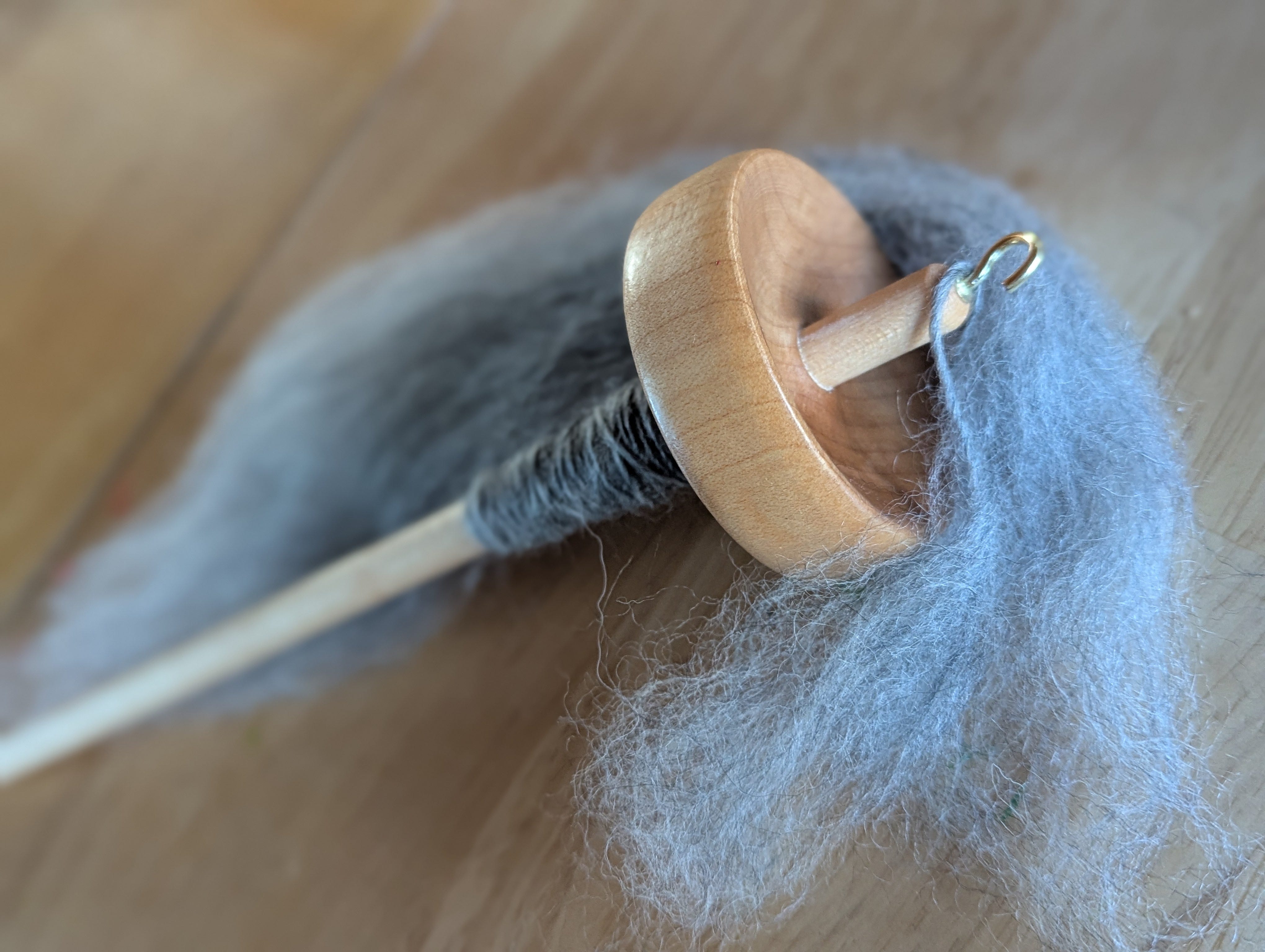
Yarn is the common thread woven through all phases of my creative life. If it involves some form of string, I’ve probably explored it. Yet handspinning yarn is the hobby that lifts the most eyebrows and generates the most bewilderment over the time and effort involved. If you’re a person who wonders “Why would you spend hours knitting socks when you can buy a pack at Wal-mart for $5?” then I fear the economics of spinning one’s own yarn may shock you.
Very few get into fiber arts to save money. It can be done thriftily: using cheaper acrylic yarn, repurposing sweaters from yard sales, or selling finished items to support a yarn-buying habit. But the makers I know are in it for the beauty. We value the unique, the slow craft, the hand-dyed, and the precision with which we can make our visions come to life. Many of us have acquired a taste for ethically-made, long-lasting clothing. I could never afford (let alone find) a gold and green plus-sized cardigan in a Merino-cashmere blend from a retailer; but I have made one out of $280 and 18 months of intermittent effort, and I feel that value every time I wear it.
The allure of making one’s own yarn is harder to explain, even to dedicated crafters, since a braid of hand-painted fiber is not much cheaper than a skein of yarn, and making the yarn adds considerable time to the process. So, if neither time nor money are saved, why do we spin? For me, it’s because the act of making yarn is a bit of modern magic. You take a handful of fluff, mix it with physics at the tip of a spinning wand, and create something new out of nothing in an instant. Ta-da!
I could watch loose fibers twist themselves into orderly strands of yarn forever. The movements are so simple that pre-industrial era children as young as five years old were responsible for an entire household’s spinning needs. Using a spindle, it’s a portable form of relaxation and productivity. If you’re a neurodivergent dopamine-seeker like me, it’s a pleasant visual and tactile stim, with bonus yarn at the end! And it’s just one more avenue for creative expression and control over producing the exact garment you envision.
But I have a secret: For all that I love to spin, I haven’t finished very many handspun garments. It takes a long time to create something from nothing, and in my 16 years of spinning, I’ve completed only five projects from fiber to finished object. I’ve spun and knitted one hat, two cowls, one pair of mittens, and one shawl. This doesn’t sound like much, especially when compared to the ~260 projects I’ve knit or crocheted with commercial yarn over the years, but I treasure each handspun item more than any of the rest.
When I hold a handspun piece, I remember its origin, the feel and color of the wool as it flashed through my fingers, the specific way the fibers twisted into thread, the sometimes surprising characteristics of the finished skein after plying and washing, and the delicious energy it had during knitting that only handspun yarns possess. Each piece is a tactile reminder of when and where I was while I spun it, the stresses it soothed, and the pleasures it provided.
I started spinning while earning my Master of Science in natural resources management during graduate school. After hours of research stuck at a desk, I craved a creative outlet, and knitting just wasn’t cutting it anymore. I needed the excitement of learning a new skill, but it also had to be simple enough to calm my burnt-out brain. I needed a reason to get away from my desk and back into my body, which spinning does as well. So I watched a few videos, bought a spindle and the wrong type of fiber, and spun my first terrifyingly lumpy yarn—but I was nonetheless entranced because I had made it myself and that was amazing.
I dove into books about fiber and its sources, tried new techniques, and leveled up. I collected spindles and a couple of wheels. I spun as much as I could, through heartbreak and triumph and exhaustion and fear. Spinning was the perfect tangible demonstration of how small, stolen bits of time and effort added up to big accomplishments, something that I needed to see during grad school and afterward when I was planning a wedding, getting married, and struggling through my first pregnancy.
Soon, I was too busy and burnt out even for spinning. My toddler wouldn’t stay out of the spinning wheel and I couldn’t find a moment for myself. My spindles were bundled into pretty wooden bouquets and stuck in vases on the shelf. My rainbow of unspun fiber was stashed away. I focused on healing, working, mothering, and mending a marriage that was past its honeymoon phase. I got pregnant again, had my second son at the start of the first COVID lockdown, and life continued to spin out around me. I lost loved ones, had career shifts, and felt like all my energy went toward holding things together. For a while I became the spindle, and my efforts were the force that twisted a good life out of desperate handfuls of unruly time and raw materials.
Eventually, when my kids got older and home life became more manageable, global life became more stressful…so I picked up spinning again. This time around, I needed its grounding force. In the face of unending environmental and political horrors, I ached to make something beautiful. I savor the facts that my handspinning hobby is off the grid, that the resources I spend on it support women-owned small businesses, and that the items I make will outlast whatever happens during this shitshow of a political era. I want my children’s children’s children to be able to hold what I’ve made and know that hours of my energy were poured into it. I want them to know that when society seemed bent on destruction and things really sucked, some of us still made things. We makers create our own joy, beauty, and function out of nothing, and that is absolutely worth something.

Alicia Morandi is a biologist, environmental consultant, and mother of two from Rhode Island who writes poetry and essays during the midnight hours. She likes to spin yarn, knit, crochet, and play ukelele during stolen moments. She posts on Substack at unmask & make and Instagram @amorandimakes.

I spin too!!! I am a neurologist with a love for fiber arts. I learned to knit when I was in college from my roommate. when my kids were little I picked up knitting again. I ended up going to a weekend retreat instructing on dying yarn with natural products collected in the woods. There were several people at the retreat that had spinning wheels or hand spindles. I was fascinated. by the end of the weekend I had learned to spin with a drop spindle. Within a month I had purchased a spinning wheel off of eBay. I, like you find it relaxing and love that you are creating something from virtually nothing. Since then, I have acquired friends, including one local alpaca farmer, who provide fiber. When my girls were old enough, they also learned to spin. My older daughter also found it very therapeutic. I once taught a classroom of third graders how to spin. We made our own drop spindles using a dowel and a weighted disc, purchased from a local craft store. Thank you so much for sharing your love for spinning. It warms my heart!
I was thinking as I read that whatever we make - an essay, a sweater, a cucumber, takes time and the making is probably more important that anything else for the sanity of some of us!