

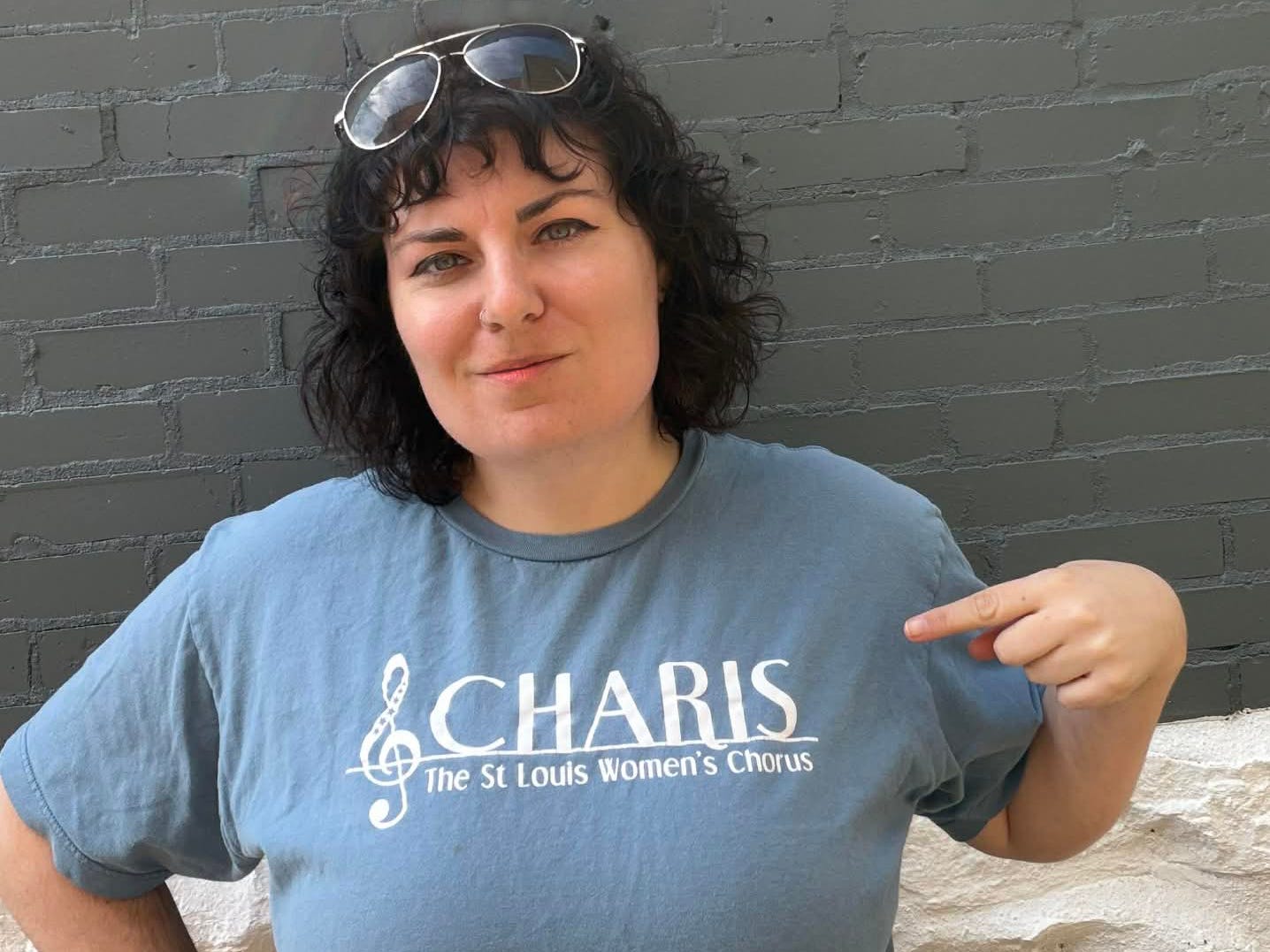
On my first day joining the queer chorus CHARIS, my rib was broken from playing roller derby, I was diving headfirst into divorce litigation, and I couldn’t reliably tell the difference between a quarter note and a half. The last time I’d interacted with sheet music was sixth-grade choir, when my teacher suggested I quit because she could hear how out of tune I was no matter where I tried to hide in our warmup circle. Walking into the first rehearsal at age 30, I knew that I craved a deep connection, but I didn’t realize what I was in for.
I’m perceptive enough by this point in my life to notice a persistent pattern I’ve established, which is joining things for which I have absolutely no skill. I have always loved learning, loved being in training, a student, a mentee. When I joined roller derby in my early twenties, I had no prior knowledge of roller skating, weaving, spinning, or hitting, but I was familiar with the competition structure based on my years of competitive swimming. Though I wasn’t a beginner in writing when I started my creative nonfiction MFA, higher education often felt like a completely unfamiliar subculture. It wasn’t the world I came from. Grad school in particular was utterly mysterious to me. Still, I imposed the team mentality on my small cohort when I felt camaraderie between us because I had the language for it. I told one visiting writer at a private conference, “I don’t know how to be a person without a team.” She said I needed to explore that on the page.
After grad school, when college swimming was a distant memory and my time in derby was wrapping up, I started performing drag. There were many reasons I was drawn to the artform, such as realizing it was a way to find a new kind of team: one where I wouldn’t risk another concussion or breaking another bone. I couldn’t dance. I had no inherent talent in costume makeup—not without a lot of help initially. But I understood what it meant to compete. The same went for pageants, where contestants vied for titles by participating in categories like talent and formal wear. I learned from my mentor, previous title winners, and the King of Pride at the gay bar. My mentor reiterated at the end of every show as she announced the weekly winners, “Take what you need, and leave the rest,” which was an important reminder, along with a little push to splurge on the no-budge mascara. “My God, you’re worth it.” I had my coach, I knew the game, and I was surrounded by my team.
The first time I heard CHARIS sing was at a queer event at the Missouri History Museum where I was reading from the manuscript that would become my book, Drag Thing: A Memoir of Mania and Mirrors. CHARIS was advertised as “a diverse group of women united in our mission to perform music that celebrates and encourages women and the LGBTQ community.” They performed several songs, including “Unwritten” by Natasha Bedingfield. I was close enough to the performers to see their faces. There was a butch singer in the front with rolled-up sleeves showing off her shoulder tattoos, boogying to the campy choreography. There was a younger person with pigtails clapping to the rhythm. There were septum rings and gray hair. Diamond rings and cheap plastic jewelry. It was as if The Breakfast Club and Glee had a baby.
As I watched the choir sing, I felt fully present, but I was also being wrenched back in time. I could practically feel the heat in the back seat of my mother’s Ford Festiva en route to a 12-and-under swimming competition where I had my eyes set on a 200-freestyle record and insisted on playing “Unwritten” on repeat until we arrived. I had the same feeling in that Ford Festiva before diving into the pool as I had on the side of the stage watching CHARIS for the first time: I was about to make something amazing happen.
Showing up on the first day of rehearsal, I bypassed the choir director, who was sitting at the piano doing voice classification tests to check singers’ ranges and just plopped down in the Alto II section. I had no idea if I was a soprano or an alto, but instinct told me I could hit the low notes. One of the alto singers had a bearded dragon on her shoulder and I wanted to hold it. Also, the alto II chairs were set up closest to the door, so I figured it would be convenient to escape if I realized I’d made a huge mistake. No one was about to convince me to sing by myself in front of the choir director. It didn’t even help that she was wearing a Bikini Kill crewneck and yellow-tinted John Lennon glasses and we looked like we could run in the same queer circles. I was so used to lip-synching I didn’t know what would happen if I tried to emit sound. I hadn’t received any feedback on my voice since I was a kid, except for the time I got carried away performing a drag number to Melissa Etheridge’s “I'm the Only One.” I won the whole show that night, which made me feel fierce until my friend whispered she could hear me over Etheridge when I leaned in to accept her tip.
At CHARIS we were working toward a nature and environmentalism-themed show called “Wild,” with choral arrangements that were new to me and some songs I did know, like, “Lovely Day,” by Bill Withers and Skip Scarborough, “Pocketful of Sunshine,” by Natasha Bedingfield, and “Heaven Is a Place on Earth” by Belinda Carlisle. As much fun as I had during the first few weeks and months, they were also full of tiny humiliations. The sheet music itself was useless to me, though I befriended a progressive paster who sat beside me and ran her finger along the staff (a term I learned from her) so I could at least watch the notes rise and fall as I tried to emulate the director’s sound. In a particularly difficult song for me called “Wild Embers,” by Melissa Dunphy and Nikita Gill, I leaned over to the paster and asked, “What is this mark here?” She stared at me and told me it was called a rest. I asked how many seconds I had to wait before I started singing again. She stared at me blankly and then quickly tried to suppress her grin. “You can’t measure it in seconds,” she said. We both burst out laughing.
I sang softly in rehearsals. I drove around the city every morning with my old dog and listened to the practice tracks, which was the primary way I could learn my music: by emulating another alto II singer and then integrating those notes into the rest of the chorus. I showed up to every rehearsal and almost always left feeling lighter than when I entered. I learned people’s names, and their stories. There were two married women who had been in CHARIS for as long as I’d been alive. There was the section leader of the alto IIs who also happened to be a pinball champion. There was the self-trained artist and tech guru who said joining CHARIS had quite literally saved her by giving her access to her people—queer people, passionate people—and scratched an itch to make the kind of joyful music from her childhood and adolescence that had been dormant for decades.
What I was recognizing through my participation in CHARIS was that my definition of “team” was evolving. I felt the same sense of camaraderie, synergy, and collaboration that I had in my previous experiences of teams, not all of which were sports. Those whose names and stories I learned, like I did in roller derby and drag, became crucial people in my life. I saw intergenerational models for what I wanted for myself as I grew into new seasons of life. I gave and received support. My relationships with members of CHARIS blossomed. Notably, what was absent from CHARIS was a sense of competition, whether real or self-imposed. We were working toward a goal together: a concert with songs and choreography and set design, but there was no opponent this time. It often didn’t even feel as though we were competing against ourselves, or past iterations of ourselves singing the very same versions of songs, since before each try, our director literally implored us to “Make loud mistakes,” and then celebrated when our voices shook with uncertainty or half the chorus missed the moment she cued us in.
We celebrated when we nailed a song in its entirety: “Labour,” by Paris Paloma, in which our collective anger reverberated off the cinder block walls of the basement where we practiced, or “Mashed Potato/Love Poem,” by Sidney Hoddess and Paul Carey, an operatic-sounding choral arrangement that declared if there was ever a choice between our partners and three helpings of mashed potatoes…we would choose the mashed potatoes. There were challenges and victories—which sometimes my old conditioning still framed as wins and losses. Many of us were going through hardships in our personal lives, not to mention the national and international upheaval we were experiencing. Even the smaller setbacks and breakthroughs we faced as a choir were stepping stones to putting on a dynamic, resonant concert. As someone who was used to being yanked around by the emotional highs and lows of competing, it was a relief to have this group of people around me as a steadying presence, and even be the steadying one myself.
I couldn’t tell if my singing was improving, even during my third concert cycle with CHARIS, but for the first time in my life, I wasn’t worried about gains like that. The singing wasn’t the point. I was far too invested in the people standing beside me, what had brought us all to this place, and belting out Chappell Roan’s “Pink Pony Club” while snapping rainbow fans or closing my eyes and performing “Breakaway” by Kelly Clarkson. I used to ice skate to “Breakaway” on the lake in my hometown, a very conservative place in the palm of Michigan that made coming out one of the most difficult challenges of my life. Maybe, at 30, I needed a change from what I was used to: playing games, taking my mark, and measuring my success against other people. Maybe I had been working toward this moment since I was 9 years old, diving into the pool to compete, or crunching my small body into the leg press machine at the gym to constantly strive for a new personal record. At CHARIS, the kinds of personal records I grew up knowing didn’t exist.
Sometimes, when I meet a new member of the chorus, I tell them my secret. “I’m not a good singer.” They stare at me quizzically; they don’t know if I’m joking. “Trust me,” I say. “I’m almost 32 now. This is my third concert. I can’t even read music.” Some of them don’t believe me, even though they should. Some of them laugh it off. The ones I like automatically say some iteration of my favorite thing in the world: “Who cares? You’re here. Let’s sing.”

Gabe Montesanti (she/they) is a queer writer and artist who resides in St. Louis, Missouri. She is the author of Brace for Impact: A Memoir (2022), which chronicles her time skating for Arch Rival Roller Derby and Drag Thing: A Memoir of Mania and Mirrors (2026). Gabe has been a competitive swimmer, a drag artist, and an educator. She was raised in the working-class Midwest.
"Who cares? You're here. Let's sing." Yes and yes. I performed in drag once, sang a parody song in front of an audience, and had to take singing lessons just to do an imperfect job of it. But that wasn't the point. The point was feeling alive. Some things you do not to get good at them but to prove to yourself that you contain multitudes.
Gabe, your story really hit home with me. I have the opposite approach to exploring new activities. I am moderately talented in a wide variety of areas. I much prefer to do things that I am good at. I am terrified of failure or embarrassment.
Now, my husband is a different story. He, like you, has chosen to pursue tasks and new endeavors that are outside of his natural talent and ability. Some of this may stem from having a very sheltered childhood during which he did not get to explore his environment or world very much. For example, when our children were learning to ride bikes, he announced he would also learn. I was skeptical. However, after lots of skinned palms and bruised knees, he was a successful bike rider. He still rides regularly. I eventually taught him to roller skate as well. He has not yet gotten around to roller derby.
He also decided he was going to learn to sing and play the guitar. As he is tone deaf and has never touched an instrument, I was also skeptical. I cringed when he announced he was going to put on a Christmas concert for my family. However, the concert was a rousing success. It was not due to his on-pitch performance. It was due to his determination and heart.
I need to take a lesson from both of you.
By the way, we live in St. Louis too! We need to hang out sometime!