


I grew up with exactly two 1970s space exploration Lego sets. Just space, with a small s, in the days before Lego realized there was much more money to be made in collaboration with upper-case intellectual properties.
My sensitive, gender-confused farm-kid heart loved playing with Lego, especially when my oversized sensitive emotions seemed to be inconveniencing the people around me, which seemed like always.
You can’t stab together Lego pieces in anger, frustration, or impatience. If you’re sad or lonely, building with Lego can be distracting. You might not feel less sad or lonely, but you might not feel sad or lonely about feeling sad and lonely, and preventing that spiral can be darn handy.
I’m 100 percent sure I wouldn’t have called playing with Lego “self-regulation,” partly because it would be decades before adults said such words in casual conversation, let alone children. But much more because in my stoic Germanic family, it was assumed we would not have feelings, let alone regulate them.
But in retrospect, building with Lego was my undercover soothing mechanism.
I was a closet self-regulator.
My fervently Christian grandmother’s living room featured artwork that also soothed me: a movie-poster-sized reprint of a watercolor painting of the tallest building in the United Nations complex. Beside the tallest building in the United Nations complex stood a casual-looking Jesus. A 40-story-tall casual-looking Jesus. He was leaning over a bit, peering into the topmost floors in a Savior-Meets-Peeping-Tom mashup. Super Tall Jesus is mid-knock, his knuckles in contact with the windows around the 35th floor, his face in an intense partial frown. The expression was probably meant to convey concern. But if the image were nicknamed Our Lord ff The Ongoing Constipation Tendency, it might be considered in poor taste, but it wouldn’t be inaccurate.
Visits to my grandmother’s house did involve a lot of church attendance. But they also involved awe-inspiring meatloaf, very tasty scalloped potatoes, apple pies, and patience with me and my overly sensitive and inconvenient feelings. I retained my love for the artistic rendering of UN Jesus long after I retained belief that any actual Jesus was involved in a constructive manner with humankind, mediated by the UN or otherwise.
In adulthood, I rediscovered Lego as an almost unnervingly powerful self-regulation tool.
Some folks meditate. Some folks journal.
Some folks do yoga.
Me?
Although I am allegedly a radical queer anticapitalist, I hand over my hard-earned cash to purchase a box of tiny corporate plastic rectangles. And squares. And triangles. And hinges. And windows. And doors. And a round orange piece that is a basketball in one set, the foundation of Oscar the Grouch in another set, and a droid of some kind in the Star Wars set.
The small three-bedroom rent-stabilized apartment I share with two other unrelated folks in the unintentional intentional community we call Queer Study Hall is a Lego sanctuary. There are flowers, spaceships, a boat, more than a few dinosaurs. A city skyline. A train associated with a now known to be grossly transphobic intellectual property. This train is being terrorized by two dinosaurs wearing tiny trans flags as capes.
It might sound like a tremendous amount of brickwork, but I have safety guidelines for how often and under what conditions I permit myself to procure Lego. My Lego purchases aren’t reckless, yet they often come with a poke of shame. Why does it take tiny plastic objects to calm me down?
A few years ago, I had a routine knee replacement that went awry. The bone-level infection turned an uncomplicated orthopedic procedure into a very complicated seven-surgery ordeal, with MyChart mentions of “20 cc of frothy brown fluid” and “round-the-clock use of portable wound vac.”
During one particularly bleak stretch, when the implant had to be removed entirely in an effort to clear the infection, a friend visited me as I sat on my couch with my painful, kneeless leg propped up on pillows, surrounded by Lego bags and instruction books.
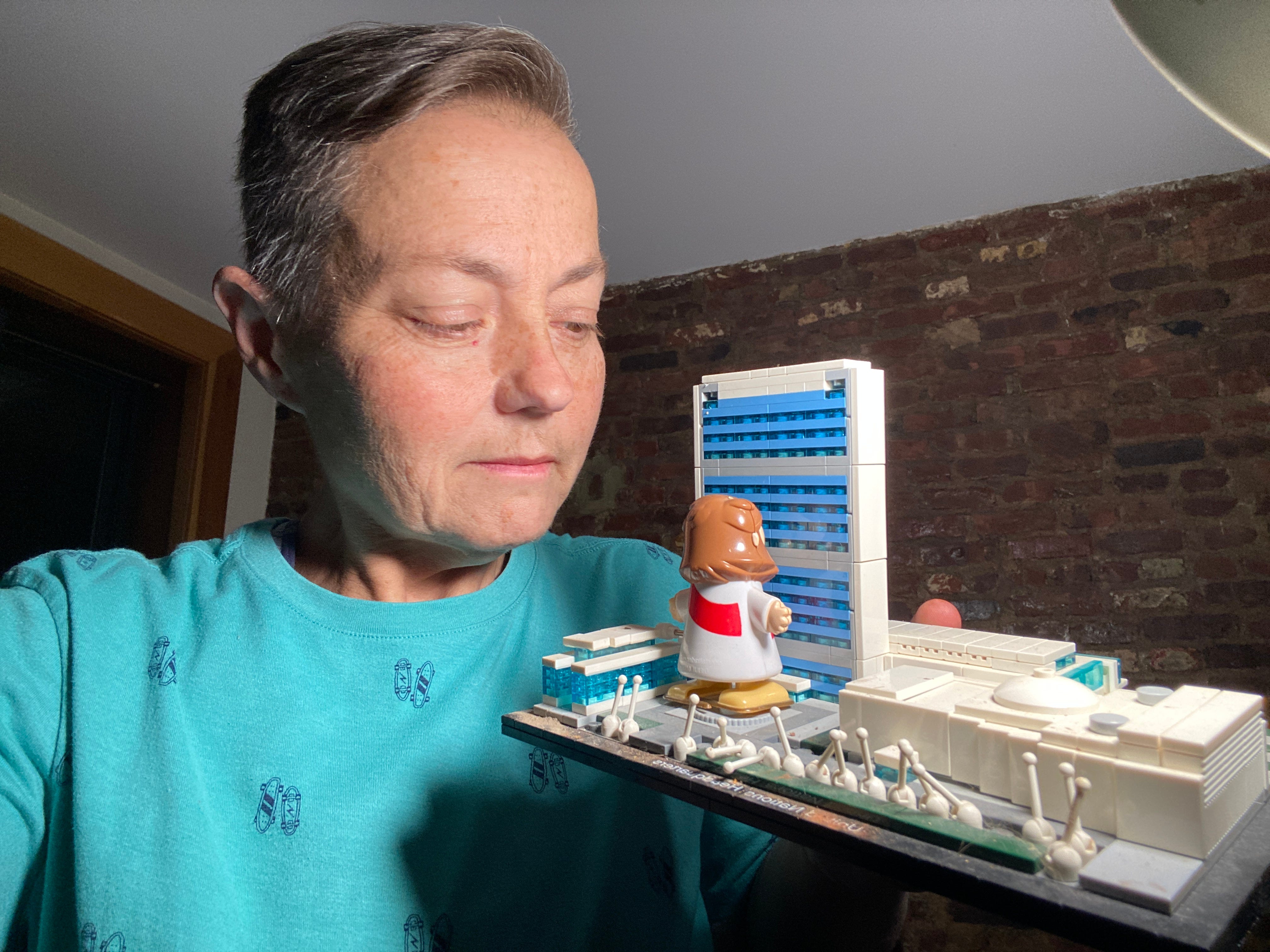
I was putting the finishing touches on the Lego United Nations tower, a set gifted to me for a birthday many years past. As I finished, I grabbed a wind-up plastic Jesus from my past-life religious tchotchke shelf to stand beside it.
I realized I had recreated the poster from my grandma’s living room. But in Lego.
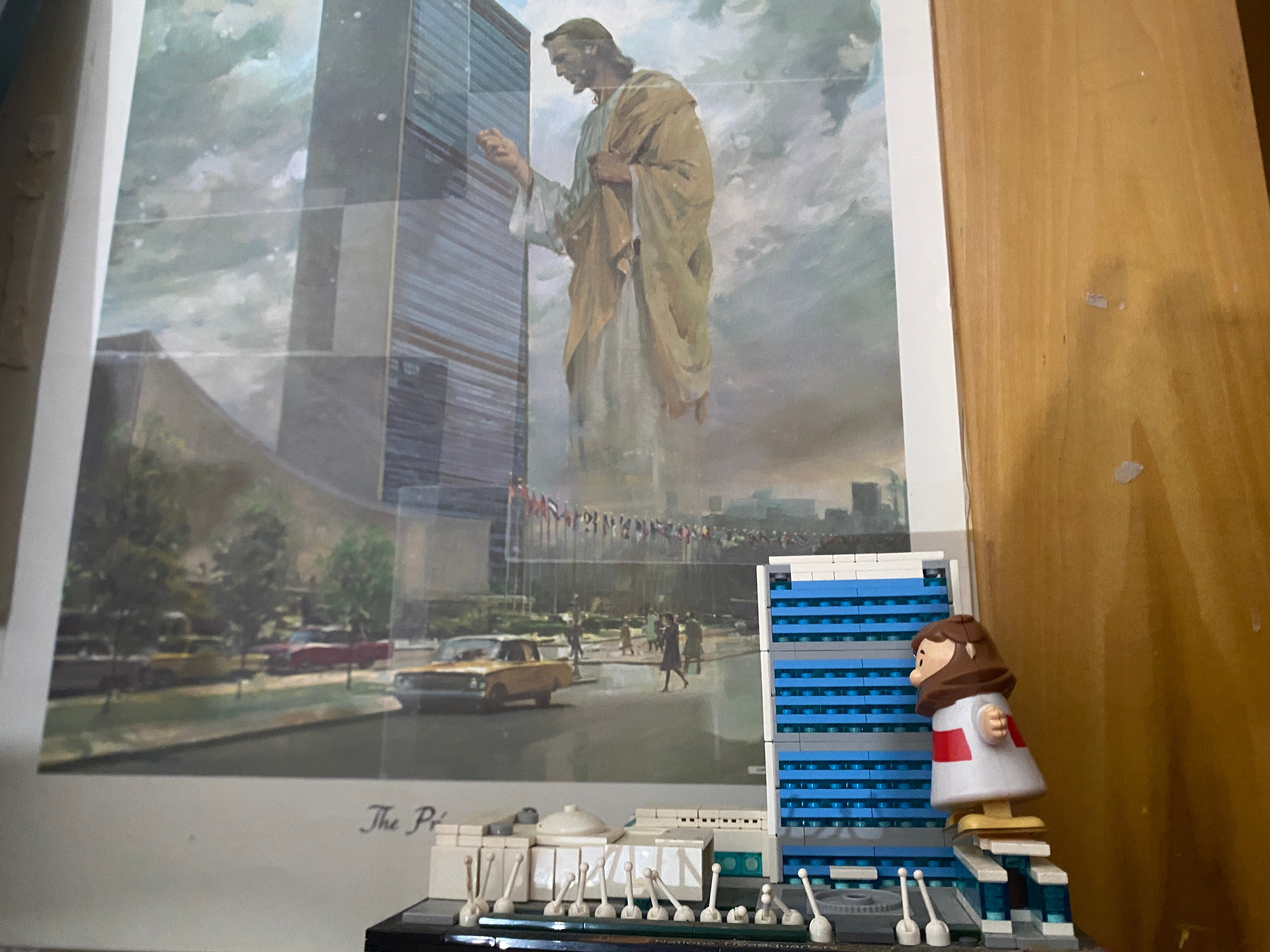
A girlfriend had once found a copy of said poster at a garage sale and gifted it to me in a moment of “we’re not sure how ironic we’re being” humor. Now it hung with command strips, unframed but not unloved, on the back of our bathroom door.
Because of this, my friend also came to the same realization I had.
I was so embarrassed. It wasn’t just capitalist-plot Lego that was soothing me. Now it was the dumb poster and my weird childhood Christianity residue.
I guess I didn’t hide my embarrassment very well, because my friend immediately sat down on the couch beside me.
“You know, it’s not actually the plastic pieces or the weird giant Jesus working the magic, right?”
I opened my mouth to argue.
Um. Yeah, it was the plastic.
Obviously, it was bathroom-door Jesus.
“It’s the connections,” he said, becoming weirdly earnest and settling into the tone of voice used by the red-headed lady on Intervention.
“The Lego connects one little piece to another until something steadier appears.”
When did my friend become such a cornball?
“Or maybe you just get steadier! That poster connected you to someone who held space for you when no one else did. You learned early that you could build safety.”
I started to cry, which wasn’t that unusual. I didn’t have a knee. I cried a lot. Plus, an earnest emotional lecture from a queer who’s usually dry and sarcastic can also be a lot.
I gestured to my wind-up Jesus UN diorama. “It’s not weird?”
“Oh, it’s totally weird,” he said, grabbing me in a big hug. “Just in a way that also makes perfect sense.”
Kelli Dunham is a nonbinary ex-nun, trauma-informed comedian and storytelling nurse. Kelli is the author of seven hilarious books about not hilarious subjects including a bestselling book on puberty and the creator of the hilariously helpful (and helpfully hilarious) Substack, Hoping Intentionally.

What a wonderful story. While I've never seen the poster of a 40-story-tall casual Jesus peering into the top floors of a building, I have been traumatized by Hologram Jesus when his sad gaze followed me everywhere in Sunday School. I must have been such a disappointment to him. If they'd let us build with Legos, it would have been calming. I'd have enjoyed a Noah's Ark set.
Such a stunningly entertaining read, from one quiet activity/ Lego processor to another. Thank you for sharing this!