



It’s a mild February day on the Gulf Coast, so I sit beside the pool, sip my umbrella-garnished drink, and bask. From behind my sunglasses, I read with one eye and people-watch with the other. Today, I’m soaking up Anne Lamott’s witty wisdom on how we wordsmiths are prone to seeing connections everywhere. As if on cue, I scan the set and let my imagination take me away.
At this resort-slash-conference center, there are singles, couples, and so many families, each with narratives I can’t possibly know. But I can create worlds that don’t exist with the stroke of a pen—or with no pen at all.
A mom shouts to her preschooler, “I think I see your other flip flop, over there!” I spy it tipped on its side, and I’m tumbled thirty years into the past, when I searched frantically near our dock at the lake for the match to the pricey extra-wide Stride Rite sandal we’d driven an hour to buy and couldn’t afford to lose.
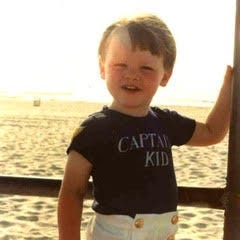
I unearth the wayward sandal from beneath the pile of towels, stash it into the beach bag, then help Eric wade into the shallow water on his sturdy little-boy legs. I alternately encourage and caution: “C’mon, you can do it! Come closer...now, be careful. Don’t step on that rock. Look here! Do you want this sand pail? Wave hi to Mrs. Jackson. There, you’re doing great!”
The past evaporates into the Florida heat as a young woman strolls silently to the in-ground kiddie pool. She seems quiet, yet sure. Just behind her, a little girl, two years old, maybe three. They’re mother/daughter, for the sake of my story. How would I describe the little one, I wonder?
To me—the decades-ago mom of three roly-poly toddlers with baby-fat bracelets—she seems ethereal. Her sparkly pink swimsuit hangs off her small frame, bagging at the legs. The curly blond locks, secured in miniature rubber bands, escape in wisps to frame her petite features. Sunglasses—pink, of course— perched on her tiny nose, she carries a ball, ever-so-gingerly balancing it between her delicate hands. I can almost see the faint clouds of fairy dust she leaves in her wake.
Mom sets her on the edge of the splash pool, where the broad arcing steps lead gently into the water below. I expect her mother to drop down on the ledge beside her or lower herself into the shallow water, poised to catch her daughter. Instead, Mom circles the perimeter to sit facing her. She’s within a safe distance for rescue purposes, but far enough—out of arm’s length. Mom observes as Tinker Bell watches the older boys and girls splashing, shrieking with laughter.
Before long, she tosses her ball into the water, and it’s snatched up by a boy from a boisterous clan. Dark-haired and solid, he’s nearly the perfect opposite of Tink. I tense, fretting she’s seen the last of her toy, wondering how Mom will negotiate this turn of events, but the ball comes right back to her. She tosses it away, again and again.
It’s only a ball, and Mom is right there, but our little girl is not at all concerned. She already trusts that what she sends out will return to her, trusts that who she is will be enough. I suspect her parents have taught her this confidence, standing in for the world as they take what she sends them and return it, predictably, reassuringly. Mom looks on, but I see no dispassion here. She knows Tink will be fine; the little one knows she’ll be fine, too. This letting her discover who she is, free from unnecessary intervention—it mesmerizes me.
Frankly, it makes me uncomfortable.
Is this the mistake I made? I cuddled and snuggled, declaring my love and his lovability, while teaching Eric to survive in a world where not everyone loved him. I cheered him on and gently warned, a continual game of warmer and colder designed to keep him within the safety zone. It seemed a reasonable approach, this shaping him into someone who stays between the lines, someone easy for others to accept. It’s all about common sense, I thought. It’s all about balance.
Yet I felt a subtle urgency then, a quality so completely missing from this mother-daughter pair it takes my breath away.
Stop this, I scold myself. Maybe I’ve attributed great wisdom where there is only passivity. Maybe I’ve witnessed this mother’s self-centeredness masquerading as self-confidence.
Or maybe it’s genetic, this sense of being entitled to a place in the world. Perhaps some—the lucky ones—inherit the secret password and hand it down to their children, never knowing what it’s like to worry about being accepted. I wonder how that would be, even now, waking up in the world like you already know you belong there.
Tink has it easy. Others try too hard, hoping you’ll notice they have the privilege of membership. They’re not hard to spot. Then there are the rebels, who stare not belonging right in the face, daring us to make them care. They work so hard at not caring that we see right through them, too.
It strikes me that it’s those who walk both of these paths—juggling the endless trying and the not trying at all—yet are so skilled at hiding their struggle who must suffer most.
I’ll never know exactly how Eric saw himself at the end, when his recklessness led to his death in a single-car crash at twenty. No one can know the true depth and breadth of his pain. But I do know one thing: This was not the balancing act I had hoped for.
Wails from the wading pool catch my attention, and I’m shocked to see Tinker Bell kicking and crying. Little Miss Calm has lost her cool. She’s confident, all right—confident she’s not ready to leave. Mom’s anything but hands off now. She wraps Tink in her arms and whisks her away, beads of perspiration gathering on her upper lip, tension in her brow. The fairy dust has vaporized.
Perfect parenting is, perhaps, as ephemeral as fairy dust, here one moment, gone the next. What a relief.
I turn back to my book and hide a tiny smile.

Casey Mulligan Walsh is a retired speech-language pathologist who has written for The New York Times, HuffPost, Next Avenue, Modern Loss, Hippocampus, Barren Magazine, and numerous other literary magazines. Her essay, “Still,” published in Split Lip, was nominated for Best of the Net. Her memoir, The Full Catastrophe: All I Ever Wanted, Everything I Feared, was released from Motina Books in February 2025. Casey also serves as an ambassador and Board member for the Family Heart Foundation. She lives in upstate New York with her husband, Kevin, and too many books to count. Learn more at caseymulliganwalsh.com.
I loved that this story was told, primarily, without dialogue and highlighted the assumptions we often make about strangers.
The writing here does what the best memoir does: it stays close to the particular and arrives somewhere universal without ever announcing the arrival. Yes I agree, a beautiful, heartbreaking piece. 🙏