


If you tell people that you’re going an entire year without buying a single stitch of clothing, if they care at all they are generally some combination of skeptical and impressed. I know this because during the 12 months I recently spent abstaining, I missed few opportunities to interject my undertaking into conversation. This was partly to establish some accountability, but mostly to brag.
I knew it would be hard and I was more worried than I care to admit about my underpants supply. I figured if I could do it, though, my strengthened resolve would stick with me even beyond the year. Maybe it would be a hard reset on the buying habits that had been making me feel so queasy and out of control.
My big, beautiful internet is full of cats and first-day-of-school pictures of my great-nephew and weirdly satisfying videos of pet lizards shedding their skins. Yours is different, but you love it too. The price of admission to this warm bath of delectable content is merciless thrall to a mighty algorithm to which we voluntarily bare our souls, allowing every click and lingering gaze to be monitored and monetized. We teach it what we love and what we fear. Armed with this insight, it manufactures a sense of lack specifically tailored to our unique combination of insecurities. Then it presents us with a convenient purchasing opportunity in the exact size and shape of that lack, a button for our little rat paws to smash that sends a fleeting hit of dopamine straight to our grey matter.
We know, intellectually, that it won’t work, that the shapeless, formless want won’t ever be sated. “Enough” is fiction, and all this endless insurmountable longing has been painstakingly engineered by our technocratic overlords.
Maybe your algorithmically assigned fetish objects are woodworking tools or candy-colored insulated tumblers or expensive skincare products. Mine has always been clothing. I genuinely love apparel as craft, art, and a means of self-expression, but it’s not a simple or clean love. I cloak myself in a loud, high-femme style in the hopes that I will one day achieve “pretty” sufficient to allow me to take up space in the world without some version of permission that will never come. I’m convinced on, like, a cellular level that there exists a dress or a pair of shoes that, the moment I buy it, will render me so perfectly lovely that I emerge from the carapace of self-loathing I’ve built up over the decades I’ve spent marinating in mass media and the male gaze.
Hook. Line. Sinker. I know better. I do.
The environmental degradation and human misery associated with the fashion industry is far from a secret, but the wretchedness of it all is neatly elided for the consumer. After a one-thought, one-click purchase, a three-dollar designer knockoff blouse from a fast-fashion company travels across an ocean from a Chinese sweatshop to an American doorstep, dissolves after two washes, and then gets landfilled or “donated,” which means another trip across an ocean to get dumped onto a once-beautiful beach in Ghana. The mental gymnastics required to not see any of that journey beyond the ’fit pics ought to be staggering, but the experience is rendered sterile and seamless for the buyer.
I don’t participate in fast fashion, and I know there’s an element of privilege at play in that choice. For most of my life I’ve been fortunate enough to be able to buy quality clothes and take excellent care of them. There are articles of clothing currently in my rotation that I bought during the Clinton administration, but excess still finds me. I own ten pairs of dapper oxford shoes and a half-dozen fitted grey wool sweaters, which is a plainly excessive collection for someone with just the two feet and the one torso.
So, an experiment. A challenge. I decided I would go birthday to birthday without buying—no clothes, no exceptions. Perimenopausal chaos started right on time for me, so I knew going from age 45 to 46 without buying a single pair of drawers might be a tall order. I decided not to be an underpants martyr, but I hoped to avoid activating my one allowed exemption. I stocked up, blew out my candles, and braced myself.
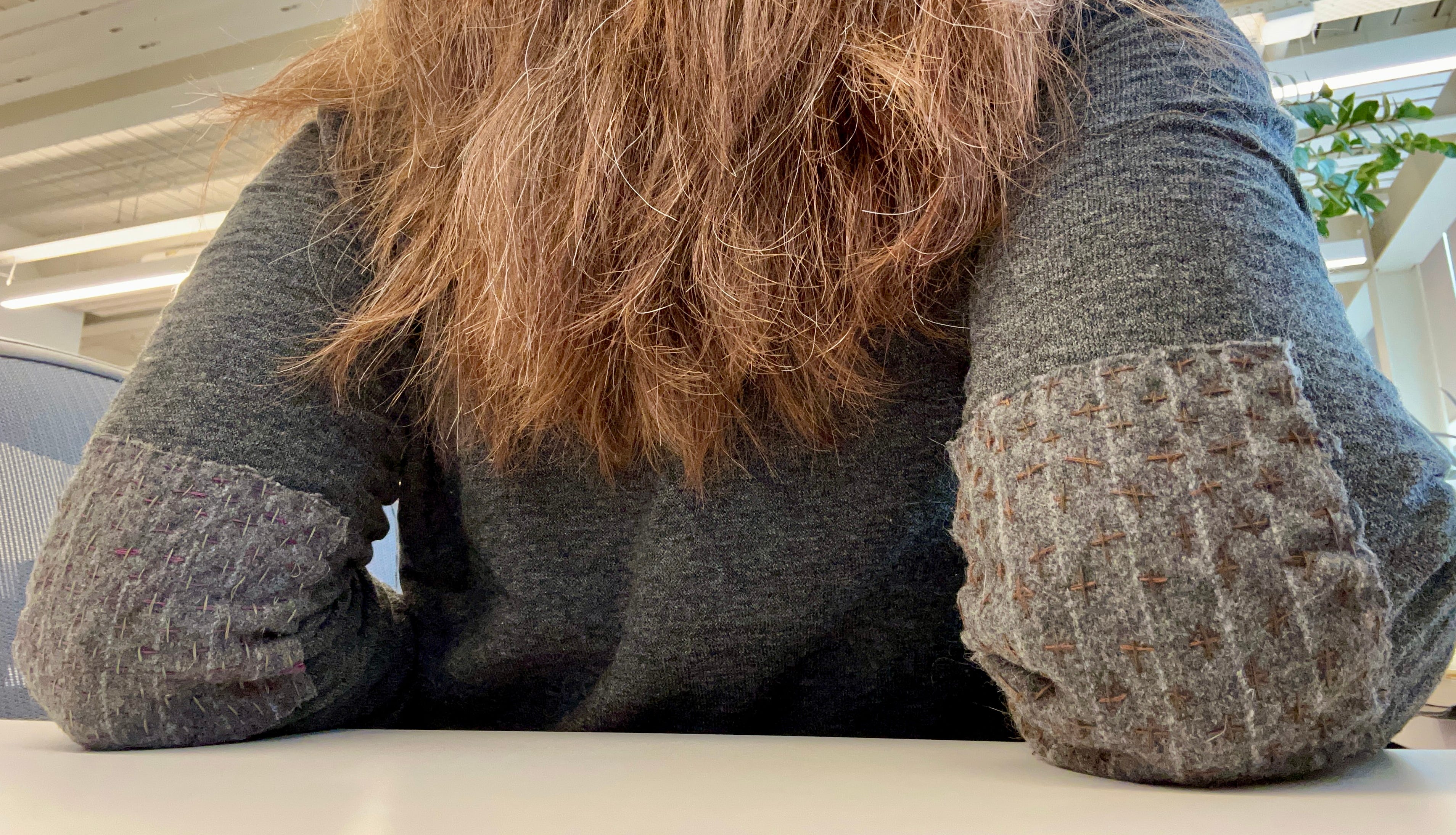
Dressing for a year with no novel options led me to recombine hardworking favorites in new ways, some of which were fabulous and some of which were not. I have done a C minus job of darning a few holey socks, which is not impressive but not a failure, either. A fifteen-year-old grey cardigan-style Yohji Yamamoto dress with demolished elbows is back in action after hours of painstaking and occasionally painful sashiko patching—a Japanese style of visible mending where countless tiny stitches affix patches over damaged fabric. I conquered a few stains I thought were permanent. I was vividly reminded of why certain garments stay in the dismal dark at the back of my closet. I learned that I have so much more than enough, and that almost none of my buying is in response to genuine need.
The main effect of cocaine, I ‘ve been told, is a profound and immediate desire for more cocaine. Even if you’ve never done so much as a bump, though, I’m going to guess that you know about want on want on want, a never-ending narcotic scroll through empty and unslakable longing that replicates itself forever. Dating apps, online pornography, streaming services—all these marvels of technology leave us ever thirstier, never quenched. There’s always a better option just a click away, and perhaps this one will turn out to be the one that provides the elusive perfect fit.
Spoiler alert: It will not.
We live in an environment that nurtures greed, a sludge of unmet and unmeetable desire created and stewarded by men who have spun our sad longings into galactic wealth for themselves. That feeling of bottomless lack is exactly what these new-world titans want for you, and it dovetails beautifully with the effortless opportunities for compulsive consumption with which they have surrounded us.
But I did it. I resisted the siren song for an entire year. Sometimes it was torture, like when I watched a criminally underpriced Dries van Noten dress get snatched up quick on Poshmark, never to appear again. It didn’t take too long for the volume to turn way down, and for not-buying to become automatic.
Right after the year was up, the immaculately curated vintage shop in my neighborhood was having a big sale. It seemed like the perfect way to emerge from my self-imposed period of asceticism—more sustainable and certainly hipper than tossing down my zero-balance Nordstrom card. I looked through their entire stock and tried on a shirt, a skirt, and three dresses, but I couldn’t pull the trigger on anything. I’d given myself permission to go utterly apeshit, and nothing seemed worth taking home.
That failed sortie gave me hope that I had uncooked my brain, at least a little bit. But that was months ago. My algorithm is relentless again. It has noticed that I’ve been giving precious eyeball nanoseconds to well-crafted cotton shirtdresses and high-end lingerie. Oh, you like that signet ring with Medusa on it, do you? How about these cashmere socks? Won’t they make you feel like less of a middle-aged punchline with a burgeoning spare tire? What if it’s 15 percent off? Hey, take another look. Take another look. Another. Another.
I’m repulsed by how much I’ve bought since my birthday. All told it’s not that much but, other than a pair of replacement running shoes, I needed precisely none of it. The circus was right there all along, just waiting for me to look at it again.
Nothing I learned in my year away from retail was particularly groundbreaking. The Buddhist tradition has been pretty clear for millennia that bottomless desire is at the root of most forms of suffering. I didn’t transcend anything so much as I muscled through, but for 376 days I yanked a tiny bit of power back from our lust-farming overlords. It was barely enough to be symbolic, but it was more than nothing—and to me, that was worth missing out on any number of Biggest Sales Ever.
Melissa Meinzer began her writing career in the alt-weekly world in Pittsburgh, Pennsylvania. She lives and writes in St. Louis, Missouri and holds an MFA in Creative Nonfiction from the Institute of American Indian Arts in Santa Fe, New Mexico. Find her online at @meinzermelissa.

"...That feeling of bottomless lack is exactly what these new-world titans want for you, and it dovetails beautifully with the effortless opportunities for compulsive consumption with which they have surrounded us." Don't I know it sister. As it happens, I have also begun my own intention of not buying any article of clothing for a year. I've spent the past few days unsubscribing to every shopping related email. Getting back all that time I shopped online alone should be worth it. Wish me luck! Congrats to you!
Oh my god. "I’m convinced on, like, a cellular level that there exists a dress or a pair of shoes that, the moment I buy it, will render me so perfectly lovely that I emerge from the carapace of self-loathing I’ve built up over the decades I’ve spent marinating in mass media and the male gaze." I am in love with this piece. Fantastically fun to read and thought-provoking and your STYLE. Wonderful.