


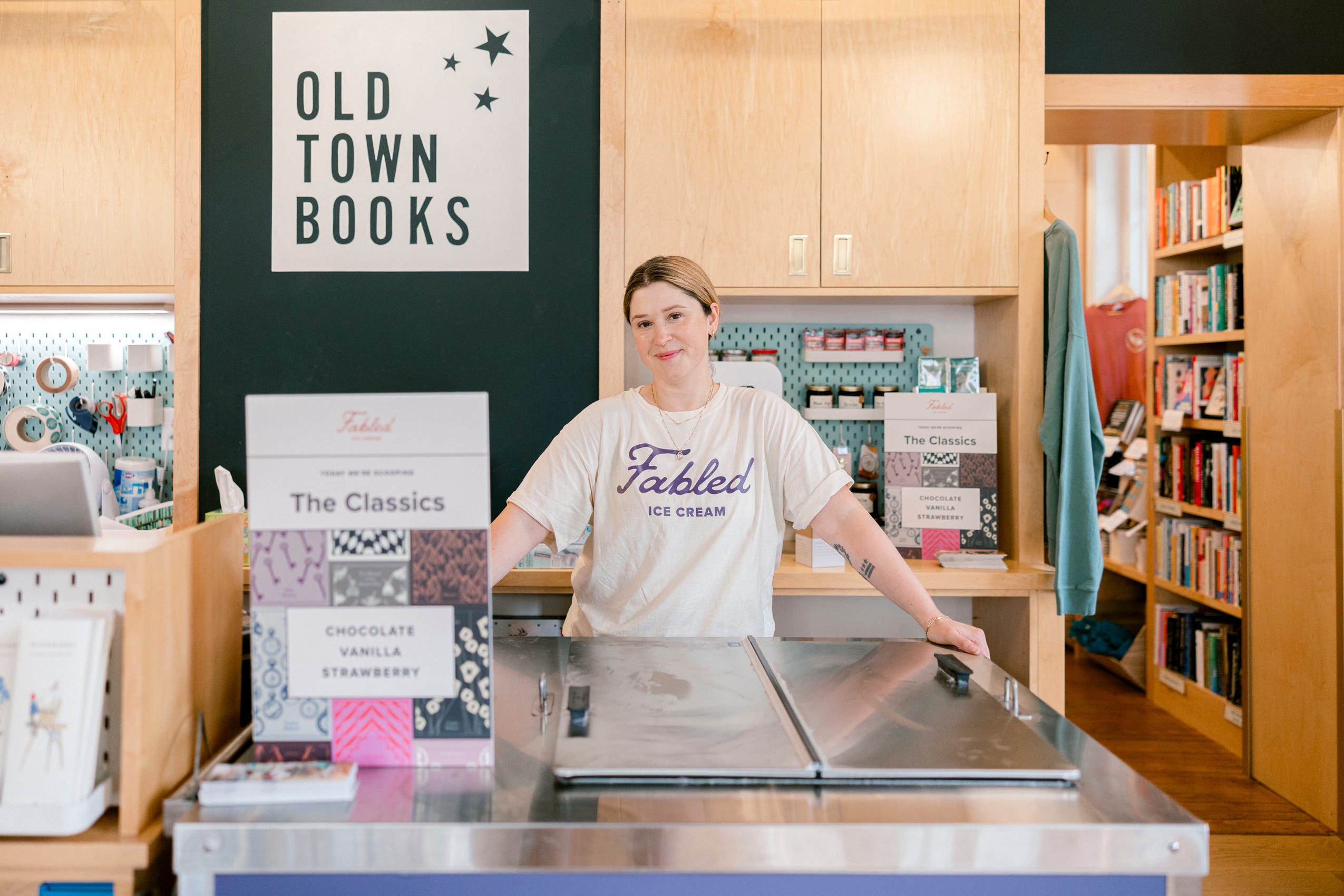
I love building things. That feels obvious to me now, but it hasn’t always felt like something I could claim with confidence. For a long time, I was self-conscious about how many ideas I had and how quickly I became interested in new endeavors. Once, a colleague made an offhand remark that hit me hard: “You like the idea of something.” I took it as a rebuke. We were standing off to the side of a local TV set, about to go on air to promote my independent bookstore, Old Town Books. I was rattled, red-faced, and thinking now only of my limitations. Did I just like the idea of something new? Had I lived only in the beginning of things, but lacked the work ethic it takes to carry them forward?
What I’ve come to understand, slowly and through experience, is that loving the idea isn’t where it ends for me. It’s where it begins. In graduate school at NYU’s Gallatin School for Individualized Study, I built my own major by combining classes from across the university. Looking back, interdisciplinary study was an early expression of how my mind works. I’m drawn to intersections. I like combining things, shaping something that doesn’t quite exist yet, and then figuring out how to make it real.
Opening my first business, an independent bookstore in my hometown of Alexandria, Virginia, gave me my first real experience of that process at scale. I had worked in retail or the service industry since I was sixteen, but this was the first time I had struck out on my own. It started as a small pop-up with secondhand shelves and a limited inventory. I spent long days rearranging displays, talking with customers, learning systems as I went, and slowly building something that began to take on a life of its own. The store grew because of community, consistency, and because I stayed with it through the less glamorous parts (e.g. COVID.) That experience grounded me in a way nothing else had. It showed me that I don’t just love the spark of an idea, I love the long middle where the real work happens, too.
Even with that proof, I still hesitated when a new idea took hold.
Ice cream didn’t start as a business idea. The spark began in the middle of an emotionally hard winter, when the days felt short and more than a little heavy. I needed something to shift my energy, something tactile and fun, so I began tinkering in my kitchen. I can still picture those early experiments clearly. Measuring cream and sugar, stirring at the stove, waiting for the mixture to cool, testing batches that didn’t quite work and then adjusting again. The first time I got the texture right, something clicked. It felt familiar in a surprising way, like I had tapped into the same part of myself that had built the bookstore, just in a completely different medium.
Books have always been my primary way of connecting to the world. Reading can be slow and reflective, restorative. I love that feeling, but I also started to crave something that operated on a different timeline. Ice cream offered that contrast. It was embodied, sensory, immediate. You could make something in a few hours, taste the result, adjust, and try again the next day. It gave me a feedback loop that felt energizing and exciting. It was also challenging. I hadn’t gone to pastry school, or even ever really made my own ice cream before. It was new, and that newness was inspiring.
There was also something deeper at play. I loved the nostalgia element. I have three young daughters and the idea of raising them as a mom with a bookstore and ice cream shop? Priceless. To say they were supportive is an understatement. Their enthusiasm for my new business idea was encouraging, even if it meant them rifling through the freezer at all hours sampling my test batches. Ice cream, for kids and adults alike, creates an immediate moment of joy. You taste it, you react to it, you share it with someone standing next to you. I found myself drawn to that immediacy, to the idea of creating something that could bring people together in a different, more spontaneous way.
Once I understood that, the project made more sense to me. It wasn’t a departure from what I had been building. It was an extension of it.
What began with curiosity quickly became an obsession. I found myself reading about ice cream late at night, thinking about butterfat percentages while driving, and paying attention to details I’d never considered before. At a certain point, I had to decide whether this would remain a hobby or become a project I took seriously. Choosing the second path meant committing to the full process, not just the creative parts but the technical and logistical ones as well. There wasn’t one clear moment when I decided to take ice cream from fun side project to a business idea, it was an evolution. The more time I spent in the kitchen, the more certain I became I wanted to make ice cream for a living, not just as a hobby.
I went to Idaho to attend Ice Cream School (yes, that’s a real thing!), and spent three intensive days immersed in a working commercial kitchen, asking questions and observing how professionals approached their craft. I also enrolled in coursework through Cornell University’s Dairy Foods Extension Program to better understand food science and safety, grappling with material that pushed me into a beginner’s mindset again.
Bringing that new knowledge back home introduced a different kind of learning curve. I decided to go for it and set up an ice cream cart inside my bookstore. The first pop-ups felt both exciting and slightly surreal, with books lining the shelves, shoppers browsing, and ice cream being scooped in the midst of it all. There were more than a few books damaged by sticky dripping cones. And the bulky cart and line of customers was a thorn in the side of my booksellers.
At the same time, I was navigating an entirely new set of systems than I had with selling books. Permits, regulations, storage requirements, production logistics. Sitting at my computer with multiple tabs open, trying to piece together what was required and how to do it correctly, was a whole new challenge, a crash course in a world that didn’t function on enthusiasm alone.
There were moments when it felt overwhelming, when it would have been easier to step back and stay within the retail world I already knew. But I’ve started to recognize that feeling as part of the process. That friction isn’t a sign that something is wrong. It’s a sign that something is taking shape. A meaningful moment came when I launched a community-based fundraising round online that raised $30,000 of seed funding. Pressing publish and then watching people choose to invest in something that was still in progress was both humbling and energizing. It reinforced the idea that building something is not a solitary act. It’s an invitation for others to participate, to believe in what you are creating.
I’ve begun to reframe what it means to be a serial entrepreneur. It’s not about being scattered or unfocused. It’s about being responsive to curiosity and willing to follow an idea far enough to understand its potential. It’s about trusting that the skills built in one project will carry into the next, even when the surface details are entirely different. The bookstore taught me how to create a space for connection through books. Ice cream is teaching me how to create that same sense of connection in a different form, one that’s immediate, sensory, but still rooted in a similar kind of pleasure.
So while that “you like the idea” comment has stayed with me, it no longer feels like a critique. Yes, I like the idea stage, but I also like everything that comes after it. I like the learning, the problem solving, the late nights, and the long stretches where things are uncertain and evolving. I like building something from the ground up and staying with it long enough to see what it can become. Most of all, I’m learning to trust that this way of working, of moving between ideas and following them into reality, is not something I need to fix. It’s the foundation of how I build, and who I am.
Ally Kirkpatrick is the founder of Old Town Books, an independent bookstore in Alexandria, Virginia, and Fabled Ice Cream, a literary-inspired ice cream company launching in 2026. Her work centers around building community through storytelling, whether through books, events, or food. She writes about entrepreneurship, creativity, and small business ownership, and her work has been supported by the Vermont Studio Center and the Virginia Center for the Creative Arts. Her writing has appeared in publications including Edible DC and Roxane Gay’s The Audacity.

Ally, you sound like the exact opposite of someone who (just) likes the idea--you really did the work here!
As a person who absolutely loves both books and ice cream, I enjoyed this essay! And congrats on your persistence and discovery along your journey. My favorite part: "The bookstore taught me how to create a space for connection through books. Ice cream is teaching me how to create that same sense of connection in a different form, one that’s immediate, sensory, but still rooted in a similar kind of pleasure."