


My brother Paul and I navigated childhood for twelve years under the same roof, but in adolescence, our family unraveled and spun apart. We have travelled wildly different paths since then. Our infrequent conversations could be contained in a single day in which we failed to find common ground. Then the omicron variant of the COVID-19 virus put a period on the possibility that we ever could. Paul’s death at sixty-four meant that we would never share an actual laugh, compare our children’s endearing eccentricities, commiserate about, well, anything from our father’s heavy drinking days to our lesbian mother’s contributions to women’s liberation.
I will never know his demons—forged out of some extreme notion of Christian good and evil—that led him to expel me, his lesbian sister, and our mother from his family pantheon. And he will never know mine—a murky stew of self-doubt and recriminations that I can never be good enough to deserve love, that people I love always leave.
Once, when we were both middle-aged parents, we briefly overlapped at our dying father’s house. We were cleaning up the apples that had fallen and were fermenting beneath a pair of heirloom Rhode Island Greenings who reliably birthed them year after year, their sharp, vinegary smell stinging our sinuses, sun glinting through the canopy and dappling the soupy blobs underneath like butter on an apple crisp. Every attempt to speak of something I thought safe—what kind of car did he want to buy? Did he do any fishing now that he lived on the Gulf Coast?—somehow always ended with Paul’s admonishments that we (I was never sure if he meant humanity in general, or Mom and me specifically) had been expelled from the Garden of Eden and that there was only one true path to redemption, which was to accept the Lord Jesus Christ as our savior, a path I had not taken.
This was not a conversation; it was an impromptu hellfire and brimstone sermon delivered by my little brother more at me than to me; it was a repeat of the one he delivered at my mother’s deathbed a decade before. Where I saw nature’s bounty and the sacred cycle of life, he saw eternal damnation. There was no opening for conversation. I fell to shoveling up rotten apples in silence. As siblings, as members of a family, albeit a divorced and reconstituted set of families, we more closely resembled the family shrapnel than far-flung loved ones.
Words, in the end, failed us.
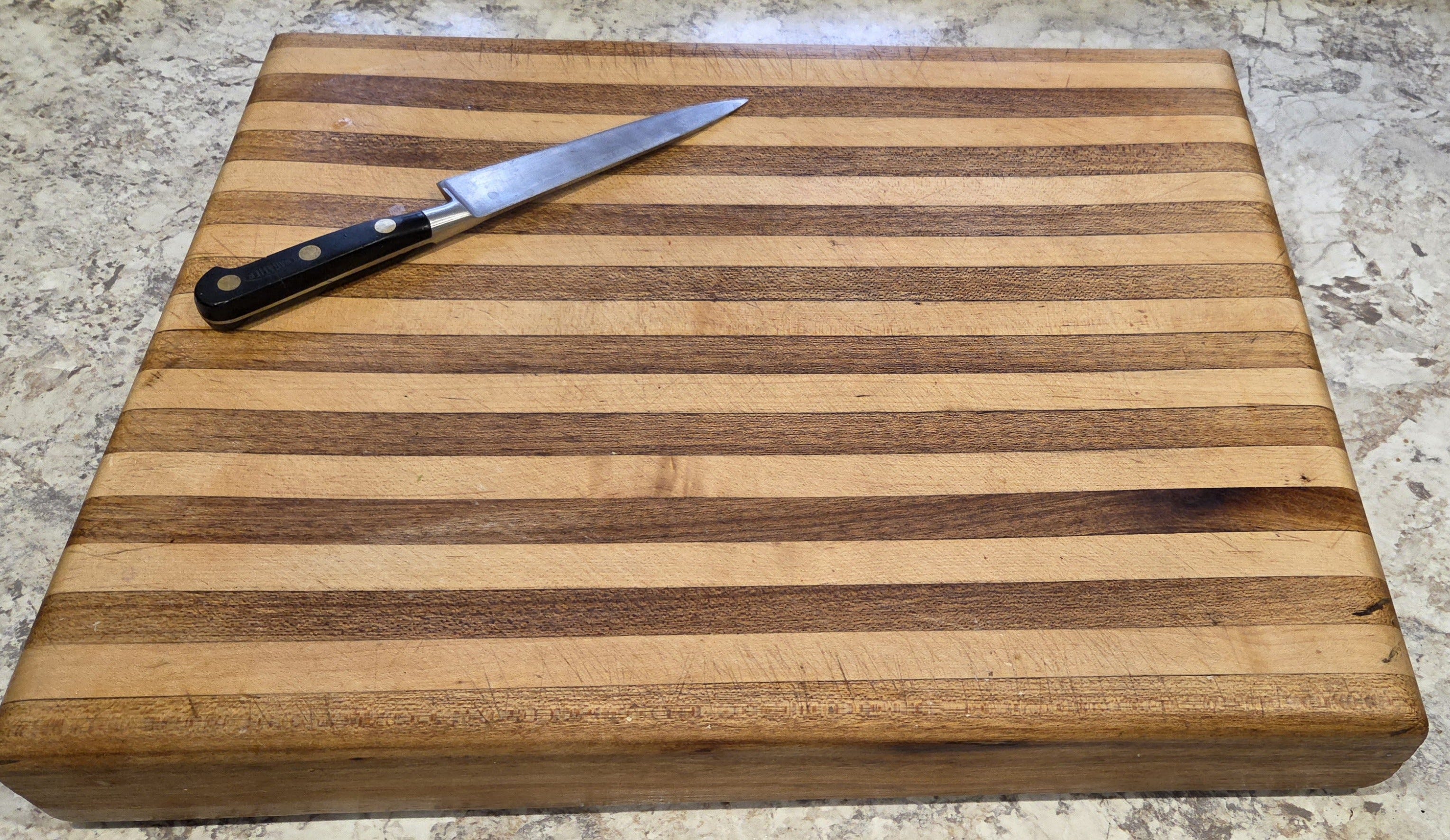
And yet. When we were teens and no longer living together, Paul took a shop class in school. At Christmas, one that required visits to two parental households in two states, Paul presented me with a beautiful chopping block: light and dark strips of maple and oak that he had expertly cut, sanded, and painstakingly pieced. The edges were rounded and the bottom was fitted with four rubber feet. I don’t remember what I gave him. It was our last Christmas together.
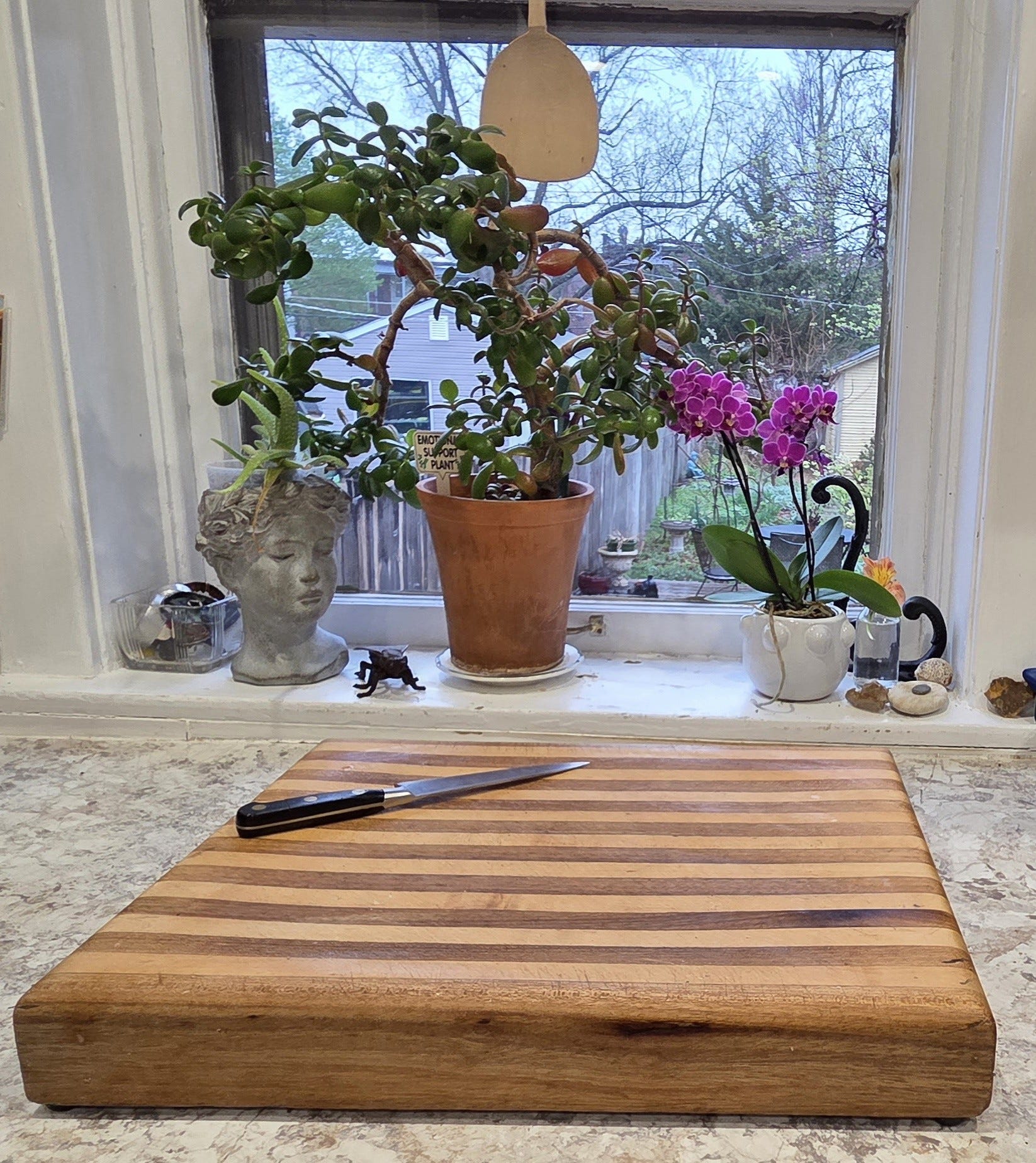
I have started every meal of my adult life on Paul’s cutting board: five decades, nine households, and an infinity of recipes. It is redolent with thousands of cloves of garlic. When I had in-laws, I had to remove bags of groceries and purses with nasty bottoms from it because it seemed to call incoming dinner guests to place such things upon it. It has that kind of magnetic charm.
Its once perfectly flat surface now features two deepening depressions where I have repeatedly pressed a blade into it in a relentless percussion of slicing, dicing, mincing, cubing, quartering, trimming, coring, and peeling. I can no longer roll out biscuits because the rolling pin cannot make contact with these deepening hollows.
When I learned Paul was on a ventilator and would not survive, I swept my hand over the gentle dips in the cutting board in a soothing motion. I thought about how, a half a century ago, he selected lengths of oak and maple 1x2 boards with intent. How he crafted them into this workhorse of a lifetime, one carefully measured cut after another.
I felt my brother speaking to me in the language of blade against woodgrain. A call and response. A cadence of cuts. A correspondence carved in wood, a Braille for siblings who could never see through to each other’s hearts.
Not long after Paul died, I took my knives to be sharpened and mentioned to the cutler that my cutting board was no longer a flat surface. As he wrote out my ticket, I chatted to fill the silence. “It’s hard to get a good cut.”
He offered to sand it smooth.
“No, no!” I replied instantly. “It’s a story.”

Kris Kleindienst is a writer, queer elder, and bookseller. She has come recently to literary nonfiction after twenty-five years as a columnist for her local LGBTQIA+ newspaper and fifty-two years as the owner of Left Bank Books, served concurrently. She believes that objects, particularly ones made of organic materials, hold significant spiritual energy when we slow down enough to pay attention. The kitchen is her holy place. She is working on a family memoir and is always saying she will post more regularly on her Substack.
Object-ives features flash nonfiction essays of 500-999 words on the possessions we can’t stop thinking about.
Recommended reading on possessions:
“I Figured Out Why I Love Tiny Houses So Much” by Jen Hubley Luckwaldt, Old Mom Things
“10 unusual ways to use the empty notebooks you keep buying” by Amy Catriona
“Vintage Inspired Amp: part 1” by Victor Velt, Vic’s Amps
“Lena Dunham on the Retail That Raised Her” by Lena Dunham, Shop Rat (run by Emilia Petrarca)
Writing travel notes by Ayah Ziyadeh
“Why young Americans are buying $200 notebooks from a store in Paris” by Megan Sauer, CNBC Make It
“I’m a Professional Thrift Shopper—These Are the Items I Wish People Would Stop Donating” by Ashley Poskin, Martha Stewart

I have two family members with whom this very thing has also happened. One is my Father-in-Law whom I adored for well over twenty years until he became Fox News obsessed and religious all of a sudden. I named my son after him and now wish I could take that back. If a person could be a cutting board then my son is that person. I am the person I always was and he is some angry, bitter 87 year old I don't even know. The other is a cousin that I was raised with like a brother, who became religious in our thirties and angry because his beloved father, my beloved uncle, was taken way too soon. He too is an angry, Fox watching religion spewing person I don't recognize except for occasional conversations when I laugh, he laughs, and I almost forget that he wasn't always the person he is now. It makes me sad for them.
Having not had a conversation with my only sibling in well over a decade, your story resonates.