


My matrilineal line can be traced in fabric and fibers, beginning with my great-grandmother Anna, who saved the scraps of her husband’s worn, patterned blue shirts to stitch together, making a quilt my mother found, unfinished, in a trunk in her own mother’s house in the mid-1990s. At one of my bridal showers, my mother gave it to me, finished by a tailor against a deeper blue background. I felt a shock of connection when I fingered it: work upon work upon work, gift upon gift upon gift, generation to generation. The quilt is so delicate and the shirts so threadbare that daily use is now hazardous to the fabric itself, but I cannot bear to let it go.
From my grandmother Jean, who was neither sentimental nor warm with us, came two crocheted blankets made with cheap synthetic yarn in colors I suspect were carefully chosen to match my brother’s and my bedrooms when we were teenagers. They are indestructible, useful for any number of tasks and destined to outlive everyone I know.
From Goldie, one of Jean’s five younger sisters—a broad, vibrant woman who hugged hard and spoke gushingly about anyone she loved—I was gifted the perfectly knitted pink sweater I treasure, its tiny, even stitches in horizontal lockstep reminding me of the day she tugged it straight over my chest and winked. These sisters bickered constantly throughout my life, each criticizing the other’s handiwork to me in thick Brooklyn accents. Now, despite the many washes they’ve had in the years since their makers’ passings, these gifts carry a kind of DNA that can’t be soaped away: in my family, what we do is make things for each other.
My mother Diane refused to learn crocheting or knitting. Instead, she taught herself to sew. At first, she made simple things from patterns and then, when I was very little, began to assemble patchwork quilts, not yet aware that she was taking up her own grandmother’s practice. Few in my generation made it to adulthood without a quilt from my mother; in fact, when my brother’s raucous childhood bed-jumping tore through the first one, he became the rare recipient of a second quilt. I can remember her laying her unfinished quilts across the dining room table, tape measure in one hand, basting tape in another, careful notes on yellow legal pads at the ready. My quilt, a pattern of brown and white squares with flowers and gingham, has been tattered and re-sewn, new edging added by tailors and new tiny yarn bows tied one at a time between the squares. I bring it out of the trunk where I store it when I have trouble sleeping; it’s made for a twin bed, not the king one I share with my husband, so it’s just for me: the imagined sensation of my mother’s ghostly hands smoothing it over me in the dark.
My daughter Ronni, great-granddaughter of Jean, taught herself to crochet nearly ten years ago, learning from videos online. Our collection of her handmade hats is impressive, the weights of yarn varying so that I have a favorite for every season. She has finished other crochet projects—stuffed animals, small blankets, coasters, flowers mounted on pipe cleaners—but the hats are my favorites. No one told me that someday my child would make me items so useful, perfect, and splendid. I wear the hats like secret report cards, privately gloating. My daughter made it, I tell the strangers who admire them.
It was a regret of mine, for many years, not to have something tangible to leave behind as my ancestors have and my daughter will. I thought I possessed only more ephemerally-productive skills; I thought of myself as a good cook and baker; a passable gardener; and a loving storyteller, able to bequeath memories and ideas and traditions, but nothing physical. I tried learning both knitting and crocheting and failed. Sewing requires the kind of precision that eludes me entirely. It wasn’t until I discovered the fiber art equivalent to paint-by-number that I began to create something that might, in the end, outlast me: cross-stitch samplers.
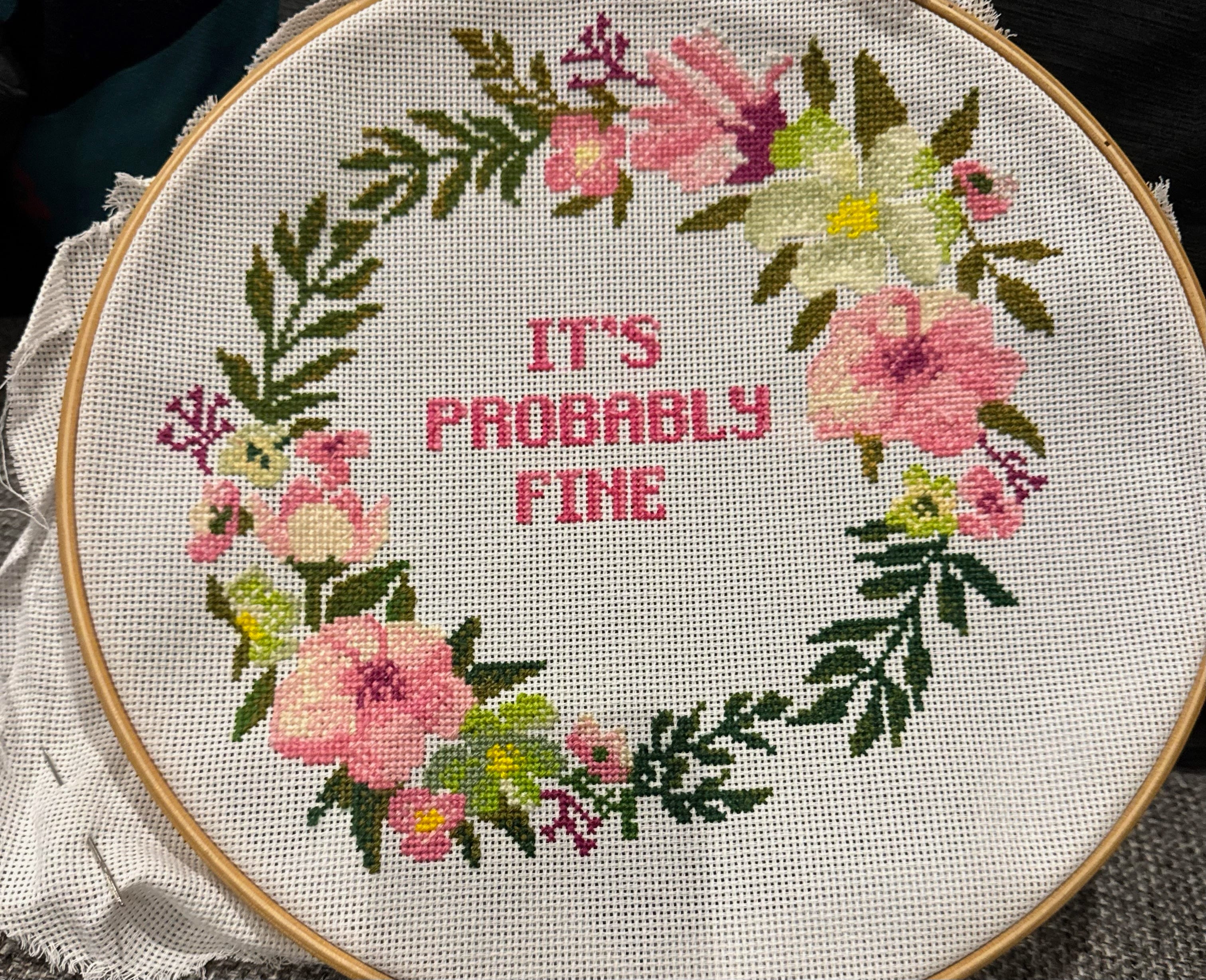
Cross-stitch, spanning the middle-ground of equipment requirements between the yarn arts and sewing, asks only for a hoop, a fabric grid, a needle, and a collection of embroidery floss. Beyond that, I need only what I think of as the recipe for each project: a pattern, downloaded from the internet, for a wreath of flowers surrounded by an irreverent bit of text. “DOING MY BEST” read my first wreathed creation, followed by “WELL SHIT,” “HAVE A NICE POOP,” “IT’S PROBABLY FINE,” and “A WISE WOMAN ONCE SAID FUCK THIS SHIT.”
Anna, Jean, Goldie, and Diane would likely be horrified at the language, but they would recognize the lowering of blood pressure as I sit down to work on each new project. They would know the hybrid sensation of productivity and relaxation that comes from taking up the fibers with one’s hands, the sweet reminders from threads stuck to one’s sleeve, the secret thrill of a new project as it morphs from unrecognized potential into a shape that can be discerned by passers-by. My great-grandmother, grandmother, great-aunt, mother, and I have shared, across time, moments of laying our hands on something we’ve made for someone we love and imagining that object extending long past our lifespans. Who else will hold this, we all wonder, and will they know who I am?
Sometimes my daughter and I sit together on the couch and work on our projects as we watch TV together. “Look how cute this is,” we each say, sometimes, but mostly we just move our hands in silence. The work speaks for itself and, we hope, always will.

Debi Lewis is the author of the memoir Kitchen Medicine (2022). Her short fiction and essays have appeared in The New York Times, Pangyrus, Eureka Literary Magazine, Bon Appetit, Hippocampus, and more. Find her speculative fiction Substack at ThisCouldHappen.Substack.com.

Story telling is a legacy too; just as long lasting as fibre! I love the love that you weaved so beautifully through remembering.
Love this piece! Makes me want to take up needlework.