


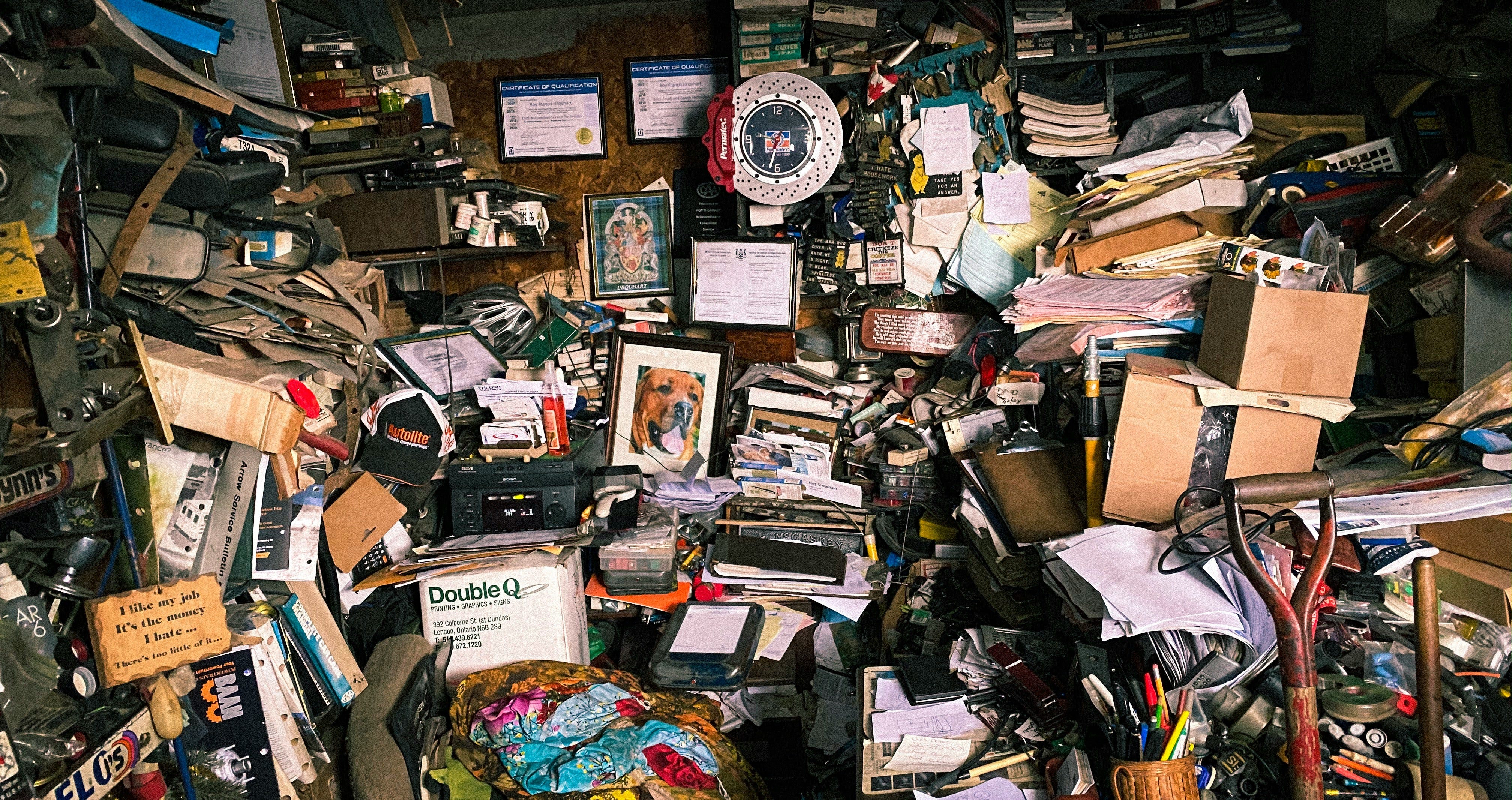
The attic is chilly in a cloudy New England spring, the sunlight almost grey. It is sometime in the early 2010s and I am standing in a sea of paper that fills most of the room, piled across the floor in boxes and bins and bags. Behind me, just beyond the door to the hallway, is a growing collection of big black trash bags only half-filled because paper is heavy and I’ve still got to move them down two steeply Victorian flights of stairs. The friends whose house I’m in are somewhere else, probably at work. That’s okay. I’m in their home as a guest for a week not so much to spend time with them—though that part is lovely—but in my guise as Psychopomp of Clutter.
I have given my friends this week as a gift, a birthday present to one member of the couple, in fact, partly because our conversations have let me know that they need some help and know it, but also because sometimes people can only tolerate being helped with a thing if it’s offered explicitly and without prompting by someone they already trust. I’m aware that for years, a range of Stuff has been shoved into the conveniently gigantic maw of their thousand-plus square-foot attic with a shrug of “this’ll do for now” and a vague idea that it’ll all get dealt with someday. One of the best gifts I have in my power to give is to be that Someday, so I stuck a bow on it.
I had seen plenty of attics like theirs before, and closets and cupboards and storage rooms and basements way too full of themselves, all junk and disorderly. I have certainly seen them many times since. Familiarity has not bred contempt but rather equanimity. I am neither appalled nor surprised. Stuff can get the better of people. This seems to be a constant of the human condition, at least in the stuff-filled high-consumption era in which we live. There’s nothing to be done for it except face down the results.
That’s what I’m doing up there in my friends’ attic, quickly assessing the contents of yet another box (utility bills from the 90s) and another bin (job onboarding materials from four jobs ago, vet records for a long-deceased cat) before consigning them to their big black trash bag. Before I head back home, a commercial shredding company’s truck will come park out front for a bit, noisily ingest bag after bag of paper via a hatch in its roof and drive off in a small cloud of its own confetti. My friends and I will also go to a nearby state park for a field trip involving a picnic area, a rusty metal grill, and the burning of a few things that deserve a pyre instead. For a solid week, a dislodging, space-making energy whooshes through the high-ceilinged rooms and up and down the staircases in my wake. It’s terrifically disturbing, in the original sense of the word.
Transition is inherently disturbing. You can’t simultaneously have things be different and have nothing change. That’s why I show up to these events the way that I do, cheerful as a border collie and as pleased to work, high-functioning and matter-of-fact. It’s why I’ll often take the time to ask what should become of an old half-filled notebook even though I could just pitch it, and why I’m calm when explaining for the ninth time that day that while one can always choose to keep a thing, one cannot always choose to keep all the things.
I am not a professional who goes in and cleans a place out. I am a psychopomp, a person who walks someone through the borderland between one sort of world and another. When I become the Someday the clutter gets dealt with, I’m showing up for people, not things. A space might get emptied a little more or a little less than I might find optimal. It doesn’t matter. What matters is that the space gets witnessed for whatever it is, and becomes more available to be whatever the people who live in it might need it to become.
Psychopomps are not judges. Their role, traditionally, is to shepherd someone between the land of the living and the land of the dead. Think Anubis, Charon, the Valkyries. The dead often meet a judge somewhere in the afterlife. “Psychopomp” is just a fancy name for a buddy system that gets someone through the walk between the known and the not yet known.
I have been dealing with the Stuff of people’s houses as long as I can remember, a girl child trapped between two domestic extremes. My mother was an unsentimental no-nonsense Midwesterner whose attitude toward hard household work was an uncompromising combination of “Okay, time to roll up my sleeves” and “This is one of the reasons I had children.” My father’s was a similarly uncompromising but far less viable mix of passive-aggressive demand avoidance and the credo “dealing with that shit is for dupes and idiots.” The divorce was inevitable.
At my mother’s, cleaning out closets and cupboards and neatly replacing their contents was a thing that happened once or twice a year, much like washing the walls and woodwork. Both were matter-of-fact processes, a little strenuous but not too bad. It looked nice when it was done. Every so often I would be taken somewhere as part of the all-female teams of relatives and friends who rallied when someone’s relative died or was forced into a nursing home and did the necessary. I turfed out musty sock drawers with mouse nests in them, scrubbed down bathroom grout with a bleach-dipped toothbrush until the mildew succumbed. At home, handwritten to-do lists in penciled schoolmarm cursive governed everything from my after-school routine to the proper way to use an old screwdriver to scrape weeds out of driveway cracks.
At my father’s, a frosting of dog hair and dirt coated most things, inevitably including me. The shower drain in the shadowy bathroom—burnt-out lightbulbs were only grudgingly replaced—backed up past your ankles, and somewhere in the murky soup swam something that brushed up against you like a drifting jellyfish tentacle now and then, so showering was terrifying. I might find ten pounds of potatoes rotting on the pantry floor or mosquitoes industriously breeding in the toilet in a little-used bathroom, and the only thing that kept the rotting garage from collapsing was the sheer quantity of crap crammed inside it. In out-of-the-way places, dried up, hard dog shit peppered the floor.
Whenever my father threw his back out, he’d use an empty milk carton as a urinal, setting it on his bedside table until it was full. I was sometimes tasked with emptying it, then putting it back in the little square marked by evaporated piss drips. Years later, as a graduate student, I would encounter the term “excremental assault” in Terrence des Pres’ searing An Anatomy of Life in the Death Camps, and think “Oh, that’s what that’s called!” The city eventually condemned his house.
The weekly transition between these households was rough, my mother’s bitter snarls on one side and on the other, my father’s relentless willingness to mock me as “prissy,” and “precious,” clearly a control freak like my mother. We shall draw a discreet curtain over the questions of why my mother kept sending me there so enthusiastically and why my father found it preferable to ridicule his child’s misery rather than, say, clean dog shit off the floor. The households of my childhood matter because what made me a psychopomp of clutter was the car rides from my mother’s driveway to my father’s. From the back seat of a car, I looked out the window and wondered: Which version of reality would I find behind the door of that house?
The households of my childhood left me unfazed by domestic disorder and completely equipped to deal with it. In college I was the person whose dorm room door people knocked on when they’d never had to do their own laundry and now they were out of clean underpants, and the person they’d ask to come help when a roommate’s debris field was overcoming the room. When someone I knew, on the eve of moving out of their off-campus apartment, suddenly realized that their dubious bedsheets, thrift-store kitchenware, and mixtape collection hadn’t miraculously packed themselves and all they had to pack them in was the end of a roll of kitchen-size trash bags, I got a call.
Every once in a while, it was something heavier, something harder: My father died, no one found him for three days, I have no money and my mother refuses to get involved, I have to clean out the apartment by the end of the month of the landlord’s gonna charge me for it plus an extra month’s rent. I had no money either. I took the Chinatown bus to New York that weekend, slept on a dead man’s couch, and learned the subtle art of sneaking dozens of bags of trash into other buildings’ dumpsters because this one was already full.
I get these calls far less often now. In middle age people either become less feckless or better at hiding it. They also tend to have more options for solving problems. But the people I love know this is something I do without hesitation or rancor. As our parents have begun to die off, my role has found new relevance.
At the point where I become the Someday the job gets done, why and how a household’s gotten choked on its own Stuff matter less than the bald fact that it has. Some cases are simply due to refused responsibility, just like good old Dad, but mostly that’s not it. There’s also disability and chemo and surgical misadventures that take years to heal. I know all too well the mire of depression and the heightened gravity of grief; in time I will probably share the compromises of age. In other words, sometimes people could have done much better than they did in dealing with their Stuff and sometimes not. The results are not so different. The need to fix it remains.
In myths, a psychopomp never asks whether the person they’re escorting could’ve prevented their own death. They just say “You are here; I will take you to your next destination.”
That destination, in my case, is a household with more space and less Stuff, a place where there is room to move around and do things easily and a person can find the things they already have instead of thinking, I’m pretty sure I already have one of these but hell if I know where it is, I’ll just order another. Getting there takes sorting and sifting, bending and lifting, finding things buried and forgotten and sometimes learning there was a reason a person never wanted to see it again.
A mixture of detachment and practicality is key, plus the ability to hoist a full contractor bag high enough to tip it into a dumpster. But brute force is a smaller percentage of what’s necessary than you’d think. It takes something else entirely to hold the memories and the regrets and to sit quietly with someone who is mourning all the people they thought they would become when they got that thing or this one and wow, those boots, what was I thinking?
It stirs shit up, the transition out of clutter and disorder. I know going in that there will be frustration, even anger, and once in a while it will end up right in my face. But why wouldn’t that be true? It’s my hands that are stirring shit up and my voice that is insisting, kindly and firmly but repeatedly, that so much of it needs to go. It is also my presence and my doings, no matter how sincerely I have been invited to be there and do them, that furnish the rough surface against which shame strikes matchstick after matchstick. They are ferociously reliable, shame’s matches, each one bursting into bright, hot flame.
Astonishment, apology. Sheepish laughs. Hugs. We crack open another box of trash bags.
In the intimate, sacred, mundane spaces where a person lives out the intimate, sacred, mundane parts of life, the Stuff they’ve brought in there with them becomes intimate and sacred too. “Dirt is matter out of place,” anthropologist Mary Douglas famously wrote in Purity and Danger. But a person’s Stuff, even when it holds a household hostage, is matter in its place. A badly Stuff-strangled home may be breathtakingly dysfunctional, chaotic, even unsafe. But presuming that everything you find in there is just trash is also unsafe. I can’t truly know what I’m sorting through and discarding when I toss old pickle jars crammed with Chinese-takeout chopsticks and sort drawers full of crumpled receipts and pocket change and pens. I try to be rigorous but also to tread lightly. It can be hard to know if I’m succeeding.
It is never not reassuring, at least for me, to beat back entropy a bit and feel something dammed and stagnant become something with space to flow. Even when I get scorched, it is never not heartbreaking to see someone I care about burn with shame. It is never not satisfying when someone I help looks stunned and surprised that after so long things are suddenly different, and maybe they like how that feels.
That is the shore on which leave those I escort. When I get back to my home—well-maintained, uncluttered, but scarcely immaculate—I’m tired and calm. I have gotten someone to a clear, open place where they can stand and get their bearings. I resume my life. They start whatever’s next.

Dr. Hanne Blank Boyd is a writer, editor, and book coach and the author of a number of books including Fat (2020, Bloomsbury), Straight: The Surprisingly Short History of Heterosexuality (2014, Beacon Press), and Virgin: The Untouched History (2007, Bloomsbury). On Substack, she writes Reasons Not To Quit and Developmental Edits. She has some bones to pick with Marie Kondo.

"Psychopomp" is doing something much more precise here than "organiser." An organiser solves a storage problem. A psychopomp witnesses the transition. That distinction matters especially for those of us with AuDHD, for whom clutter isn't just a visual mess. It's a field of unfinished decisions, each one sitting in working memory, each one pulling attention. The weight isn't physical. It's cognitive. Which is why professional organizers often don't work — the stranger doesn't have the relational trust required to help someone release a thing. The psychopomp has to be someone the person already trusts enough to be seen in the mess. Beautiful piece.
What a lovely piece.
This is who I am having to be for my parents right now. We’ve gone from a 3 story house (+ basement) overrun with stuff to a two story with only the basement overrun with stuff so progress has been made. I do my best to show up in the way you describe, as I know it will be mine to deal with either way - now or when they’re gone.
I’m not without my own stuff that needs sorting and releasing, my own dreams that need grieving. I’ll hold your words close as the journey continues.