


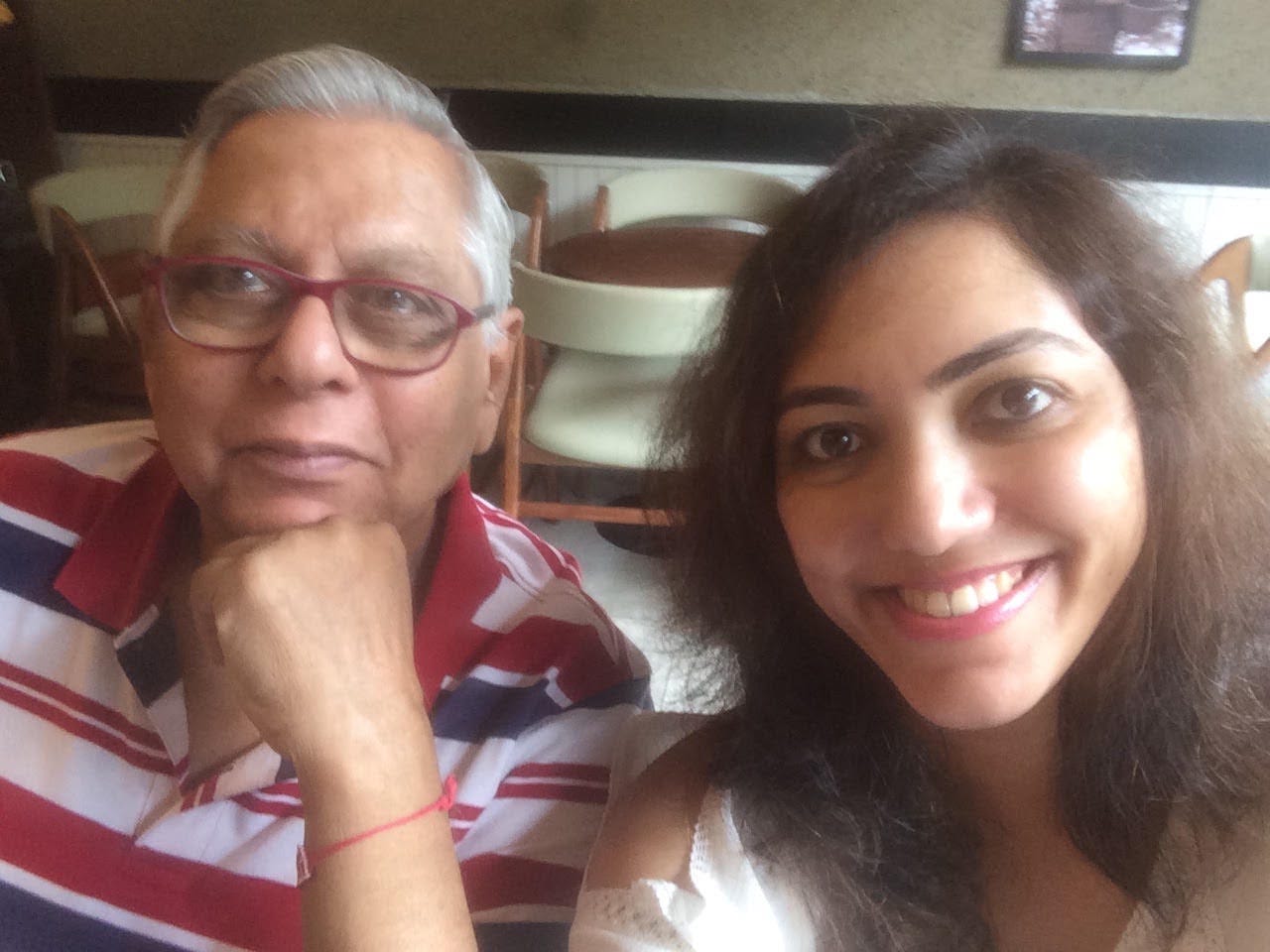
Every morning, a familiar message would ping me as I tied my shoelaces: Started seven-thirty. I’d wriggle my feet into socks and shoes, then rush out the house to catch my father for our daily walk.
For more than three decades, no matter where his work took him, he’d always ferret out a park within walking distance and circle it for forty-five minutes. When he retired and moved into a neighboring apartment, I became his satellite for the regular stroll. Within a few days of fixing our routine, he tossed in a new tradition—the cryptic crossword , one in which the clue is a word puzzle to work out the answer rather than a description or synonym of the answer itself.
As a family, we’d always pounced on the crossword page of the newspaper every morning. My gaze would often dart to the cryptic clues. I’d read them and reject their complexity in favor of my loyal friend, the simple crossword.
But imagine my delight when I glimpsed the method behind the madness in the pages of P. G. Wodehouse novels. In his novel Much Obliged, Jeeves, Bertie Wooster’s beloved Aunt Dahlia prides herself on solving the Observer crossword puzzle but struggles with one particular clue. A quick conversation with a new acquaintance not only resolves her conundrum, but also gives her insight into how she worked it out.
We dove in, like detectives attempting to solve their first mystery. Weeks passed before the crossword-setter’s tricks revealed themselves to us. But as we cracked each one, our confidence blossomed.
Only one flaw stood in our way—the filling in of answers while walking. But this trivial matter couldn’t stifle our enthusiasm. My father’s gnarled fingers clutched the paper that he had folded many times over to a width that held only the puzzle and the clues under it. We carried a pencil and scribbled in the letters in the steadiest hand we could. Later in the afternoon, when my daughter bounded home from school, she would grab the paper and pen down the answers in blue ink.
The clues challenged us more than we liked to admit. Only the anagrams came to us in a flash. We pencilled those in first, then ticked the respective clue. The ones that required our general knowledge took longer. Yet others, that read like riddles, worked the cogwheels of our minds. But we plodded our way through the little squares. Each time we struck off a clue we’d heap generous praise on each other. Often the solution would dawn upon my father, and only later would he figure out how the clue led to it.
At the end of the week, on Saturday night, we’d cast aside the paper, the squares bereft of letters taunting our puzzle prowess.
My morose expression would prod him to say, “Don’t worry, tomorrow morning, I will have all the answers for you.” That would invariably trigger a chuckle from me, for I knew he’d copy over the answers from the printed solution that would appear alongside the next week’s puzzle.
Stephen King admitted in his book On Writing that, for him, every day was a writing day. My father followed the same principle. Every day, no matter the weather conditions, his mood, or whether I accompanied him, he walked, and every day was a puzzle day. On rare occasions, he’d skip the Sunday session if he had enjoyed a peg or two of his favorite Scotch the previous night.
One fine cool morning, he suffered a partial stroke. Four days we spent in the hospital, while he underwent a battery of tests. His limbs remained unaffected by paralysis, and in the year of the Covid-19 virus, we regarded this as a silver lining. But swallowing became a chore, and a sense of imbalance ruined any chance of resuming his cherished strolls.
In the confines of the sanitized room, an intravenous drip had supplied the nutrition he couldn’t consume orally. But at home, he’d have to survive on a liquid diet, so he did, for the first week. We watched, pained, as he took sip after excruciating sip, gulping down smoothly on some occasions, but often collapsing into full-blown coughing fits. The liquids meant for the food pipe often found the windpipe instead, and after each swallow he cleared his throat several times, the sound reminding me of a train chugging reluctantly to its station.
The days passed in a blur of semi-liquid foods and a stream of medicines. I negotiated a new routine with my workplace and stepped in to handle the tasks he’d previously handled, like picking up my son from school.
Walking remained out of the question. Every day, he linked his wrinkled hand with mine and shuffled around the house for ten minutes, claiming he’d completed his exercise for the day. The crossword hadn’t slipped his mind, though, and he resolved to dedicate more time now to the puzzle.
When the Sunday supplement arrived one morning, a few weeks after the stroke, I found him attacking the clues with his usual vigor of old. But when he tossed the folded paper to my side, I noticed it was blank.
A couple of anagrams came to me instantly. He beamed and wrote them down in a shaky hand.
The walks still haven’t resumed, but the puzzles remain a cornerstone of our Sunday mornings. I long for the day when we note down the answers while breezing past our campus lawns, but until then, I’m content to bask in his company, and note down the answers he dictates.
As for the title of this essay, the avid puzzlers might have worked out that it’s a cryptic clue—for crossword.

Gargi Mehra is a writer, a computer engineer, and a mother. She plays the piano and thrives on word games including crosswords, Scrabble and Wordle. Her creative writing has appeared in several literary magazines online and in print. She lives with her husband and two children in Pune, India.
