


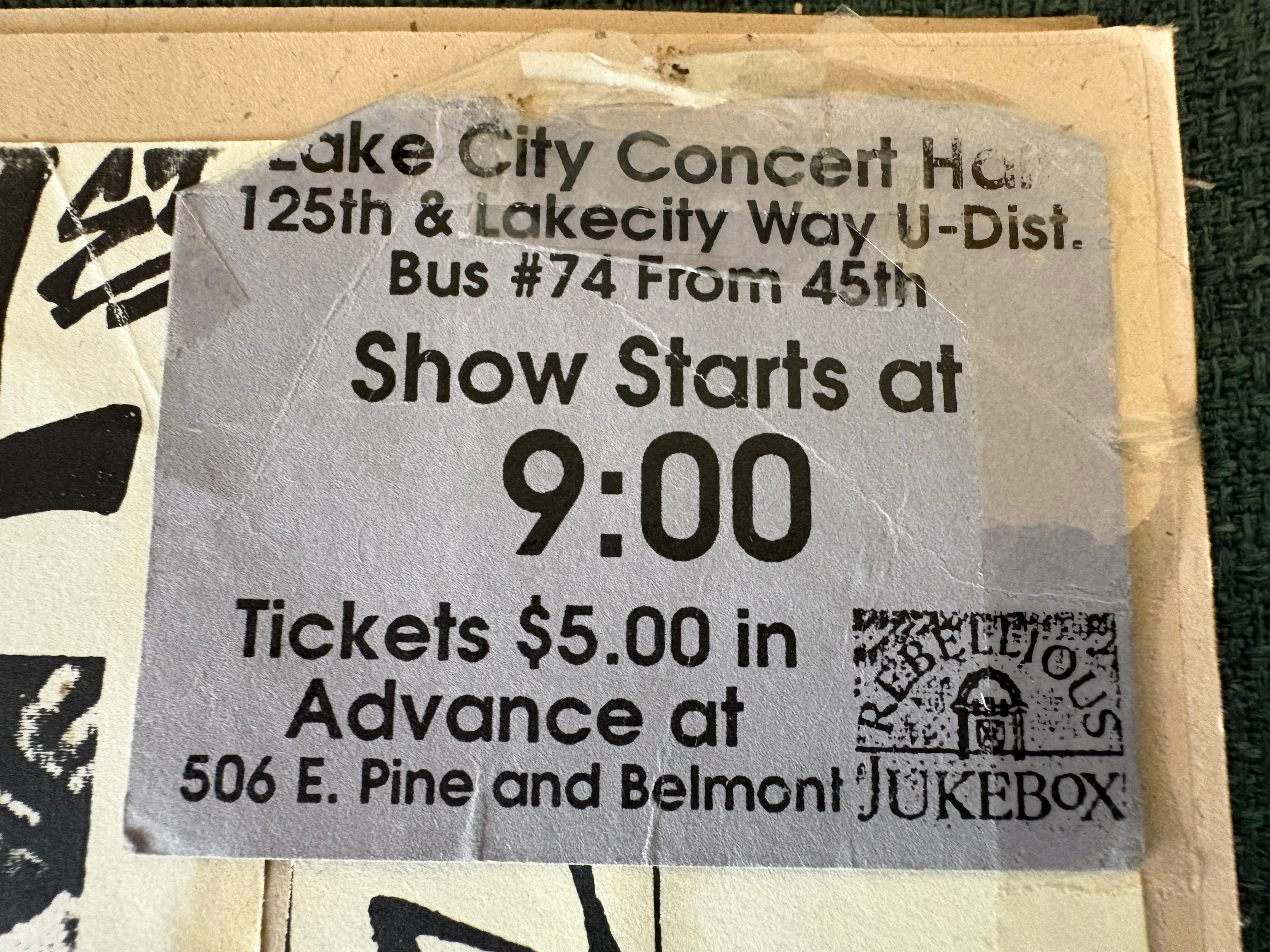
What kills me is that the bus route is printed on the old ticket, a purple square of paper I bought at the Rebellious Jukebox record store for five bucks. The five-dollar price tag kills me too. Most concerts were twelve bucks in 1990, but Fugazi made their shows all-ages and cheap.
I was 19 when I rode the city bus to that Fugazi show at Lake City Concert Hall, a horde of Seattle punks spilling from the seats: Mohawks, leather jackets and pierced faces, a few understated kids in plain flannels and Chuck Taylors and Levis like I wore. “Grunge” hadn’t been coined yet. This was a year before Nirvana’s Nevermind came out. Some of my friends in the D.C. hardcore scene told me this great band was coming through, so I’d bought a ticket without once hearing a Fugazi song.
I was a queer kid and I wasn’t sure if there were other queers on that bus, but riding to that concert was one of the first times I felt less alone in my life.
It was a soul-killing, arduous task to be out and queer in 1990, a time when we gay people were excommunicated from the human race. I’m not exaggerating when I say that gay people were not considered to be human beings in the 90s. We were clocked as monstrous creatures by mainstream society, where thousands of parents disowned thousands of sons dying of AIDS in lonely hospital beds. Instead of family, we Gen X queers had friends. Our friends were our world.
My Seattle friends in the punk/straight edge scene knew my story, that I had dropped out of college in Arizona, the only state I’d ever lived in, and followed a woman here, to this city where I knew no one, and then...she married her boyfriend. My friends knew I was in love for the first time, then flattened with devastating heartbreak. I hadn’t yet been in a mosh pit, but my friends knew this Fugazi show might just be my cure.
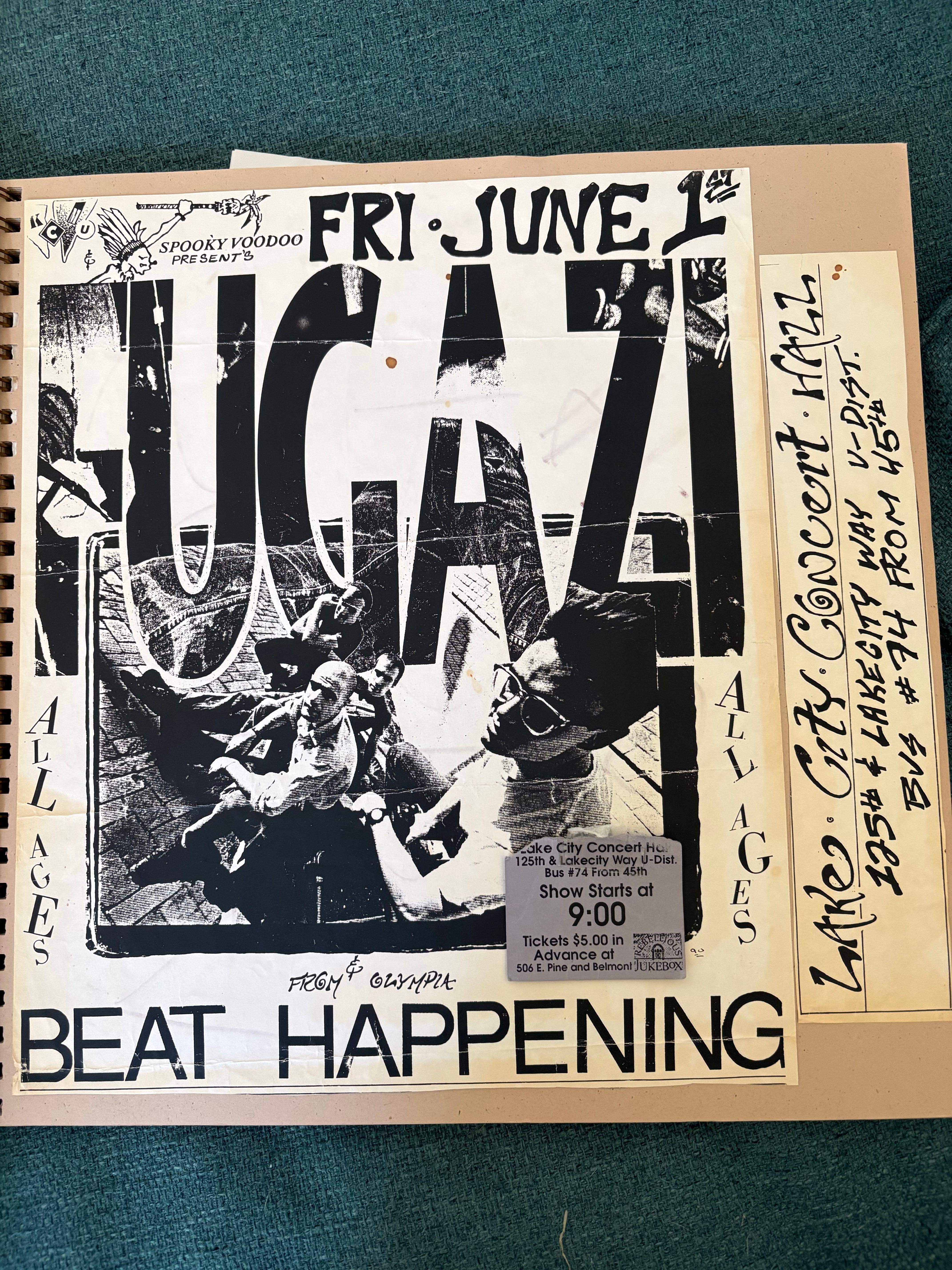
Now, I’m 55 years old and that little square of purple paper serves as proof. A kind of Gen X. I.D. It reminds me what little 19-year-old Molly managed to do. My parents paid my first month’s rent and then expected me to make the next month’s payment or come home. I had to land a job quickly. I was getting resumes copied at Copy Mart when I saw their for-hire sign and just started working there. I made five dollars an hour making 3-cent copies for lesbians from the Wild Rose bar around the corner and I hung out with the punks I met on the job. I was living like a full-fledged adult at age 19. Only now can I see how young I actually was.
I didn’t know that I had arrived in Seattle at a watershed moment in American music.
I knew that I’d followed love here. I knew that I’d followed a woman here and that we both were in love with music and were both following that music and that intense love for it to Seattle.
These days I also still own a cassette tape of Nirvana’s Bleach, the Sub Pop album that preceded Nevermind. That object comes close to meaning for me what the Fugazi ticket means, because, like a paper ticket, a cassette is proof in a format that’s not manufactured anymore. And that cassette is the closest I have to some proof that I attended the Nirvana Motorsports show in October of that year, proof that I was there to see Nirvana with the Mudhoney drummer on stage and Dave Grohl in the audience deciding if he wanted to be in the band.
This is probably a good moment to ask myself why I need and keep proof of anything. Is my 90s archiving a weak, desperate part of my 55-year-old self that clings to a nostalgic past? Am I just trying to prove that I was, for a brief, fleeting moment…cool?
Sure. Alright. That’s part of it. Because I was barely two years out of high school when I went to that Fugazi show, and in high school I’d been a freak and an outcast. I got ridiculed everywhere I went. Being cool in high school would have meant feeling safe.
I’ll cop to it: All of us high school losers keep proof of our living well as the best revenge.
But that Fugazi ticket stub also means this: my first time moshing, all of us balancing and swaying as we wait for the band to start, all packed in, sweaty body to sweaty body, our feet nearly slipping off the wooden arm rests, my friend Mary trying to put a contact lens on her eye as we jostle and sway. Bam! The bassline pounds and the first chords rip out. The moshing is this weird miracle. The friction of the fast, gutty melody disintegrates the boundaries of our bodies into fusion and collapse and frenzy. We are angry kids drowning in bliss. We are the roar of a fierce, unstoppable lion, not bodies, not flesh—we, all of us, become pure sound, liquid sound, a mighty flood ripping giant trees from the earth.
My ticket stub says that for the first time in my life, on June 1, 1990, I felt truly alive.
Unafraid.
I knew I could kill my depression, belong with people, and live a life worth the hassle.
Now in 2026 as my beloved country collapses under dictatorship, ruled by total dicks who are the same total dicks from 80s high school, I can grip this ticket between thumb and forefinger, feel the grit of the cheap construction paper, and find the fierce youth I’ll need for the fight ahead.

Molly McCloy is a four-time Moth slam winner and Lambda Literary Fellow. She won the 2023 Book Pipeline “Unpublished” contest for nonfiction and The Quill Prose Award from Red Hen Press who will publish her memoir Nine Grudges: The Spiteful Origins of the Happiest Dyke on Earth in September 2026. Her work has been featured in O Magazine, excerpted in the Blue Mesa Review and Foglifter, and broadcast on the Best of Risk! podcast. She earned an MFA from The New School and teaches writing for the awesome students of Pima Community College.
Object-ives features flash nonfiction essays of 500-999 words on the possessions we can’t stop thinking about.
Recommended reading on possessions:
“A vinyl collector with one rule – he can’t keep anything.” by Chris Schulz
“Collector’s Lot” by Jane Housham
“bare bones living” by kathryn mayer, writing out loud
“For These Millennial Fountain Pen Fans, Community Is the Real Collectible” by Rachel Myrow, KQED
“You Can Have My Walkman, Just Don’t Take My Mix Tape” by Kera Bolonik, The New York Times
“My Deranged Quest to Hunt Down a Viral Pumpkin-Head Gumball Machine” by Joshua Lyon, Wirecutter

As someone who also has a drawer full of useless paper proof from decades ago, I appreciate the honesty here. We collect these things because we're terrified of forgetting who we were before the world beat us down.
Great piece. I especially love how you bring it back around to present day. And those dicks in high school who are now the dicks in office. And the final hope that desperate and exuberant youth will be key to saving ourselves again, just like you did as an individual. Excellent writing!