


As a Taurus, I know that earthy, material things make me happy; they keep me grounded. The way a certain fabric feels. The scent of a particular perfume. A juicy burger with the softest bun, cooked to the perfect temperature (medium rare, of course). Because of this nature, I am ever the crafty-crafter. I love knitting, collaging, and baking.
With the world on fire, knowing this about myself is important more than ever. Grounding is necessary in global (and life) upheavals if I am (we are) to survive this.
Enter: pottery.
I’ve always craved to know what clay felt like, wet and spinning on a wheel. What was it like to get messy and make something from a blob of water and dirt? But as a girl growing up in an Asian immigrant household, getting dirty was not something I could do. You got dirty? You got punished.
Meanwhile, raised Catholic, I’ve always thought about the teaching that God is the potter and we are the clay. I wondered: What would it be like to be God? What would it be like to make something, to shape something from clay? And would I be able to breathe life into it?
I started pottery about a year and a half ago, in the midst of trying to understand who I was, now that I was divorced and a single mom of three. It had been two years since everything was finalized and legal, and I was still fumbling around in this new version of me. Who was I, now that I was single again? And not just single, but “divorced.” And in midlife.
When I started pottery, I was very focused and intent on “getting it right the first time,” whatever that meant. (How very Asian of me.) I followed the instructor’s guidance. I made sure I made no mistakes. I was careful in my movements. I was reluctant to trim, to sculpt. I wanted to make each piece perfect.
But what I didn’t know about this craft was that pottery was all about mistakes. They were inevitable. The whole point was to surrender and adapt.
Ha! As if!
After a year of instruction, due to my schedule, I had to shift to open studio hours where I would work independently. There was no instructor. Only YouTube videos if I got into trouble. But who wants to check their phone with mud all over your hands and a brown lump spinning wildly in front of you?
I learned how to surrender the hard way.
One time, I threw down about two pounds of clay on the wheel and started centering it. Or at least I tried. The thing didn’t stick and just slid off. I sighed. I stopped the wheel, took off the bat with one hand while holding the clay in the other, grabbed a fresh, dry bat, put it down, and threw the clay on that. This time a little harder. This time, it stayed and I worked on centering, reminding myself: I’m the boss and the clay cannot push me around (despite the clay actually throwing my hands around in wobbly circles until I pushed back and got it centered).
Another time, I was working on shaping a bowl and my pull was uneven—the bottom was thicker than the top. So I worked on drawing up the clay from the bottom to even it out. But then the dreaded Wobble showed up. The top part of the bowl was too thin and started to collapse. Wobble, wobble. I accepted my fate. The last time I tried to fix the Wobble, it didn’t work out so well (RIP, bowl). I got my pin tool and trimmed off the top half. My bowl was now a plate with a tall edge.
Last week, I had to smush down a bowl whose bottom I made too thin so that when I wired it off the bat, there was a big hole. I didn’t want to make the effort to create and attach a false bottom, so I just smushed it down back into a blob.
Time and again, I’ve been asked to surrender to the clay. Instead of being the God-like potter who was in charge, I was the servant, the one in service of the clay. What did the clay ask of me? What shape wanted to come through and how could I help form it?
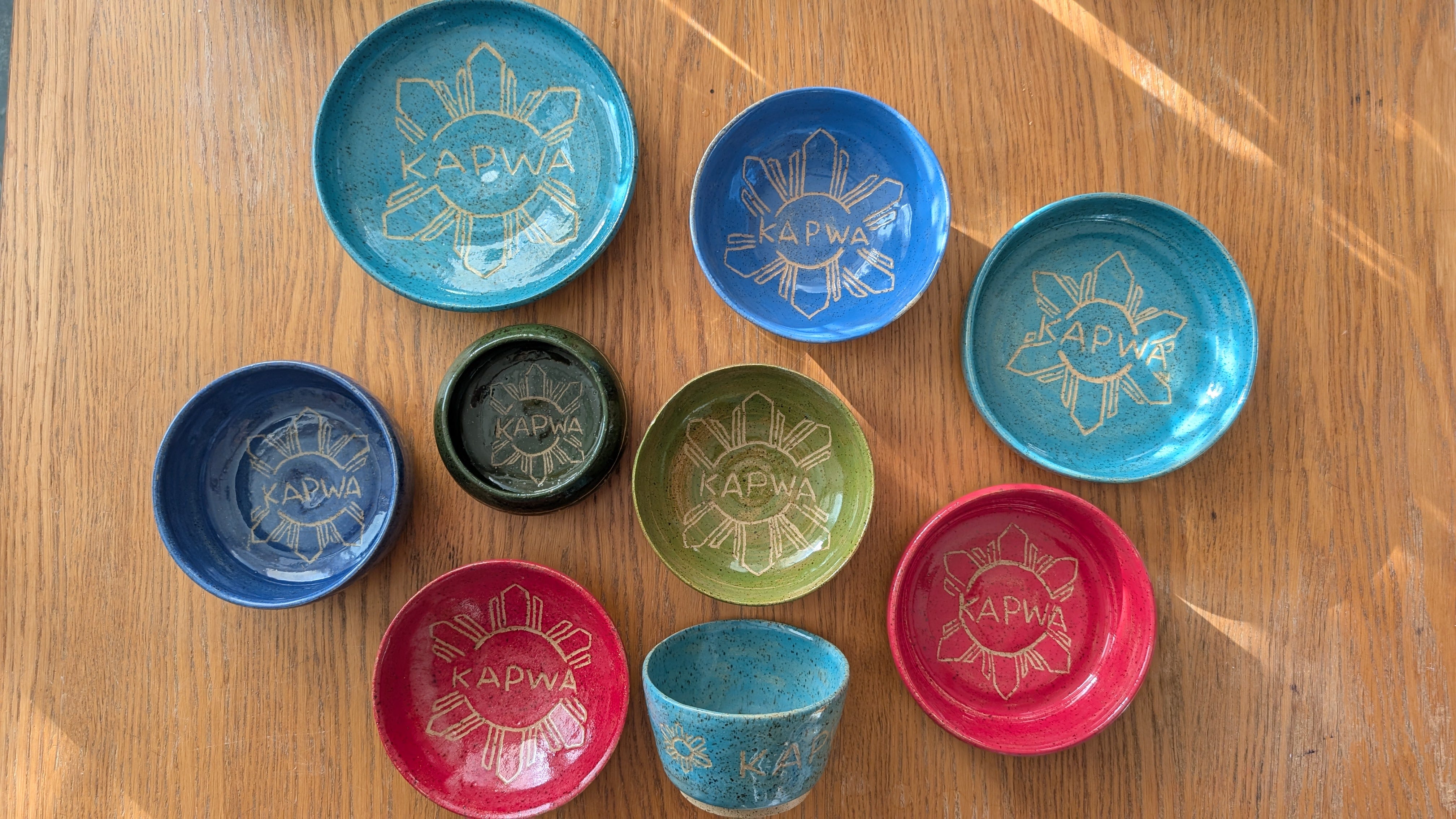
What has emerged for me has been a practice in deep listening, in coming to pottery as a sacred act of connecting with the divine. And honestly, I didn’t see that coming. But what has come forth are sacred vessels that remind me of who I am and where I come from: a colonized people who have resisted and persisted for centuries, a people who remain despite the attempts at erasure.
My bowls are made from speckled brown clay, a symbol of Filipino “mixed-ness” as the people of an archipelago. They are then painted with underglaze, representing the attempts of colonizers to “civilize” us, to erase our “savagery.” Then, the bowls are carved using a technique called sgraffito to show that we still remain and we refuse to be hidden or silenced. The etching away of the underglaze says: We are still here, found in the symbol of the Filipino sun and the Tagalog word “kapwa” (which means interconnectedness, all are one from the same source).
Who I am has not changed. I’m still a Taurus. Still a Catholic. Still a daughter of Filipino immigrants. The only thing that’s changed is the way I’m showing up in the world. And I’m still learning, still changing. Thankfully, in the face of constant change, pottery has become the grounding and guiding force that always brings me back to Me.

Leslieann Hobayan is a Filipina-American poet, essayist, activist, and host of Spiritual Grit, a podcast on spirituality and activism. She is the author of the chapbook, Divorce Papers: A Slow Burn (Finishing Line Press, 2023). Nominated for a Pushcart Prize and a 2018 Best of the Net, her work has appeared in The Rumpus, Aster(ix) Journal, The Lantern Review, The Mom Egg Review, and elsewhere. She was awarded the 2025 NJ Council for the Arts Poetry Fellowship and teaches at Rutgers University. Find her on Substack at Adventures in Midlife! Find her sacred bowls at hobayanhouse.com/kapwa-bowls or on IG: @leslieannhobayan

I came to this from a different world. Twenty years of building companies and your line about surrendering to the clay is the truest thing I have read about them in a while. I started every business intent on getting it right the first time. The good years only began when I learned to ask what shape wanted to come through. The plan was never the boss. The clay was.
I loved the connection between the clay body, underglaze, sgraffito, and your experience as a colonized Asian-American! Brilliant. So brilliant I almost want to copy it 😂
I'm a Chinese adoptee, raised by a white woman. The humbling hobby of pottery has been amazing for my mental health, in more ways than one. It's great to meet someone else who has healed through clay. Lots of love!