


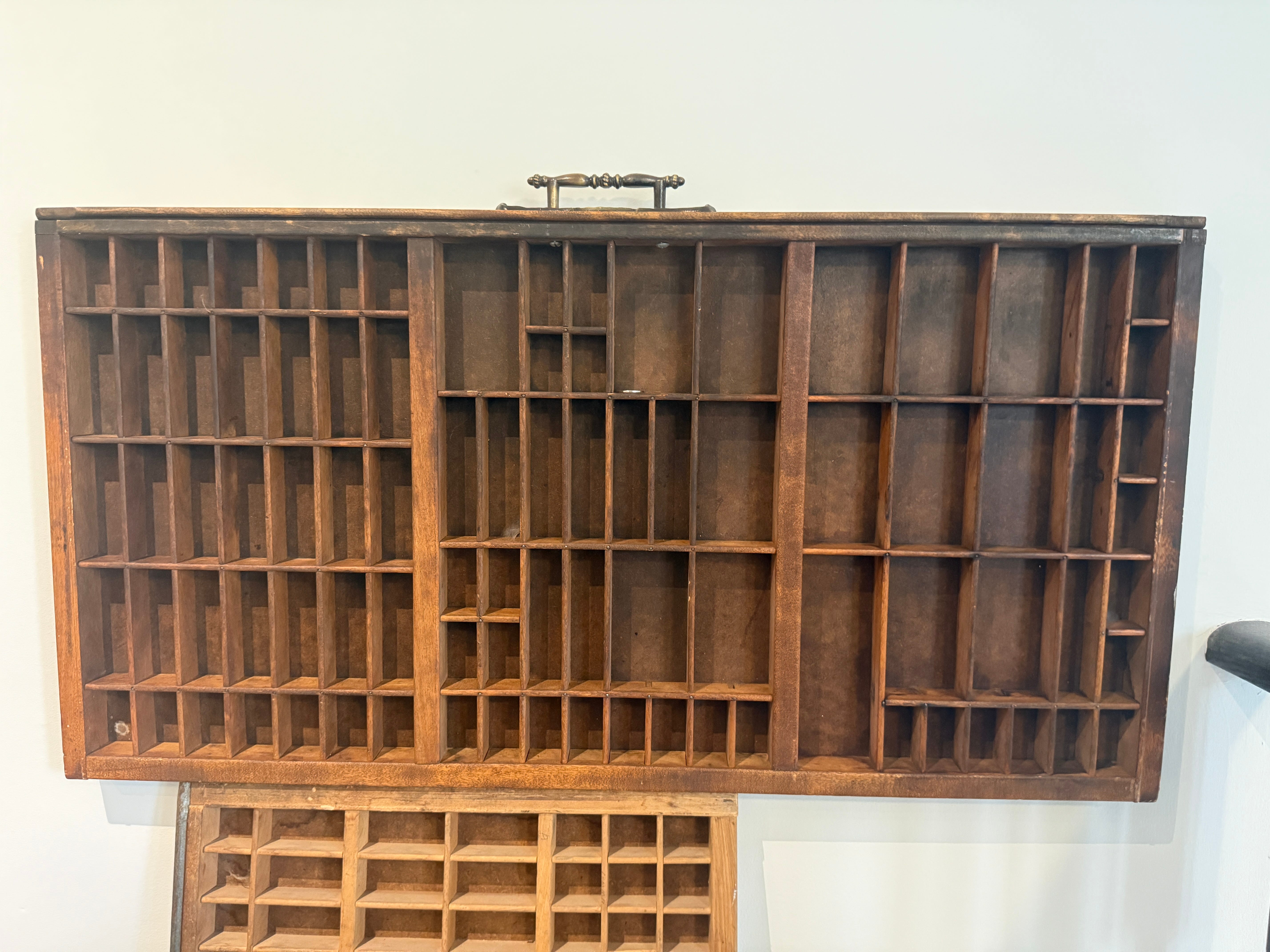
For eleven moves, I’ve carried three linotype cases myself because they are too precious to hand off to movers.
”Oh, I’ve seen those things before. What are they?” people say when they see linotype cases on a wall in my home. When I tell them, no one knows what they are. Even writers and avid readers don’t know they are looking at the history of publishing. It wasn’t always computers, drop-down font menus, and page layout templates that determined how our printed pages look. It was the skilled hands of composers like my father who did it for hundreds of years before.
Catching a glimpse of the typecases showcased on my wall, whether holding Lego mini-figs, rolls of coins, or wine corks, visitors are peeking at publishing legacy while peering through a porthole into the making of me.
My dad was my rescue companion and lighthouse: a beacon of relief from critical gazes and escape from being relegated to the dank basement crawlspace a “should be seen and not heard” child was supposed to play in. If I’d been asked, I would have chosen books over Barbie, Tolkien over tea parties. But I wasn’t asked.
As a kid, my true play spaces moved with my father’s day. More his kid than hers, I went to work at his print shop with Dad. There were no limits at the shop. I couldn’t get anything wrong there. My father’s hands were huge and skilled. He deftly swirled a wide spatula through pots of primary-colored ink, blending shades to Pantone precision on a sheet of glass. My job was to say when Pantone’s Navigate (17-5025) developed to Deep Teal (17-5024), one step away on the color swatch. I still believe I see more colors than other people.
Dad jogged six-inch-thick stacks of newspaper-sized paper, riffling the stock with air so the sheets wouldn’t stick together as they shot through the monstrous Heidelberg press that sat like Jabba the Hut in his shop corner. I knew about paper types, weights, and sizes. I had access to a small warehouse of colored Bond paper, a precursor to my serious stationery habit.
But nothing captivated my interest more than how ink could be laid out on the page to tell a story.
My father was a compositor and later a hot-metal linotype operator, until the machines were phased out of every print shop, newspaper press room, and publishing house in North America by the early 1970s. I have one California Whetton post-war job case and two Hamilton Triples. The Hamiltons are less common and more ambitious because they can carry an entire font family in a single tray. (No need for an upper case and lower case with the Hamiltons.) Chances are good that these cases held an ancestor of the Times New Roman font for the small-town newspaper my father worked for after high school.
Before my father sat at the linotype’s clacking keyboard casting whole lines in molten metal, he composed by hand. The process didn’t change much after Gutenberg’s invention of the movable type press in the 1400s. I saw how small a single “sort” of type was, and couldn’t imagine my dad’s big hands reaching into wooden cases, but the edges of the tiny compartments were worn dark by fingers pulling each letter and symbol, and space, quad, or lead out one at a time. He would have been transcribing mentally from handwritten copy or typewritten pages, setting type backwards and upside down, building lines into a composing stick until he judged it would justify. The transposing eye of a compositor or linotype operator made margins flush, decided on hyphenation, and corrected orphan words before software did.
He became a machine operator, casting lines at speed, and when offset printing made his own business possible, he evolved. When computers came, he found a way then, too. The technology of book building changed, but he stayed, and so did I. The linotype cases moved from his office wall to mine.
Dad was well-known for his long-winded, detail-laden recounting. Our window-down station-wagon trips were lessons in post-WWII cultural change, delivered by story. He’d call out farm family names, breeds of cattle, and the make of every airplane and car. We were inseparable; less his choice than mine.
He taught me about scenes and they became the core of my non-fiction teaching and book coaching career. His stories featured visualizable details, and not just commonplace descriptors. Dad made me a writer from my discerning font choices to narrative mosaics. Like the finest of storytellers, he was life taught, and short on academic training.
He made one demand of me, in my entire life. “Go to university for something, anything. You can always come back and run the business.” I wanted to make books, but I never went back to the print shop for long.
My downsizing last year was more keep-what-your-heart-can’t-part-with than pitch-the-cracked-and-dented-things purge. It was my reckoning with rupture. I had become a reluctant curator of ghosts for other people’s stuff. I feel a kinship with containers. So I mudlarked through discarded family jewelry and envelopes of loose black and white photographs of family I’d never known. I made difficult choices. I held tighter to the things I feel define me. The things I choose to keep tell me who I am.
The linotype cases will always be part of my home. They are as essential as family photos for me; they’re my origin story. Books are in my blood. We have forgotten how books are made. Without personal storytelling, we risk forgetting the people who formed us, too, or misremembering the moments that created us. Writing memoir is an act of personal archaeology.
I keep them to protect them and the remainder of his fingerprints and to honor the man who made me and the profession that fostered my own. I keep them because I couldn’t bear to part with them. Isn’t that why we keep so many things, or what we tell ourselves?

Patti M. Hall is a writer who walks comfortably among ghosts—of cities, family, and partially told tales. From them, she crafts maps, meaning, and memoir. She is the author of Loving Large (2020) and is writing Things We Choose to Keep, a memoir about the sacred weight of kept things. A lifelong independent authority on Mary Shelley and Frankenstein, she writes about books and the writing life at Behind the Book on Substack. She is a writing coach and publishing strategist to non-fiction and memoir writers crafting impactful books that serve.
Object-ives features flash nonfiction essays of 500-999 words on the possessions we can’t stop thinking about.
Recommended reading on possessions:
“LOSING MY WATCH” by Abigail Thomas, What Comes Next?
“You Can’t Buy Memories” by Timmarie | Honestly Away
“What Dolls Taught Me About Being Human” by Dr. Erick DuPree
“Downsizing” by Pam Johnston, The Middler
“‘I felt the space opening up around me’: Author Ann Patchett on what she learned from a radical declutter” by Ann Patchett, Good Housekeeping
“Is It Ever OK to Declutter Your Partner’s Stuff Behind Their Back? Asking for a Friend” by Lisa Milbrand, Real Simple
"The things I choose to keep tell me who I am." - Agreed!
The cases are stunning and clearly dripping with meaning. Thanks for sharing.
Beautifully written, Patti! A lovely tribute to your dad, and the power of the things that define us. The Georgian Bay School of the Arts was gifted many of these boxes. Mammoth Hall Press teaches courses on letterpress and other printing making methods there now using mid 1800’s presses. I’ve taken three with them already. Could be a fun trip down memory lane for you too!