


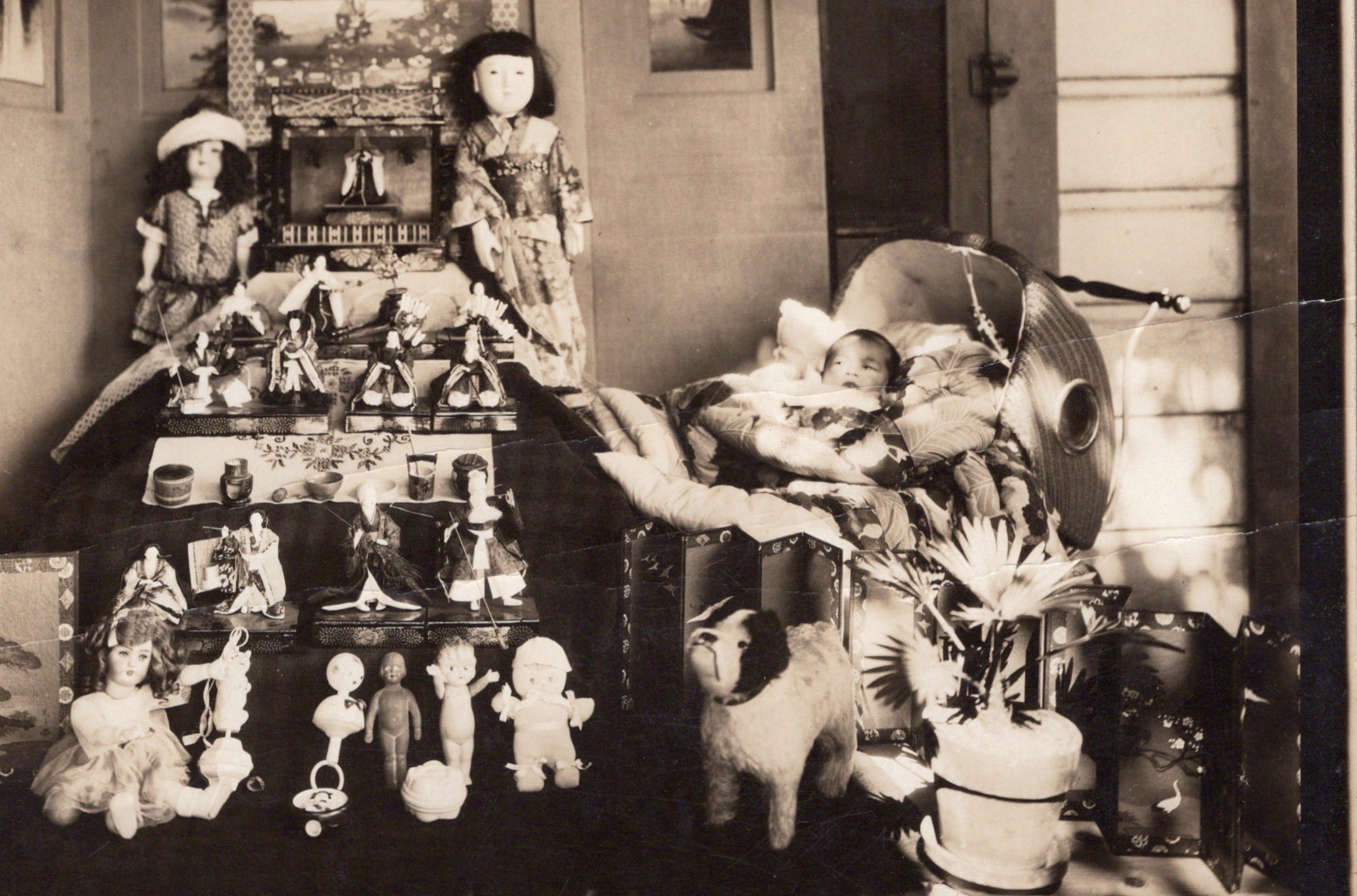
Out of six siblings, only two baby pictures from my Japanese American father’s family survived. One of them I keep by my front door: a sepia picture of a Japanese Girls’ Day doll set, complete with an emperor and empress, courtiers. Families display Girls’ Day dolls each year, a Japanese tradition meant to celebrate girlhood and wish daughters happiness in marriage. Not so traditionally, this set included Kewpie dolls because my Japanese immigrant grandfather wanted to include some American context in this Japanese setting. Next to the dolls, there’s an infant sitting upright in a basket. In front of the baby, there’s a vase of chrysanthemums, signifying wishes for long life. The setting is the porch of a wooden farmhouse in Northern California sunlight.
The baby is my oldest auntie, Hisa.The remaining family pictures were burned by her younger brothers. One of them was my father.
The story behind this first picture’s survival is a small miracle of kindness.
Before the war my grandparents Junichi and Shizuko were sharecropping to support five children, with a sixth on the way. I don’t know how my grandfather was able to muster enough funds for a set of Girls’ Day dolls. Before my auntie Hisa was born, another girl had died in infancy. But my grandfather was determined to celebrate the strength of this new infant girl and bought this doll set. Somehow he had this photograph taken.
When Japan attacked Pearl Harbor in 1941, the majority of Japanese immigrants and Japanese Americans were shocked. Like many other Japanese Americans on the West Coast, my father and his family were told that they had to burn anything with Japanese writing on it, including photographs, in order to disavow any connection with a wartime enemy.
Though my father died in 1984, when I was 10 years old, he left an unpublished typewritten manuscript of his wartime incarceration that he called Daruma: The Indomitable Spirit. He describes this episode in two short passages. In the first passage, the family is sitting around the dinner table and my grandfather is reading instructions from a local Japanese American organization trying to help the authorities:
The document was in both English and Japanese and, according to the first paragraph, written at the request of the United States government. My father read the letter carefully. Then at dinner that night he announced, “One of the things that puzzles me is that it says to destroy everything with Japanese writing on it. Then right after that, it says to burn all pictures.”
‘Even baby pictures?’ Nob asked.
‘Why pictures?’ I asked in all innocence.
‘I guess because they show locations, and that could be used by spies or something like that,’ my father reasoned.
‘Then why baby pictures?’ Hisa persisted.
‘Maybe baby pictures are not included,’ my father concluded, and then added doggedly, ‘The letter specifies all pictures though.’
In the second passage, my father and his older brother Nob are outside, burning pictures and books and papers with Japanese writing—as instructed.
Then we started with the pictures. We wondered about the wisdom of it all as we fed the fire. Nob and I talked about saving a few and hiding them somewhere. We talked about it some more and concluded that Father would not permit it because he did try to follow the law when possible.
‘I still don’t understand why we have to burn all the pictures. What good would these family shots do anyone?’ I said as I pitched a baby picture of Nob in the fire. Taking a last look at each one before burning them, I felt that a part of me died with each picture that went up in flames. It was no joy to part with cherished mementos from the past, and even though we wanted to save a few, we reluctantly tossed them in the burning pyre.
“The reason for burning the pictures is because we’re supposed to be spies. Don’t you know that? After all, the saying that’s going around right now is, ‘The only good Jap is a dead Jap,’ Nob said.”
I had read my father’s manuscript as a child, and that scene of baby pictures burning haunted me for decades. Then a different auntie, my auntie Sadako, gave me the family set of Girls’ Day dolls. Even though she had sons, she asked for the dolls because she wanted to display the set each year and teach her sons to respect women. (It worked, by the way.) She kept the original set preserved and added on to the display, adding the set of court musicians and the footmen and other trappings of the Imperial court.
With the dolls came the picture of the set—and with it, that picture of my oldest auntie. The dolls and the picture of my auntie Hisa are the only belongings that were returned to my family after the war, kept by a kind neighbor. When they returned after four years of imprisonment, the rest of their belongings had been stolen.
And yet. Not long after I inherited the doll set, I also inherited my oldest auntie’s scrapbook, and here I discovered the second baby picture that survived the war, also of the same auntie. I don’t know much about this picture or its circumstances; it’s a picture of an infant swaddled in blankets, in a wooden high chair. It’s labeled “Me” in my aunt’s handwriting. She also kept other pictures from her childhood in her scrapbook. Now I think she must have carried them into the prison camps and back.
In my head I now hear my aunt’s question in my father’s book (“even the baby pictures?”) differently. Her question was not just an exercise in critical thinking, not just an act of resistance, but also an act of self-preservation. I now have two photographs that speak to wartime racism: You do not get to define me. This is who I am.
Join Tamiko Nimura and Open Secrets Magazine on Tuesday, November 17 at 8:30 p.m. for our next Show and Tell on Zoom, where we’ll be discussing and sharing our favorite possesions. Open to all.

Tamiko Nimura is an Asian American creative nonfiction writer and community historian. Her words have appeared in LitHub, Electric Literature, Smithsonian Magazine, and the AWP Writer’s Chronicle. She is a frequent contributor to Seattle’s International Examiner and Discover Nikkei, project of the Japanese American National Museum. She is co-author of the graphic novel We Hereby Refuse: Japanese American Resistance to Wartime Incarceration (Chin Music Press, 2021). Her most recent book is a memoir entitled A Place for What We Lose: A Daughter’s Return to Tule Lake (University of Washington Press, 2026).
Object-ives features flash nonfiction essays of 500-999 words on the possessions we can’t stop thinking about.
Recommended reading on possessions:
“My daughter’s Day of the Dead altar has changed over the years” by Jacqueline Dooley, The Halfway Path
“The Library” by Shawna Ayoub, Survive Your Story
“What America Is Living Without” by Alissa Quart, The New York Times

What was done to Japanese American citizens during the war is disgraceful, another dark mark on our history.
I taught in Los Angeles under the first Asian, female principal, Mrs. Mabel Ota, who had been sent to a camp as a young bride. Her first baby daughter was born in the camp. Due to poor conditions and nutrition the child was mentally challenged which only added to the horror.
Mrs. Ota helped get restitution for those who had suffered and was a highly respected member of the community that had once shunned her.
What a beautiful and inspiring story.