


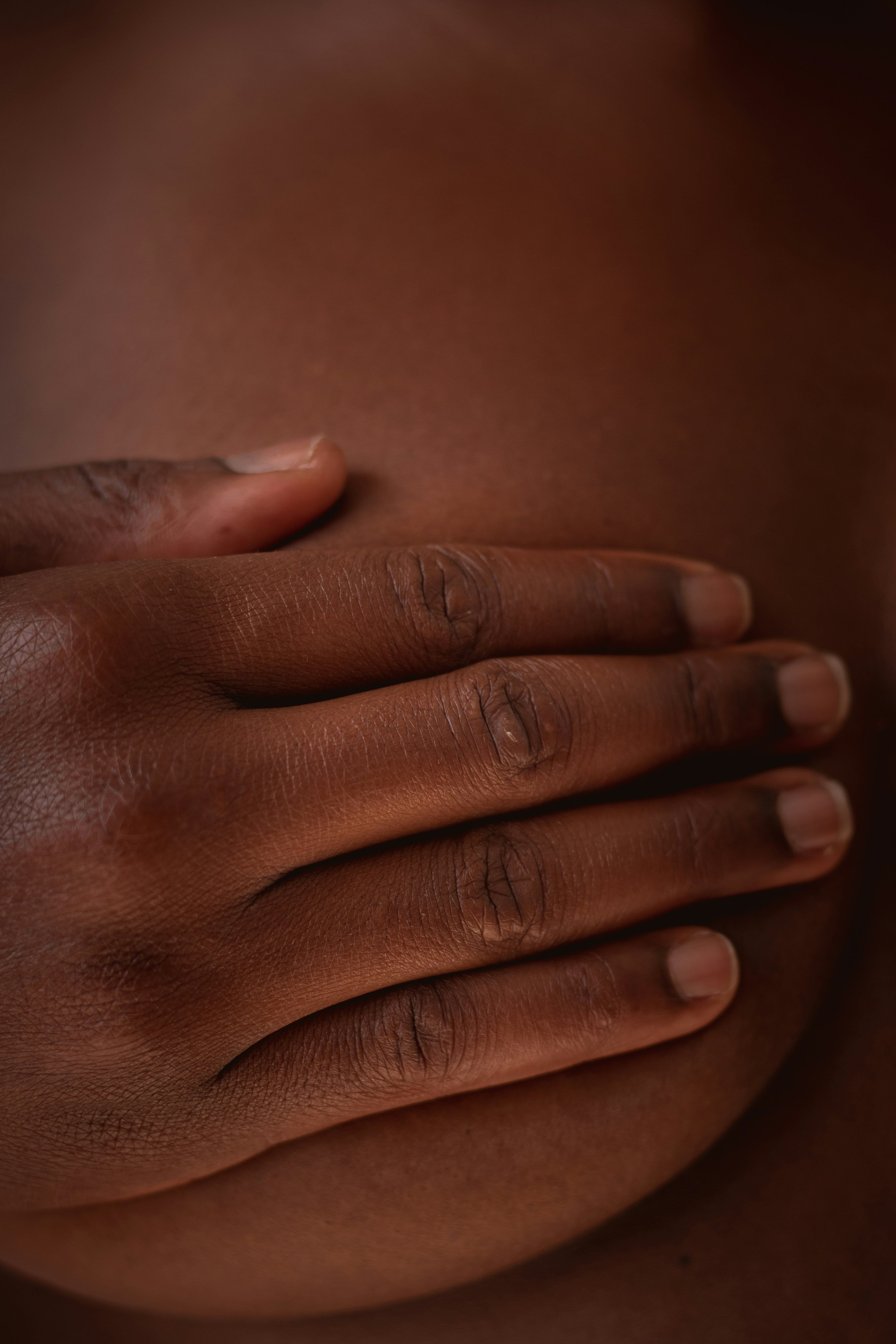
The curtain offers an illusion of privacy more than actual privacy because I can’t get it to close all the way. It’s hung on the rod in that way curtains can be where it’s at a certain angle and doesn’t meet the wall. Someone walking by could look in if they want, but I don’t know why they would want to, and I decide not to care.
I take off my shirt and bra, tucking my bra into my shirt and placing them in the cheap wooden locker. I use the provided baby wipes on my underarms to clean off the deodorant I suddenly remember I don’t have on. The gown is a faded dusky pink, much better than the baby pink gown I’ve worn at other facilities. There’s nothing babylike about what I’m about to do. I put on the gown and walk to the waiting room.
The first time I saw my mom after her diagnosis, she was waiting for me on her porch. I drove up and lost my breath. She was so thin. Like a famine victim. I helped her stand up and glanced at her body. It wasn’t the body of the mom I’d had for almost 40 years, yet it was. The string cinched around her hips to keep up her sweatpants showed how thin she’d gotten. She could tell I was in shock and said, “I look bad, don’t I?” I told her she was sick and it was okay which didn’t answer her question but was all I could say.
It seems inevitable that I will develop breast cancer. My mom, my mom’s sisters, and my mom’s mom all had some form of cancer, mostly breast cancer. When my mom got breast cancer the second time, her eye doctor discovered it. By the time he found it, the cancer had spread to her lungs, stomach, and behind her eyes. Obviously I don’t want to get breast cancer, but sometimes in my head, it’s not so obvious. Would having breast cancer be a new connection with my mom?
I calmly and politely get through my yearly mammograms because the discomfort of one cannot come close to the pain I saw my mom experience from breast cancer. We talked on the phone at least three times a day, and she always seemed on the verge of tears. Our brief conversations seemed to tire her, yet she told me she wanted to talk to me. Sometimes her voice was so quiet and shaky that I couldn’t make out what she was saying, but I didn’t want to ask her to repeat herself. Now I wish I had because it would have been a few more seconds of time with her. More time to talk about what seemed insignificant like what we had for breakfast or lunch. To try to make her laugh at the story of me being trapped in my car by wild turkeys. To tell her about the kind, elderly couple that lived below me who I thought of as the grandparents I never had. A few more seconds of being a daughter to a mom.
I feel a quiet acceptance while I wait to be called. I don’t really mind being here with the other women, going through our collective rite of passage. One woman clutches her gown to her body, but then I think about the mammogram tech who’s about to see way more than these ladies are currently seeing and stop checking mine.
There’s something freeing in being here. I usually worry about what people think of my body. Is this shirt too tight? In a place where I might find out that my body has changed itself, I’m interestingly free of any concerns about what others think of my body.
If this is the only time I have to do this for a year, I should be fine. “There are probably people out there who would pay some amount of money to see what the tech is about to get for free,” I think to myself.
One of my most haunting memories of my mom is that when she went through radiation, she showed me the skin on her breast. It looked like scorched earth: red, swollen, and cracked. My skin crawled. But how could I tell my mom who’s exposing herself like that, “I don’t want to see that. I can’t see that.”
A mammogram is a bargain we make with modern medicine. Endure the pain and pressure, hold still, and trust that this pain and pressure will let us know if we’re safe for another year. I sympathize with the techs who feel the need to apologize for any discomfort I’m in. I’ve been told I was incredibly brave for getting through a mammogram without complaining. I’ve been called “the best patient I’ve had all day.” The last mammogram tech kept asking me, “Are you okay? Does this hurt?”
No, I’m not okay. I used to think of my breasts as one of my best features. I wore balconette bras and V-necks to show them off. Now I whisper to them before each mammogram, “Just be cool, ladies. Just be cool.” I’m standing half naked while a stranger gets paid to pull and push and smash my breasts like water balloons between stoneware dinner plates so I can find out if this year is the year. If this mammogram is the one that changes my life. And yes, of course, this hurts. As if comfort matters or changes what may or may not happen. As if it can change what’s already happened.
This is what I came to do so let’s do it. Smash away.
I lived almost five hours away from my mom and would drive to her when I could. When I was there, we lay on her bed, watching reruns of The Gilmore Girls. I would take her to doctor’s appointments and buy Ensure to help her get nutrients. Falling asleep in the room next to hers, I would think about how many more visits I would make before I didn’t need to make them anymore. The thought of a life without her terrified me, but the thought of her in agony felt worse.
On my drive home, I safely hurried as much as I could so I could call and tell her I was back. She was my mom, I was her daughter, and she couldn’t relax until she knew I was okay. “Thanks. It was good to see you,” she would say. Being loved like that was a blessing and a burden. Knowing that my dying mom needed to know I was safe before she could try to relax felt wrong, like giving her one more thing to worry about when she already had too much to deal with.
“Wow, your breasts are droopy,” one mammogram tech said as she struggled to get them in the machine properly. And they are. They’re big, and after decades, gravity has gotten to them. I nodded when she said that, but on my way home and multiple times since, I’ve thought of what I could have said in reply. “Imagine how my bras feel, carrying these around all day!” “Is my insurance paying for the critique along with the mammogram?” “Well, if you’re lucky, I’ll have cancer, get a mastectomy, and next time, you won’t have to worry about their droopiness.”
While my mom was losing weight from her cancer, I was gaining weight from her cancer. I’ve thought of reasons why this happened, but the one that comforts and scares me the most is that the weight is my mom wrapped around me. The weight physically grounds me to a world without my mom. What happens if I lose the weight and I’m not in the body I was in the last time my mom saw me?
I don’t know the two women in the waiting room with me, and I’ll probably never see them again. Sitting on scratchy chairs in faded hospital gowns, we give each other a small smile and go back to looking at our phones or our hands. For a few minutes, whatever’s happening in our lives outside this room doesn’t matter.
We wait together to see if our bodies have betrayed us.

Aisha Hallman is finding her way back to a writing life. She is currently pursuing a Master’s degree in Creative Nonfiction at Antioch University and was named a finalist in WOW! Women on Writing’s Q3 2026 Creative Nonfiction Essay Contest.

So well-written and evocative. I was with you in the tiny dressing room and up against the machine. Good luck as you go forward, hoping you stay well.
so well written. only a woman can understand the fear of paying to have your breast squished and then waiting in a small closet dressed on a skimpy gown to find out if your body has betrayed you. Thank you for sharing this.