


My Mexican grandmother, who everyone called Nena, moved even more than we did when I was little. Her husband Jim was a crane operator who helped to build dozens of marinas, bridges, and man-made islands in Southern California, and Nena followed him from city to city. Finally, in San Diego, she made her stand. He could travel for work, but San Diego would be their permanent home.
This was all reported to my two older brothers and me by my mother, Nena’s eldest daughter, who had become a hippie and refused to be contained in any categories such as Catholic, Mexican-American, or married. My parents split amicably after moving us to the canals of Venice, California, in 1967. Our neighbors were a diverse lot who shared little except the habit of smoking marijuana and the desire for a better, more peaceful world. I accepted this bohemian village as the way things were and adopted the adults’ disdain for all things “square,” such as plastic toys, big American cars, and working 9-5.
My mom had wanderlust, and she took us kids traveling. A summer trip to Europe morphed into endless travel in California and Oregon, in search of an ideal place to live and raise us. We ended up in a brand new commune in the Santa Cruz mountains, living in tents and building a house in the woods; my oldest brother and I soon bailed on the whole idea, opting to go back to the Venice canals and live with my dad, so we could attend school more regularly.
That summer, newly turned 11, I was invited by Nena to visit her for a week. I can’t recall if I took a bus south or was driven, but I ended up walking from Nena’s Cadillac at the curb, over to a newish apartment complex and up the stairs to the second floor. She opened her front door and I stepped into what my young mind perceived as a slice of heaven.
Velvety blue plush carpeting covered every inch of the floor, and cool air purred from an AC unit. Sunlight emanated through long drapes, casting a dim half-light into the interior. White furniture was arranged along the walls of the living room, and a white and gold coffee table gleamed in the center of the room. Between the love seat and a couch stood a triangular mostly-glass display shelf. The angular shelves were lit from inside the display, and one shelf held a few sparkling glass figurines. I stepped close, mouth ajar.
The largest figure was a triangle of glass, faintly blue, with etched figures cut into each pointed edge. Nena took it out and carefully turned it in her hand before my eyes, saying the three different views represented the Father, the Son, and the Holy Ghost. I immediately lost interest and shifted my attention to the much more appealing rounded blue shape on the second shelf.
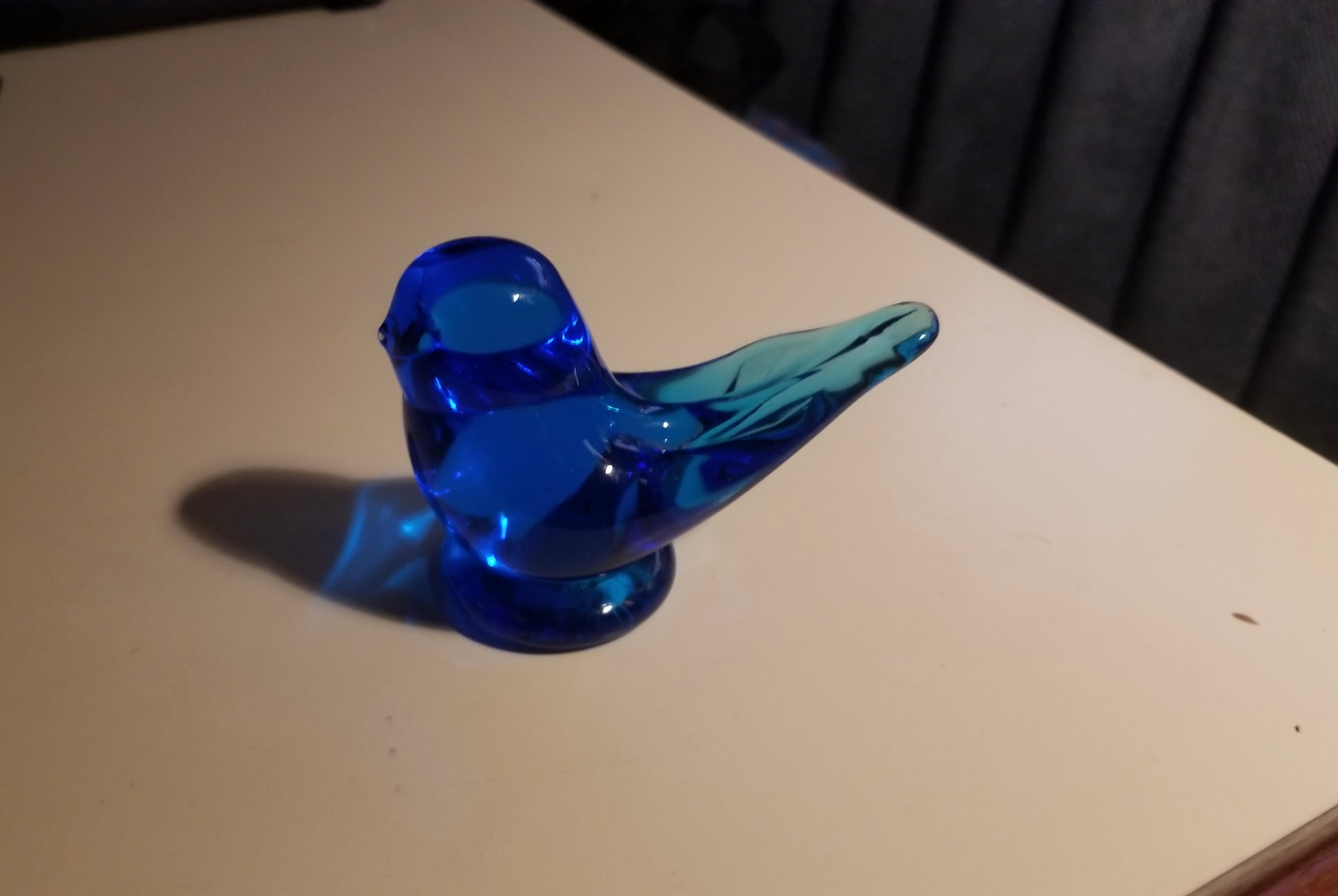
It was a plump bluebird blown from deep indigo glass. With its short sharp beak and tiny pockmarks for eyes, it seemed to be looking at me. Nena smiled and took the bird out, letting me hold it. She told me it was “The Bluebird of Happiness” and I believed her as only a child can. She told me about her father, a writer and philosopher, and how he would walk with her in the plazas of Mexico City when she was a child. She said he spoke to her about how to find happiness in life, by being useful and speaking the truth. I carried the bluebird around for hours that day, cradling it in both hands as if it were alive.
The week with Nena passed by too quickly, the glorious indoor setting matched by the courtyard between the two arms of the apartment complex, with its lush greenery, cement fountain, and comfortable patio chairs. Better than all of that, I could walk to the municipal pool just four blocks away in the local public park and swim and dive for hours in the crowded aqua rectangle of clear cool water. And on the way home, I could buy a cherry Slurpee from the 7-11 store at the corner and not have to share it with anyone.
Nena loved to spoil me, taking me to movies, shopping for cute outfits, and out to eat BLTs and French fries, my two favorite foods. She took me to Old Town to see the horses and eat churros and taquitos while she sat under an umbrella and drank a margarita. Admiring the murals and the blue-and-white pottery, she said to remember we were Mexican, not Spanish. She drove me to beaches and parks, showing me what she called “my San Diego” while I dreamed of living there.
My family did move to San Diego, and I attended school again for years, going on to a nearby college for a year before launching off. Years later, my husband and I sailed to Baja California, and I found myself feeling oddly at home in Mexico. I pictured Nena walking with her father in the shady plazas and that intergenerational link inspired me to write poetry and essays and to think of myself as a writer. Visiting Nena and Jim in their new double-wide mobile home, I shared my Baja stories, and she glowed with pride.
Years later, Nena’s dementia mandated her move to a memory care facility, where she spoke Spanish to her caretakers and called everyone Honey. I’d visit her after work and we’d sit in the sun. When are we going back home, she’d ask me. Mañana, I’d say, and kiss her smiling cheek.
Her bluebird lives with me now, in my floating home, nested in a snug drawer in a jewelry box that holds other trinkets she and my mom gave me. I’ve given much of the jewelry away, but the bluebird will stay, bringing happiness through memories of Nena and our shared love of Mexico.

Jennifer Silva Redmond is the author of Honeymoon at Sea: How I Found Myself Living on a Small Boat and a freelance editor. Her writing has been published in numerous anthologies and magazines, and on sites such as Brevity. Formerly editor-in-chief of Sunbelt Publications of San Diego, Jennifer is now their editor-at-large. Her book reviews and posts about writing and editing can be found on her Substack, Editor on Board. She lives with her husband Russel, an artist and teacher, aboard their sailboat Watchfire, somewhere on the West Coast of North America.
Object-ives features flash nonfiction essays of 500-999 words on the possessions we can’t stop thinking about.
Recommended reading on possessions:
“darling we are plushies” by Maeve, fernacular
“Personal Heirlooms: The Favorite Possessions That Tell Your Life Story” by Gregory Garretson, Living Elsewhere
“Our Favorite Food and Drink Souvenirs” by Amy Cavanaugh, American Weekender

The items that have always lived on our shelves are so precious. Thanks for sharing the story of your blue bird!
Beautiful essay, Jennifer!