


In the back of my kitchen cupboard sits a chipped mug. I can’t decide whether to get rid of it. For a time, this hefty blue cup was a favorite part of my morning ritual, its smooth red inside becoming submerged in steaming coffee and a splash of milk. Kurt Vonnegut quotes cover its surface, So it goes printed along the handle in wonky block letters. This mug, a Christmas gift plucked from my online wish list by my younger brother, who likely has never read a Vonnegut book, was beloved for years. Then it was knocked about and cracks appeared. An apt metaphor for my relationship with my brother.
I read once that, according to the practice of feng shui, you should remove items that are ripped, chipped, or cracked from your home because their energy also becomes broken, and this can be harmful to your wellbeing. Chip or not, the same recommendation should apply to gifts given by family members who have become estranged. No matter how much I might have loved the mug once upon a time, seeing it now only brings heartache, hence its relegation to the back of the cupboard. The mug oozes broken energy, but it’s not just its rim that’s chipped and raw-edged. My memories are too, the spot in my heart forever shaped like my estranged brother. That’s the reason I can’t seem to let go of the mug—it’s the last thing that connects me to him.
My brother stopped talking to me about eight years ago, my sister four years later. I haven’t had a relationship with our father in over twenty. My family of origin, in its disintegrated state, looks nothing like the potential I idealized for so long when I still believed their oft-repeated mantra, “Family is more important than anything.” But in my journey of estrangement, I’ve found a version of myself that is also different from what I might have imagined, more resilient, unwavering, and whole. If a mug existed with my own pithy quotes etched on its surface, they might say: No contact and intact! There is grief in my relief, and relief in my grief. Twenty years of estrangement, and all I got was this lousy mug. So it goes.
After I cut contact with my father two decades ago, fissures deepened in my relationships with my siblings. As the eldest, I’d always taken pride in my big sister role: bossy but enterprising, righteous but dependable, and (I thought) a good example. When we were children, I organized scavenger hunts, designed obstacle courses, and led games; later, I drove my siblings around and hosted them for sleepovers at my studio apartment; I shared music and clothes, jokes and hopes with them. Instinctively, I’d always done my best to provide stability to my younger siblings—my sister who hid under tables when visitors came to our home, my brother with a predilection for riding his bike down concrete steps. I mastered distraction tactics when our parents fought behind locked doors, our father’s angry voice booming through the walls, our mother’s whimpers haunting the space between.
Around the time our mother finally left our father, I too, in my early twenties by then, had reached the need for rupture. His relationship with me, once authoritarian but affectionate, had become unsustainable, fueled only by our conflicts and his contempt. I felt no love from him; worse, he seemed to want to destroy me. I moved away, to New York City, and told my father I needed a break from our toxic dynamic. This turned into a permanent severing of ties once I realized that my suicidal ideation had stopped and that his poor treatment of me never would.
I felt certain that my siblings, who claimed they agreed with my assessment of him, would follow in my estrangement footsteps. But my physical distance, for me an act of self-preservation, seemed to them an abandonment, spurring a parallel emotional distance. I understood this much later—the betrayal of my departure in their eyes. What I knew then was that, as I started fresh, untethered from the dysfunction, my siblings anchored in our father’s waters. As I insulated myself from his narrative, they became immersed in it. Its main plot point: I was to blame (along with my mother) for everything. Cracks began to ripple out between us, the fault deepening beneath our feet.
In my home, no special object reminds me of my father because he never gave me gifts—my mother was in charge of such things. There is, however, a stack of books he purchased for me. When I was eleven, he took me on a handful of trips to the bookstore where he bought whatever tomes I wanted. I vividly remember his warm nod, his matter-of-fact sliding of my chosen mystery titles toward the cashier, as I stood there baffled by my good fortune. This development was so out of character for him, so dramatically unlike anything that had ever unfolded between us, it felt downright magical. Not long before our bookstore adventures, I had discovered he was cheating on my mother with her best friend. I’d stayed quiet. The books still sit on my office shelves, a reminder of a murky quid pro quo that had flown way above my innocent head, a reminder of magic.
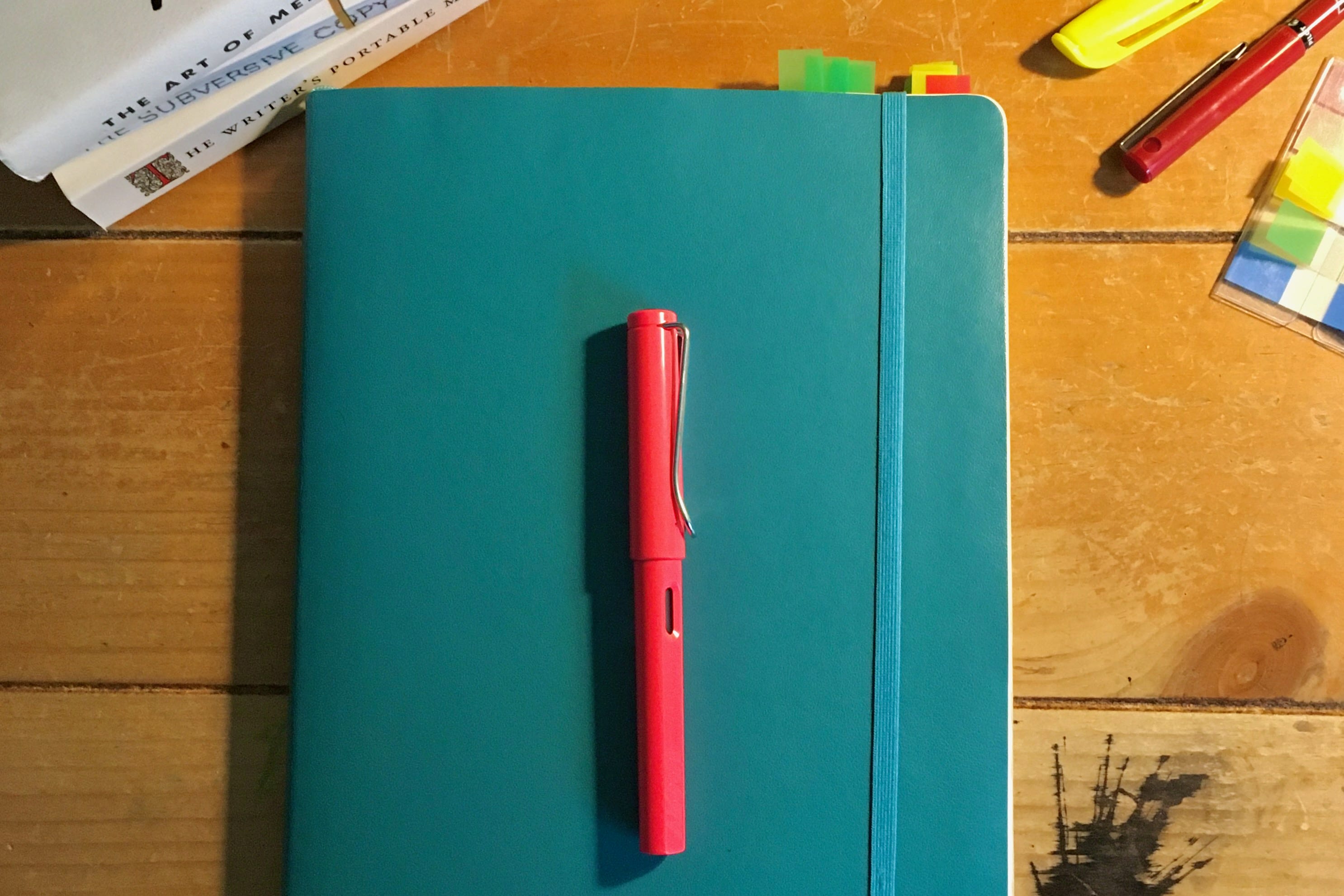
I still possess an assortment of gifts from my siblings. A neon-pink fountain pen my sister gave me. A hanging ceramic plant pot I received from my brother’s wife, hand-carved with geometric motifs. A canvas and leather tote purse from a favorite artisan that my siblings bought me together for my fortieth birthday. A hammered metal Eat sign that hung for a while over my stove. Earrings and a hoodie I no longer wear.
Like the Vonnegut mug, these objects have become tainted with memory and pain—and bitterness too. The fountain pen was another impersonal wish list purchase, a hint that my siblings in the last decade of our relationship no longer knew me at all. My sister opted for the default neon pink of the listing, rather than choosing a color I might actually like. I overlooked the garish hue for years, but now all I see is her indifference and its echo across many other instances. This fountain pen, previously my go-to writing utensil, now regularly dries up. The hanging ceramic pot was a well-chosen gift, nailing my taste and needs, but every time I water its philodendron, I remember my prim sister-in-law raising her palm in warning the only time I tried to share my story with her. “I know you and your father have your differences,” she said, “but he’s been nothing but nice to me.” As I wipe muddy water dripping from the drainage hole, shame still flushes my ears.
I cringe at acknowledging these resentments. They seem so petty. I like to think of myself as above such things; for so long I endeavored to be good, to show love, to prioritize others. But being the bigger person sometimes means you make the biggest sacrifice. Just like the chipped and cracked items of feng shui, these objects given by my siblings undeniably exude a damaged and deleterious energy. Worse, they remind me of how I lost myself. I haven’t yet had the will to give them away, but the more time passes, the less love and hope their presence conveys. Instead, they represent the lack of authenticity in my relationships with my siblings and their spouses, the repression I forced upon my needs, my demeanor, and my voice to fit in, the foolishness of my faith that I might then be seen.
Am I petty? Am I focused only on the negative? I suspect that’s what my siblings would say. How could I dismiss all the good that happened between us over time, our laughter and kinship through the years? Didn’t I also buy items from their wish lists for Christmas, what a hypocrite. Yes, I certainly had a part in our growing distance and a responsibility in our unraveling. There came a point where I too stopped knowing them. The difference in my view is that, for so long, while my siblings trucked along with enforced normalcy, I bent myself out of shape, desperate to be heard when no one wanted to hear me, folding myself smaller and smaller in some agonizing feat of origami until only my silence remained.
As the years advanced, my identity became for my siblings as it had been for my father, patchworked from untruths and conjecture rather than from facts and honest connection. I realized one day that, when disagreements occurred, no one talked to me, no one asked me how I felt or what I thought; instead, assumptions filled the gaps. The narrative was that I, the eldest sister, the estranged daughter, was the problem, and every phrase I uttered, every action I took then had to fit within the constraints of this narrative box, no matter how incongruous the interpretation. In the end, no amount of earnest effort or outrage on my part could combat the fantasy that felt convenient for them. Truth and accountability didn’t matter. I was the problem, and that was that.
To be fair, I made plenty of questionable choices. In big-sister fashion, I know I’ve pontificated and annoyed at times. I’ve argued points that were wrong. I definitely sent too many too-long emails. But I tried. In exchange, the most in-depth discussion my siblings and I had about our family’s dysfunction was, in summary, that they didn’t want to discuss it. Our physical distance didn’t help. I wasn’t around to hold my own in person, and the more I felt left out and purposely misunderstood, the less I called or visited. When I did, I no longer felt part of the family. The reason the hand-crafted tote purse they collectively gifted me sits in the back of my closet is that it reminds me of my siblings’ chummy whispers, side eyes, and stifled guffaws whenever I sat across a room from them, that dreadful sense of being ostracized, although perhaps they’d claim I imagined it.
After my father resurfaced to fuel some family drama four years ago, having constructed a house of cards too outlandish to explain here, I set some harsh boundaries. I urged my siblings to honor the truth and make things right. “I’m done,” I said, repeatedly. “I’m done offering my best to those who believe the worst.” It was, again, a too-long email. There was, again, zero discussion. My brother immediately blocked me on all social media. He no longer spoke to me by then, but cutting me off from seeing his adorable children grow up, even if only virtually, crushed me.
My sister and I stopped keeping in touch from that point on, but for a few years we still exchanged well-wishing texts on our birthdays. This kept a twinge of hope alive within me, that our relationship meant something to her, that an ember of sisterly affection still burned even if we didn’t talk, until about a year ago when I randomly realized she’d also blocked me on all social media, my silencing now complete. I don’t know what triggered her decision, perhaps the announcement of my forthcoming book about estrangement, perhaps another offense of which I remain unaware. Last year, for the first time, I didn’t hear from her on my birthday. Two months later, I sent a heartfelt text on hers, to which she responded only, “Thank you!” Those words—Thank you!—so polite and tone-less, the zing of the exclamation mark, float in the ether of our extinguished relationship.
Since then, with our rupture so palpable and, it seems, irreversible, I’ve finally begun the work of letting go—tangibly, with the items that still connect me to my siblings, and emotionally too. The removal began with the rusted iron Eat sign, once offered to our household by my brother, which I tossed in a donation box—a feasible first step, that décor going out of fashion. I can’t help but wonder if my siblings have undertaken a cleansing of their own, discarding my handmade gifts, reselling my purchases, giving away the objects that vibrate with my energy; but maybe I don’t hold that much weight.
This coming summer, my husband and I have agreed to tackle a big decluttering project to create a hang-out space for our teenagers, which will likely be an opportune time to separate myself from the objects that still connect me to my siblings and our difficult past. Perhaps one day soon the chipped Vonnegut mug will go out with the garbage. The thought feels equally painful and soothing. The tote purse may end up on Buy Nothing and the hanging pot at a yard sale—a makeshift scattering of ashes. Maybe I will tuck the neon-pink fountain pen in one of my archive boxes filled with old letters and journals in the basement—a burial. I remain reluctant to get rid of the mystery books my father bought me. The hours I spent with them and their reliable arc of justice provide their own sort of redemption, but I wonder if my reluctance is more elemental, a way to soften my strange orphaning, a last thread tugging at the possibility of my father’s love.
Estrangement is a form of grief, more complex than mourning a deceased loved one. Unlike the sentimental items that in death remind us of our departed beloveds, in estrangement an object can compound the difficulty of the rupture, forcing us to relive the relationship’s darkest moments anytime it’s in our field of vision yet simultaneously posing the question, What if?
Grieving the living is a mindfuck. Hope remains ceaselessly entwined with all the other stages—anger, denial, acceptance, and the rest. What if things could change? Truly letting go means giving up on that hope, and that can be a devastating proposition. But a broken relationship, like a damaged object, can be harmful to one’s wellbeing. Maybe, finally, I deserve better. The idea of letting go, of garnering relief one jettisoned object at a time, feels like a viable path toward healing, even if it means truly saying goodbye. So it goes.

Jenny Bartoy is a French American writer, developmental editor, and critic. She’s the editor of No Contact: Writers on Estrangement (Catapult, 2026). Her work appears in several anthologies, such as Sharp Notions: Essays from the Stitching Life, and in publications like The Boston Globe, The Seattle Times, Under the Gum Tree, Room, Chicago Review of Books, Hippocampus Magazine, and The Rumpus, among others. She holds a master’s degree from Columbia University and lives in the Pacific Northwest.

Jenny, I know I thanked you privately but I also wanted to publicly thank you for being so bold and honest here. You didn’t have to, and I hope writing about it offers at least one form of letting go, whatever you do with the gifts.
So grateful to read your essay, Jenny. Grieving the living certainly is a mindfuck.