


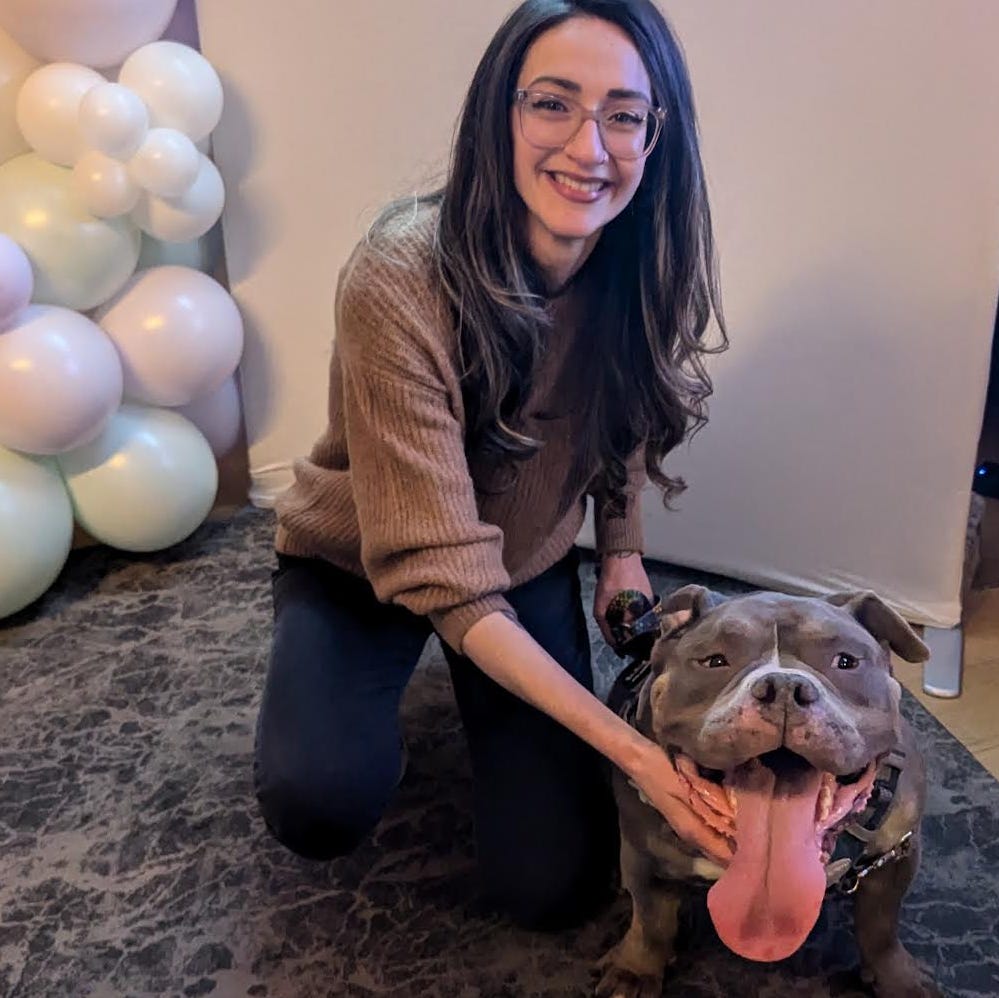
It is Zion’s 348th day in the shelter.
He’s a skinny, chocolate-brown pittie with cropped ears, gray hairs dotting his muzzle just beginning to poke through—hints of the frosty face we had hoped we’d never watch age behind kennel bars.
Today, he’s going home. The volunteer coordinator sees me returning a dog to their kennel and tells me: “Zion’s adopted.”
“Oh my god,” I say, trying to be as composed as possible because the second I move a single facial muscle, I will erupt into tears.
It’s too late; they come before I can turn away.
Minutes later, a fellow volunteer, Rachel, is filming his sendoff for her Instagram account showcasing our shelter dogs, which has amassed 40,000 followers. I am now sobbing, and Rachel catches it all on video. Mortified, but laughing, I cover my face and shoo her away.
Zion steps out, blinking into the sun-drenched lobby, his body loose and wiggly. Staff and volunteers—his people—gather, lining the hallway for soft cheers and goodbyes. He is the shelter’s second-longest- stay dog. The third-longest will be euthanized in a month. An animal’s future is never guaranteed in this place.
Outside, Zion bounds into the car of his new adopters, a retired couple still grieving their old dog.
“My husband was scrubbing the house all morning,” she tells me, eyes shining. “We had to get everything ready for Zion.” We laugh at the idea of vacuuming for a dog and cry together in the parking lot, two strangers holding the pure shock of joy.
For four years, I have spent nearly every weekend walking dogs at New York City’s open-intake animal shelter, a place where no animal is turned away and where space is constantly at a premium, and where dogs live in crates for months because a kennel is not available. It’s where every cat and dog (even the occasional pig or chicken) found abandoned in the city’s parks, streets, or vacant apartments will wind up. I began volunteering for one reason and one reason only: I wanted to hang out with dogs who needed, if just for a few fleeting moments, to remember how to feel joy again. To experience the world like a real dog again, not one trapped in a box for twenty-three and a half hours a day, on the best days.
What I wasn’t expecting was the women. An intergenerational group of volunteers whose passion for animal welfare either matches or outpaces mine.
I didn’t start showing up every weekend because I needed more friends; my social life was already full. But this community has quietly, profoundly reset the trajectory of my life. Diving headfirst into the world of open-intake sheltering with them beside me has given me peace, clarity, and a kind of companionship I didn’t realize I was missing, to guide my purpose.
Being a firsthand witness to the extent of my volunteer friends’ dedication quickly inspired me to show up more often than I’d initially planned. It made me understand that I may not be able to control the outcome, but I can control my ability to ease suffering in the moment.
They are the only people who understand the constant cycle of grief that comes along with volunteering at a shelter where animals die, the grief that can begin before one is even euthanized. Once a dog has been placed on the “at-risk” list, walks become more bittersweet, knowing this may or may not be the last time they get to sniff the treasure trove of scents in tree beds we pass, stare in awe at the family of geese commandeering the cemetery, watch the crowds of people watching for the bus, tails wagging in anticipation of a shred of attention.
After adopting my young, chunky American bully, Gizmo, a dog with an absurdly large head and disproportionately small legs who takes a full half hour to make it around the block, I knew my husband and I would be a one-dog household for a while. Gizmo filled every inch of space on our king-sized bed, and in my life.
Three months later, Connie arrived at the shelter, an elderly, deaf pitbull who waddled in on short, arthritic legs, her charcoal fur threaded with silver. I knelt to greet her. Even though I knew she couldn’t hear me, I said, This is just temporary, rubbing her chest. She blinked slowly. Something in me cracked open.
A few weeks later, my volunteer friend Elizabeth took Connie on a beach day—sand, sun, and requisite McNuggets. She posted a moving reel of their adventure, set to The Beatles’ “Here Comes the Sun.” When they arrived back at the shelter, I asked, “How’d it go?”
Elizabeth laughed. “I think she might be too slow for even Gizmo.”
I doubted it. It was clear Connie moved at the exact rhythm my life wanted to. In November, I adopted her.
Despite being ten years older, Connie regularly left Gizmo in the dust on walks. She was steady where he was goofy, unbothered where he was dramatic. Together, staring out the front door and barking in unison at absolutely nothing, all the time, they made sense.
Two years later, I lost her to cancer. A framed photo appeared on my doorstep: Connie on the beach, sunlight catching her fur, the words “Here comes the sun” beneath it. A note read, “From your volunteer friends.” I sat with it and cried, not just for Connie, but for the community that held us through both hello and goodbye.
In recent months, church bells in my neighborhood play “Here Comes the Sun” every morning, something I never noticed until Connie passed. Maybe it’s her way of reminding me I’m exactly where I should be.
Volunteering didn’t just give me purpose: It gave me a circle of women who provide me with proof that goodness still wildly, stubbornly exists. An unrelenting reminder that nothing we give is ever wasted.

Emmy Favilla is a New York–based writer and editor. Her essays have been published in Catapult, Pigeon Pages, BuzzFeed, Gloria and other outlets, and she currently works as managing editor at Forbes Vetted. She is the author of A World Without “Whom” (Bloomsbury), a book about the intersection of language and technology. Emmy is working on a memoir in essays largely focused on her volunteer work with shelter dogs and growing up in NYC.

Beautifully written essay about a beautiful topic. I'm a dog lover in the NYC area and have determined I'd never have the emotional strength to volunteer with ill-fated dogs. Thank you for what you do. I look forward to more of your writing.
Thank you for this lovely uplifting essay. I am so excited about your memoir. I'll be reading it and probably reviewing it. I love dog stories!