


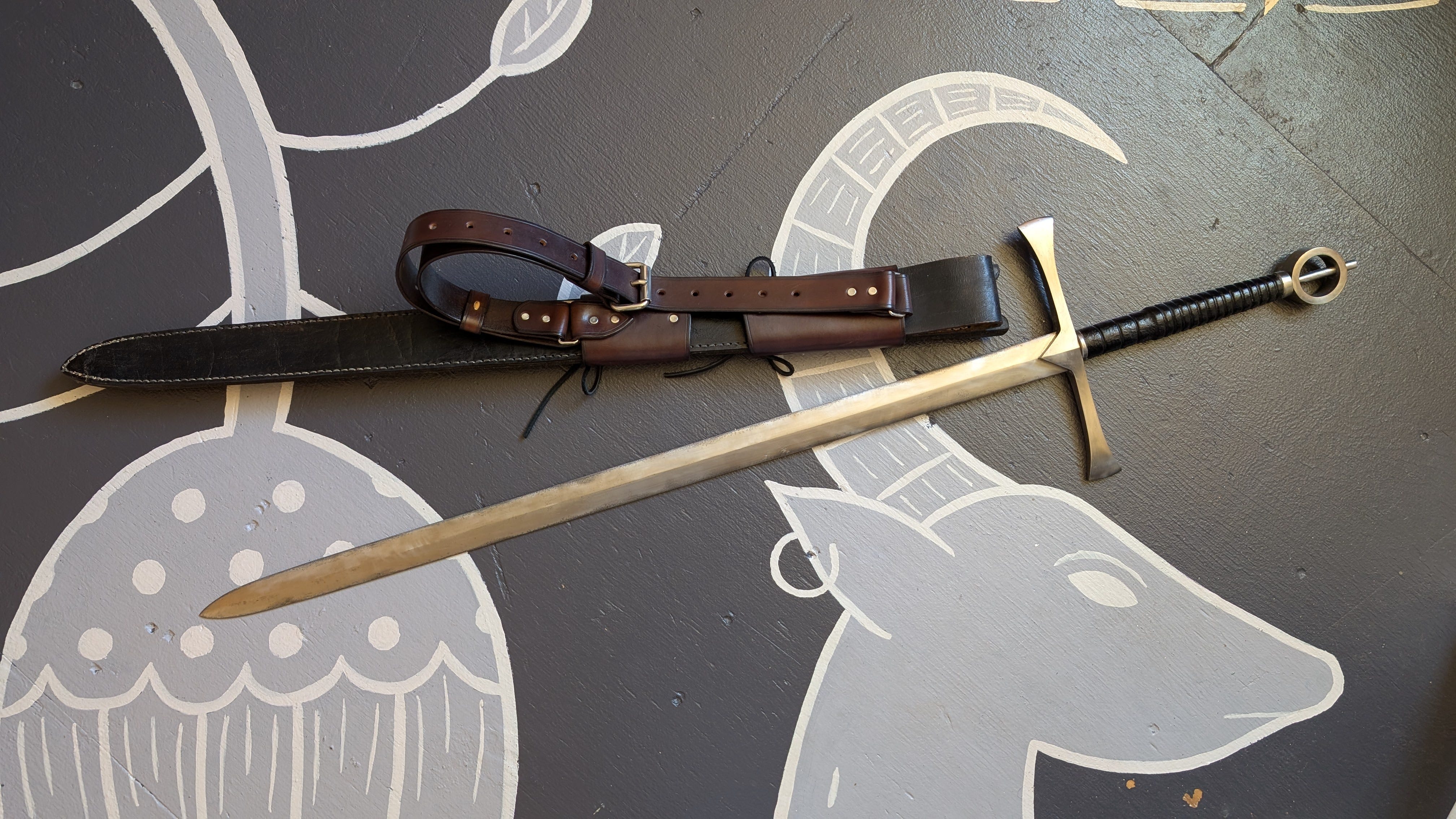
I love my mother. We talk often. She celebrates my victories, listens to my whining, and only sometimes still worries about me—a nearly-forty-year-old woman—being out after dark.
That’s why I bought a sword. Sort of.
My mother is afraid of knives because of how one was used—literally—at her throat. She’s afraid of a lot of things because of the childhood she survived, with the kinds of abuse people don’t like sharing.
Parts of her split, but not all of her. And she grew claws. They show whenever she or her children are in danger, real or not. I now understand that, to someone who’s experienced trauma, even everyday distresses can activate those deep-rooted survival-honed parts of the brain. And children are great at causing everyday distresses. In the distance of one breath, my mother can be a gentle breeze and a hurricane. I learned to walk on eggshells to please her because life became safer when she was happy and obeyed.
Growing up, we never kept a sharp knife in the house. We owned one large chef’s knife that was dull as a spoon with dents on its spine from where my mother used a honing rod to whack it through vegetables rather than sharpen the blade.
So she wasn’t happy when I, her 13-year-old daughter, asked for the money to buy a mail-order sword from a medieval enthusiast catalogue. It was a sleek, historical replica of an Irish hand-and-a-half sword with a full tang (a metal shank continuing the blade through the handle), real leather grip, and durable spring steel. At the time, in the early 2000s, it cost nearly three hundred dollars—a lavish price for a kid who spent Christmas money before she got it.
At least I had the good sense to ask for a well-made, historical piece that would last a lifetime rather than an overpriced souvenir. Knowing how much I loved medieval history, I thought there was a chance she would be willing to gift me the blade. Of course, she wasn’t, but she invited me to use my own money. If I had any.
I saw her move and parried. She thought she could thwart my plans without being the villain because she didn’t believe I could save enough. So I did the logical thing: I opened a bank account and an Excel spreadsheet to track my savings.
For one year, I noted every five-, ten-, and twenty-dollar bill handed to me. I rolled coins and returned pop cans. Every cent went into the spreadsheet. Any other item my mom said I’d need to purchase myself returned to the store shelf. I needed that sword. I needed it, I thought, because it was cool, beautiful, interesting. I needed it to help me pretend I was Queen Gwenivere, knighting Lancelot, or to pretend I was the knight herself. I needed it to cut a hole from where I was to anywhere else. I needed it.
At the time, I couldn’t conceive of a mother who could hurt me. I danced around the eye of the hurricane, thinking its raking claws were there to keep me safe while they mauled others. Sometimes I tested comments like, “Maybe the cashier didn’t deserve to be yelled at,” and her wide eyes turned to me. More often, she aimed her words at herself, like a gun to her head. I was right, she couldn’t hurt me.
I felt loved. She’d flatter herself with how smart and creative her daughter was, but when those words were tested, a new reality formed. Every ask to walk to a friend’s house involved a fight. She hyperventilated at the thought of her naive child walking alone past the woods. Her daughter couldn’t imagine the killers lurking in our family-friendly suburb. She’s weak. She can’t protect herself.
Eventually, the panic bled into me. Driving became a constant test of my likeliness to kill myself. Adulthood became a measure of the ways in which I was unprepared. What if it snowed? What if I lost my way? What if someone really was in the woods? How could I best life’s challenges? I’ll never know. I didn’t try.
* * *
In the quiet safety of my bedroom, I made up worlds where I wielded wands and lightsabers. A sword—a real-life sword could be the tool to keep me safe in her dangerous world. Swords made people strong. Dragonslayers carried them—knights, soldiers, underestimated hobbits.
After a year, my coffers were finally full. I mailed a check for the weapon’s value, plus shipping, handling, and tax. Two months later, my mother hovered, thin-lipped, by the doorway as I carefully unpackaged the long cardboard box. She couldn’t watch, but she couldn’t leave me unattended either.
I pulled the sword from an oiled bag and delicately wiped off the protective grease. It really was sharp. Lifting the blade, I learned I’d need to build muscle to hold it outright.
“Ay, Dios! Be careful!” My mother flinched. I smiled.
* * *
I don’t display it. Twenty-four years later, it sits in the corner of my office, where mostly only I see it. I never made time for a combat class or bought a plaque to hang it over the mantle.
Everyone who finds it marvels. Is that yours? Is it real? So cool. It is. But that’s not why I keep it. It’s a promise of who I want to be when I grow up—someone strong enough to cut their own way through the woods at the end of the street—someone strong enough to defy their mother. I don’t want her claws. I want to buy my own sword.

Catherine Cornell writes poetry, essays, and unfinished fantasy novels. For “work” she edits mental health writing and fiction, formats magazine layouts, and entertains people experiencing cognitive decline. You can see some of her work in Dreamweaver Narratives Magazine. In a past career, she won awards for her theatre set designs. She currently owns the sword and three really cool daggers.
Object-ives features flash nonfiction essays of 500-999 words on the possessions we can’t stop thinking about.
Recommended reading on possessions:
“What’s Your Prized Possession?” by Veronica Beard, A Need to Know Basis
“Hi, my name is Ed and I am a memory hoarder” by Edward Truncale
“The mess behind the scenes” by Tiffany Dawn, Spilling the “T” with Tiffany Dawn
“thrift month: secondhand shopping isn’t the problem, fast fashion is” by Dacy Gillespie, unflattering
“I Feel So Sorry for My A.I. Sunglasses” by Sam Anderson, The New York Times
“Groom Who Found Rare Pokémon Cards Able to Pay for Entire Wedding After Selling Them at Auction” by Charna Flam, People

Brilliant - I relate to this so much. Empathy for what your mom went through and the coexisting hypervigilance that comes from it.
An excellent read, at once subtly witty, gripping, and relatable. Brava.