


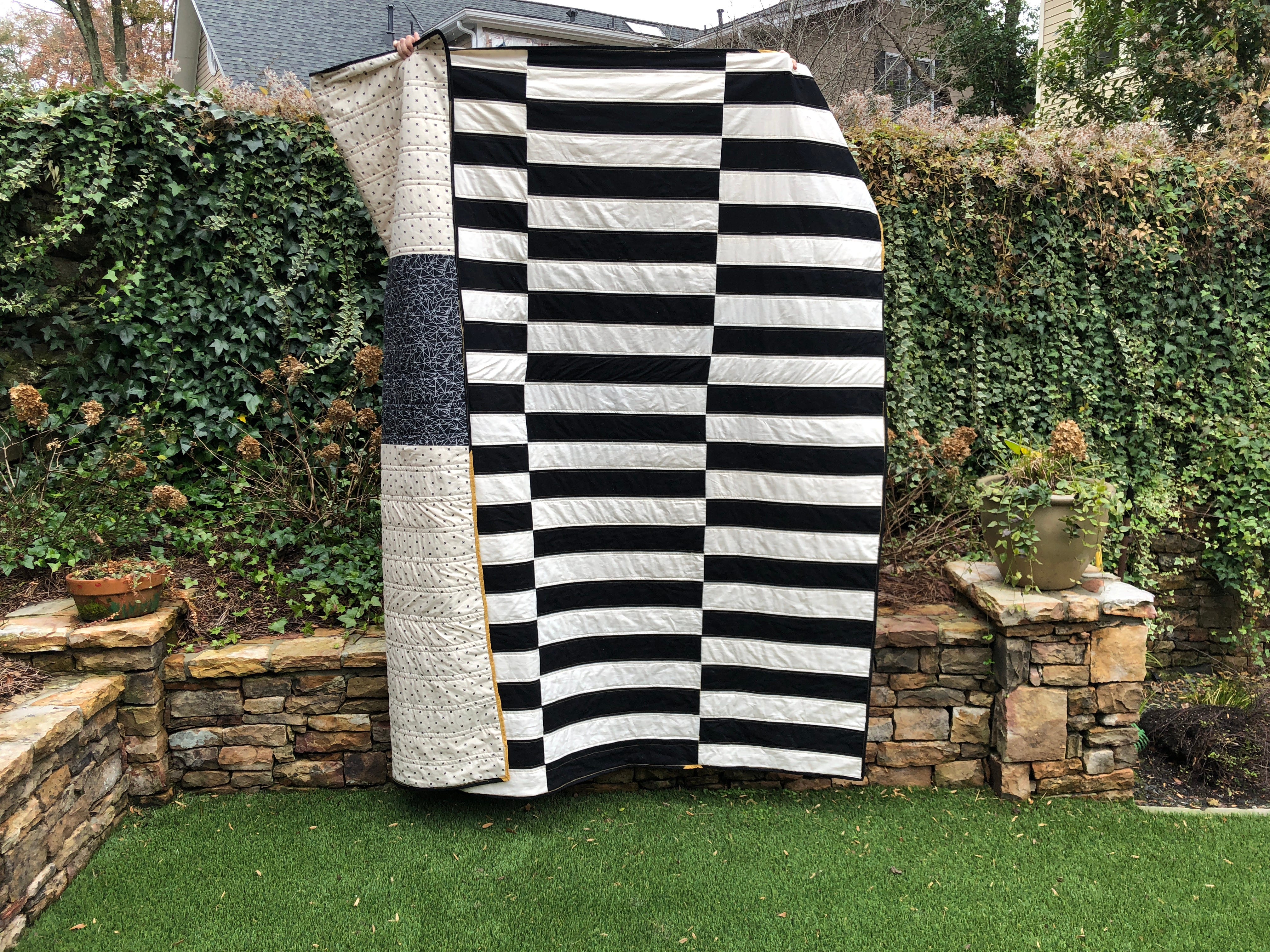
When I purchased my first sewing machine, I was coming off a year of doubt.
Twelve months out of graduate school, I decided to accept that my dreams of writing would never pay a bill. I had found myself plagued with the inability to finish the projects I started, increasingly aware of the professional opportunity costs that came with sinking myself into words that would likely never be published. I was brimming with ideas, but each time I began to lay them down on paper, they appeared flat, lifeless, a pale imitation of what I thought I’d crafted so well in my head.
So I swapped in that energy for a job updating the Twitter account for a local nonprofit, assuming that letting go of my hifalutin creative aspirations would be a reprieve. But rather than free, I felt swallowed, detached. I understood I needed a new outlet, one that would touch the part of me that posting content could never reach. That posed a problem. With writing firmly cut from my life, what to put in my idle hands if not notebooks and pens?
I had a good ear for music, but my hand-eye coordination was shoddy at best. My fingers weren’t fast enough for the instruments I longed to play. I was too much of a perfectionist to draw, and while I knew how to knit one and purl two, the thought of knotting endless rows of yarn bored me. I remembered how to thread a sewing machine, but making clothes felt unpredictable and overwhelming. As a teenager I’d once tried to freestyle a pair of pajama pants; the unlined, cotton legs ended up only two inches in diameter, unfit for even my old dolls.
I followed some quilters online and had become interested in the methodical, quiet work. The most arresting pieces were made by hand quilters, women who labored over seas of fabric as they pulled each stitch tight against the last. A single class in the ancient task taught me that I didn’t have the patience for that deliberate, time-consuming ritual. And so I bought a machine, a lightweight beginner model with the Project Runway logo stamped on the side. Every time I set it up, I felt silly, unserious, unencumbered—exactly what I was looking for.
I compiled books on classic and modern quilting styles for inspiration and puzzled through guides to color theory before sketching out some simple blocks I might make myself. I found that I loved the math of it all, calculating fractions of inches for seam allowances and binding strips. I would trace all these computations onto multicolored fabric flattened under clear acrylic rulers designed for the task.
Predesigning the projects emboldened me. I created a strict plan of execution that left no room for the creeping doubt that consumed me halfway through writing an essay. Quilting inverted the typical creative process into one that mirrored my own, allowing me to front-load my energy and excitement into the planning rather than the execution. I created guides that I could almost mindlessly follow, the pre-cut pieces arranged to correspond with a diagram on my cheat-sheet, a paint-by-numbers made of fabric. By the time I stepped on the pedal and began to feel the machine hum under my outstretched hands, I didn’t need to be creative anymore. I could give myself over to the meditative quality of its technicalities: keeping the stitches evenly spaced and in a straight line; folding down the appropriate edges and corners; smoothing it all under the weight of stainless steel and hot steam.
Most surprisingly, I kept at it, even when a single quilt took months. A wall hanging gave way to a baby blanket, and soon I was designing a queen-sized bedspread. As always, I added my fractions, purchased new rolls of cotton and batting, cut each piece with angular precision. But I soon found this project pressed my Bravo-stamped machine to its limits. The needle shook each time it pierced the layers of textiles, and the blanket had to tightly contort to squeeze under its shallow arm.
Three months into the pandemic, I turned 30. After witnessing these battles and my continued commitment, my husband thoughtfully upgraded me for my birthday. He gave me a Juki, an industrial machine at least twice as heavy and four times as expensive as my first. We’d recently moved into a new house, and I hadn’t yet unpacked my first silly, unserious machine. In the crisp quiet of that early spring, I’d started scribbling again, almost compulsively, with more deliberation than I’d ever previously been able to muster. My mind wandered and refocused. As the pandemic continued to surge forth, I didn’t unpack my Juki either.
Four years later, I finally slipped off its soft plastic coverlet. So much had changed since I first sat down with my sweet Project Runway model: I’d built a business, sold my writing, and developed an outline of a book. But on a Friday morning in late September, I wasn't thinking about any of that. Instead, I sat down at my dining room table and reminded myself how to thread the machine.
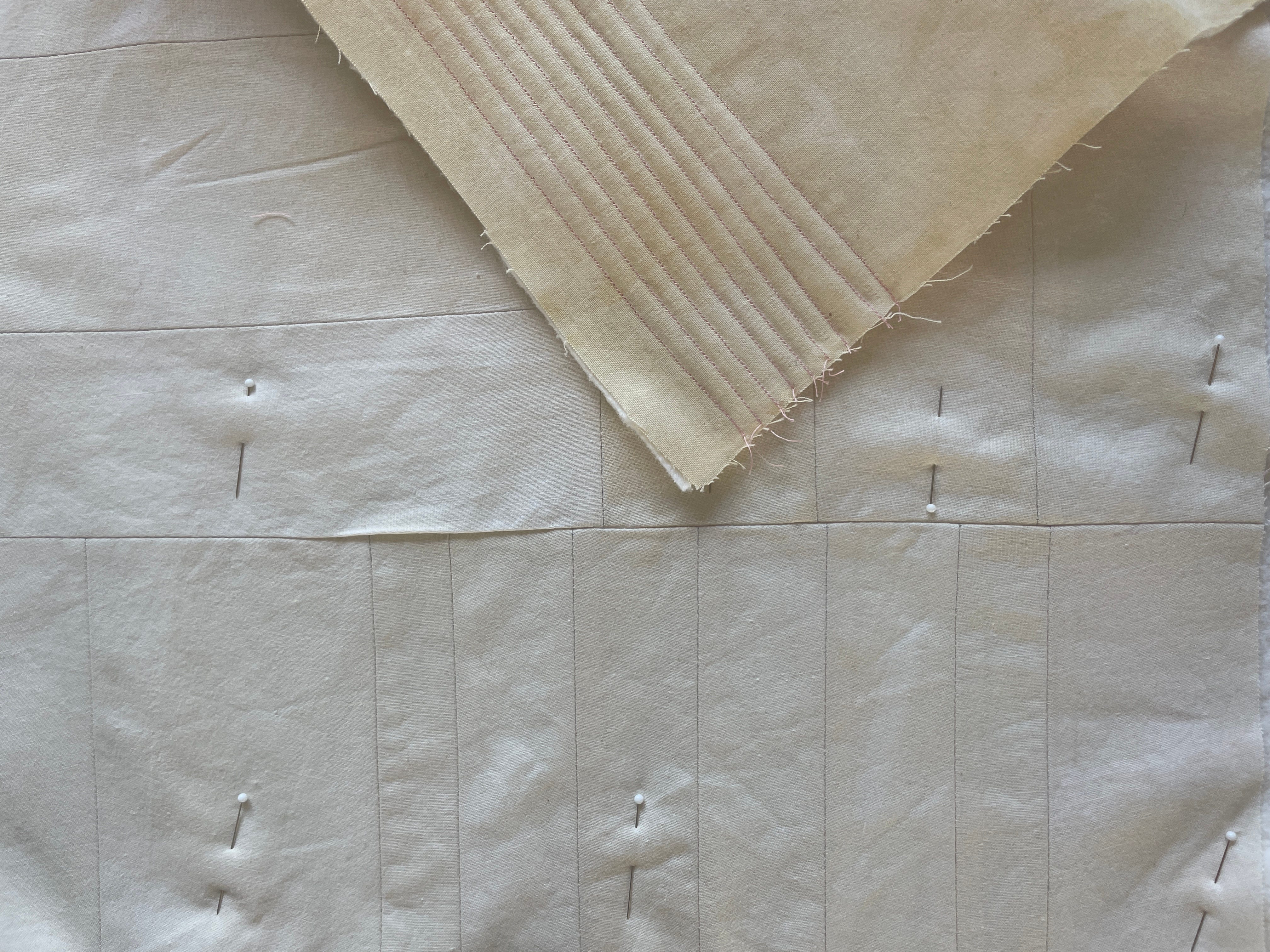
I can’t say what came over me. I don’t think quilting had been on my mind. But my hands drifted, and my mind followed. Rooting around in a box of old scrap fabric, I pulled out a piece of naturally dyed cotton, a length once made purple and yellow with cabbage and onion skins that had almost entirely faded back to white. This cotton wouldn’t have been suitable for one of my old projects, but it felt perfect now.
I laid down my acrylic ruler and began to cut without planning or math. Somewhere, somehow, I’d freed myself from the rigors of perfection, from the path where I retained all of the control but none of the outcome. Here, with no guide, I realized I could make absolutely anything.

Katie Carter King is a writer and researcher based in Atlanta, Georgia. She founded Magpie Projects in 2021, a boutique research consultancy that develops factually rigorous historical narratives for journalists and brands. A child of the Georgia Piedmont, she has also lived in Massachusetts, Mississippi, and California. Drop her a line at katiecarterking.com.

So many memories tied (stitched?) to those machines.
That Project Runway ( Brother) was a perfect beginner machine. I still have mine!