


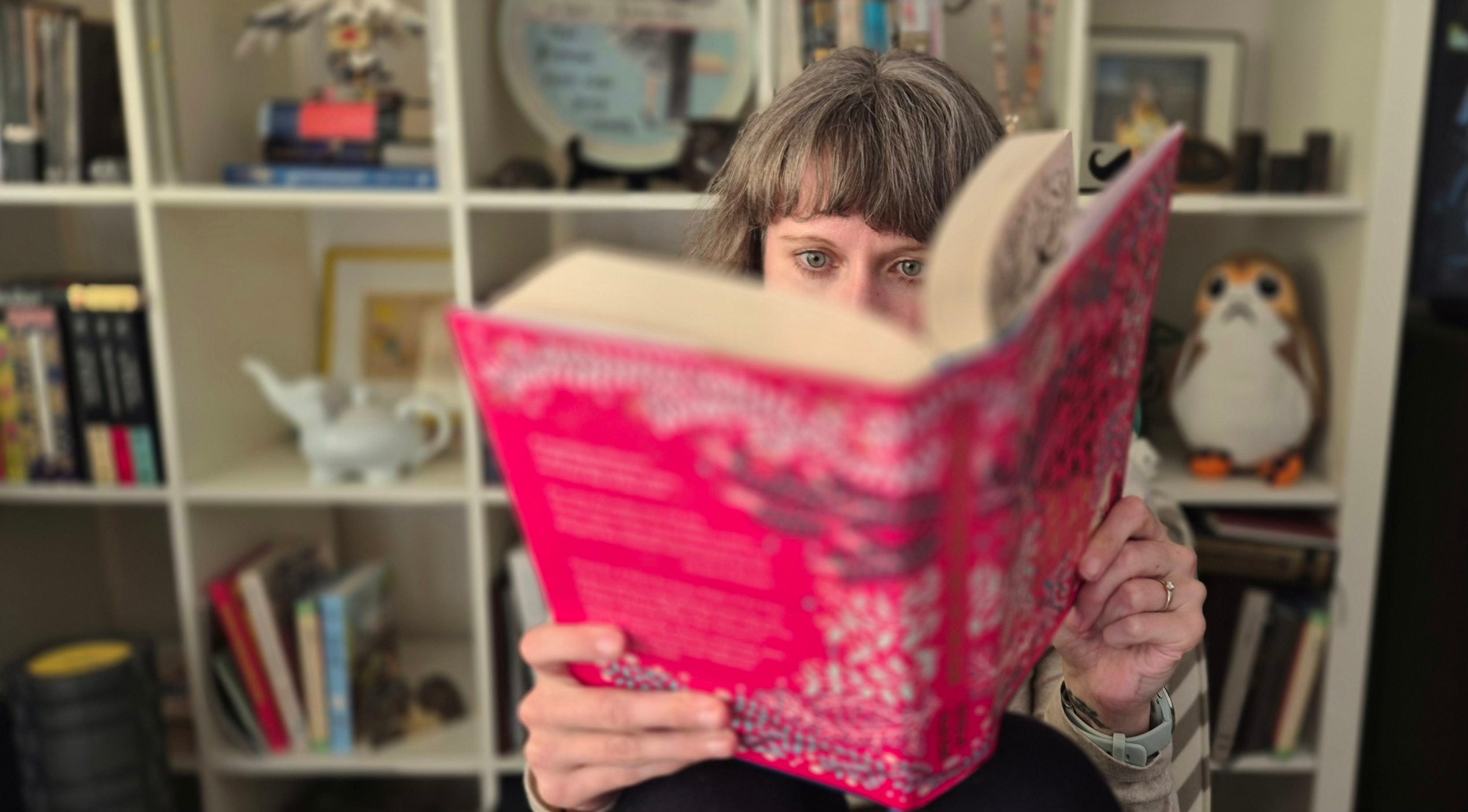
Before I could actually read, I memorized entire picture books and performed them from memory while turning the pages at exactly the right moments.
Everyone really should have known I was autistic at that point…
But it was the 90s, so I went on masking hard, and my caregivers and teachers praised me for this freaky skill.
Meanwhile, I grew more and more frustrated as, one by one, my first-grade classmates actually learned how to read. I balled my tiny fists and tried to force my eyes to make sense of the letters on the page that allegedly represented the sounds that words were made of.
Months later, things finally began to click. Instead of feeling proud of myself, I began immediately plowing my way through chapter book series like Little House on the Prairie, Goosebumps, and The Babysitters Club to make up for lost time. I fell in love with characters and fictional worlds, and with the thrill of closing the back cover of one book and starting the next one again and again.
In my high-control religious high school, I could only choose from the approved curriculum or the church library. I was at the mercy of my parents to take me on special trips to the local library or Books-A-Million.
So when I showed up at university and fell in step with the smart, honors journalism students who came in with college credits coming out of their ears, I learned a cruel lesson that reading isn’t always just reading. Sometimes it’s social currency.
My first boyfriend loved Dostoevsky, and he wasn’t very nice to me. Reading the Russians was a way for me to win the favor of him and his friends.
While earning a minor in British literature, I spent my spare time diving into the culturally-relevant, male-driven modern classics I’d missed. For me, it was the era of Fitzgerald, Hemingway, Nabokov, and all the way up to Vonnegut and Palahniuk. I loved the way my peers’ eyes lit up when I mentioned I’d read these prestigious authors. The books were fine.
College also meant spending hours watching young girls who were much more self-assured than I was, talking about their favorite authors and books from their bedroom floors on this interesting new website called YouTube. From them, I learned all about Looking for Alaska by John Green, Twilight by Stephanie Meyer, and, of course, a little series about a boy wizard by She Who Must Not Be Named.
For a while, I saw consuming this kind of content as a guilty pleasure, because the books they were talking about weren’t literary enough.
After college, with my first job, a first-generation Kindle, a tiny amount of disposable income and more free time than ever, I started reading an average of 200 books per year. During COVID, it was more like 300.
It was also during this time that I noticed the proliferation of book content on YouTube and other social media platforms. While my elder-millenial stubbornness keeps me from creating an account, I still feel BookTok’s influence on the platforms I do participate in. There are just so many “besties” babbling about what they’re reading. I love it!
These days I’m a marketer, and I make all kinds of online content for my amazing, inspiring clients. So, wouldn’t it make sense for me to make content online about books? On paper, maybe.
But I can’t!
I just can’t bring myself to talk about books on the internet. I’ve wondered if it’s because I don’t value my own voice and opinion enough. Maybe my strict high school and Dostoevsky-loving boyfriend killed my spirit for it?
But I don’t think that’s the real reason. If you scroll back to early Twitter, or stalk my ancient LiveJournal, you’d know that I’ve felt okay about expressing my opinion for a long time.
Now, though, reading feels like something for my personal, offline life. My relationships with online book creators are purely parasocial, and I want it to stay that way. I don’t want reading to become a performance. I don’t want it to be branded, optimized, and subject to any algorithm.
What I care about most is the books themselves. The books and like three people.
I dumped Dostoevsky Boyfriend fast. And after I broke up with another person who only read the sports section, I wrote a list of the qualities I wanted in a partner. The first was, “well read.”
Joke’s on me, though. My husband is six feet tall. He likes all of the specific pizza toppings I put on my list. He’s funny and kind. But he’s also been reading Dune for three years so far with no end in sight.
However, he will lovingly listen to me drone on about my favorite stories and hold me when my favorite characters die and laugh when I read him Princess Donut’s sassy dialogue from the Dungeon Crawler Carl books. He’s always down for any on-screen adaptation I beg him to watch.
He’s not upset that I don’t have a literary niche. That’s what I loved so much about those early creators as well. They weren’t brands. They were just bookish people figuring out life and sharing whatever they wanted. Their carefree attitudes toward posting made sense back then. In today’s algorithm-ruled world, I envy it, and attempt to channel it both online and off.
For me, reading will never be a performance or content. It’ll just keep being a major part of life, which I’m also still figuring out as I go.

Caroline Newton started her career reporting in newsrooms, built social audiences and websites for universities and startups, and now helps nonprofits and healing practitioners tell clear, brave stories through the work of her own communications agency. After six years living abroad, she’s now currently based in Oregon’s Willamette Valley. She writes about this transition and about beauty, power, belonging, and care in unstable systems at Anchor & Drift.

So relatable as an avid autistic reader
I can relate to this. I want to write about the books I read and how they've affected me but it just seems so impossible -- so personal, maybe, the way each subtly rewired my brain and added chambers to my heart.