



My stepfather Arthur* loves fresh fruit.
He and my mom spent their 30 years together in Florida, and for all the Sunshine State’s flaws, the produce is amazing. Citrus, melons, stone fruits, berries, even plain ‘ole apples—that man could demolish a fruit plate. When he’d come visit us in Seattle in springtime, he’d marvel at the Bing and Rainier cherries, devouring bag after bag.
My mother would chastise him. “Your triglycerides are high,” she’d say, telling him what he already knew.
My mom was right, but so was Arthur.
She knew too much sugar had consequences. He knew how to relish what he loved. But he also lacked the sense to know when something was a bad idea. Or perhaps he knew, and chose to indulge anyways, without regard for what might happen next.
In life, as in peaches.
This is my stepfather.
In 2019—about five years after he and my mother divorced—my stepfather and his business partners were convicted of scamming over a dozen people out of $3.6 million in investments. He was sentenced to 42 months in prison and to pay restitution to his victims. I have no personal knowledge of how or when these crimes were committed. I found out about it in the news, like everyone else.
I’m sure the courts went after his bank accounts and other assets. I hope it was enough to compensate all the victims for what he stole from them.
As Father’s Day approaches, I’m contemplating my own restitution. I also had something lost or stolen, but nothing a court of law could replace.
I lost my trust in a parent—and in my own memory of him.
Because this is also my stepfather.
I first met Arthur in 1987, when I was in high school and he and my mother began dating. My parents had recently separated. I’d just started to appreciate my home without my dad in it, the sense of levity I felt in the absence of his imposing presence. And then there appeared this new man, one who physically wasn’t unlike my dad: tall, Jewish, brown hair, hazel eyes. But the resemblance ended there. Where my dad was mercurial, tipping toward explosive, Arthur was chill, thoughtful, and kind in ways my troubled, angry father never was.
As an adult looking back, I have an even greater appreciation for Arthur; it’s not every 40-something man who wants to take on a girlfriend with two teenage children. But he did that and more. He quickly became a father figure for me—a relationship I sorely needed, and one that continued for decades.
Arthur listened, and he heard me. I can recall a conversation we had sometime in my twenties, even as I don’t remember what blowup with my dad had preceded it. “If your father can’t see what an amazing person his daughter is, then fuck him,” he told me.
It was so much easier to do that, knowing Arthur had my back.
I come from a loving family, though perhaps one where success is valued so highly that vulnerability gets swallowed. Arthur got it. Countless times, he reached out and asked if I needed anything, financially or otherwise, making clear it was between just us. He always made me feel like I could come to him for anything. Even better, I rarely had to—he’d ask before I found the words.
When I told Arthur and my mom I was engaged, he was as happy for me as if I’d been his own daughter. He met my future in-laws as my parent, and financed a good deal of the ceremony, expecting nothing in return but that I enjoy the day as I wanted to plan it.
At the time, I had only one living grandparent, my mom’s dad, who opted not to fly across the country for our wedding. That stung. But Arthur’s mom and her partner showed up; they flew out and danced the night away and rejoiced with our family. I don’t think I ever let them know how much that meant to me, and I wish I had, before they were gone.
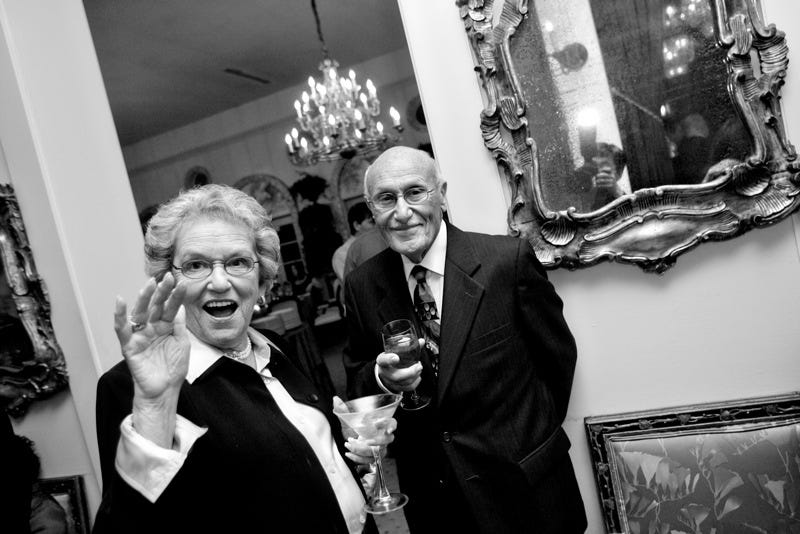
Once I became a parent, Arthur stepped up effortlessly as a grandfather, spoiling my daughters with his attention and affection. He always remembered holidays and our birthdays, and would send cards or messages.
He still does, even now.
The only years when I didn’t receive them? The ones when he was incarcerated.
My stepdad contains multitudes, and so do I.
“Do I contradict myself? Very well then I contradict myself, (I am large, I contain multitudes.)”
So says Whitman in “Song of Myself,” and so do I, as I try to reconcile a 30-year nurturing paternal relationship with the criminal I know Arthur to be. My heart and brain keep circling the same questions: how, and why? How did the same man who loved, raised, and healed me then go on to commit such crimes? Who was the real Arthur? And what was I supposed to do, as a stepdaughter and mother, in continuing a relationship with him? Does he deserve a place in my life, with my family? Do I owe him that after 30 years? Can we both hold that many multitudes?
It’s been nearly seven years since his conviction, and he’s served his time. I still can’t answer these questions. All I have is what I’ve gleaned from the past, and the steps I’ve taken—or chosen not to take—in the years since his arrest.
First and foremost, I know Arthur loves his family unconditionally. More than anyone else, Arthur demonstrated to me how to love without judgment.
In the kindest reading of his circumstances, this may have been his undoing.
It all began years earlier, when Arthur’s daughter started dating a man who was in prison, had been there for years, for some sort of white collar fraud crimes. He was innocent, of course, and he was loaded, naturally, so when he got out of prison, he and Arthur’s daughter were going to get married, or so he said.
So Arthur started visiting the prison with his daughter, to get to know this man whom she intended to marry one day.
My mother was horrified.
I understood why. I’m certain my mom gave Arthur an earful. Once again, my mom was right, but so was Arthur.
She knew validating this relationship and investing time to get to know a criminal could have negative consequences. He knew how to cherish what he loved. And if his daughter loved this man, then he wanted to support her by getting to know him. I’d never known anyone in my family who would’ve supported me without judgment like that.
I was awed by his unconditional love.
But also, I’m my mother’s daughter. I shared her misgivings. I understood Arthur lacked the sense to know when something was a bad idea—or perhaps he knew, and chose to indulge his daughter anyway, without regard for what might happen next.
Do I contradict myself? Very well, then I contradict myself.
My mother faced no such contradictions. Arthur’s support of his daughter became the final straw. They divorced in 2014.
I continued to receive texts and Facebook updates from my stepfather. His daughter’s boyfriend did get out of prison, and they did get engaged. Then they formed an investment company together. My mom and I wondered at the feasibility of it all, but now from a distance.
And that was it, for years. I can’t say what part Arthur played in the financial scam, how much he knew, or why he did what he did. My knowledge ends here, but the story continues.
On February 19, 2019—my wedding anniversary, incidentally—the news came: 16 charges of wire fraud. Then the fiancé died of a heart attack in prison. Arthur’s daughter was never charged. I have to think he protected her, though I have no proof.
Arthur reached out to me ahead of his sentencing and asked if I’d be willing to write a letter to the judge on his behalf, hoping to lessen his sentence. I wrote that letter. I told the truth, that knowing Arthur had made my life better through his kindness and support over the past 30 years.
“It made me cry,” Arthur replied when I emailed it over.
He got 42 months. I’m not sure if that was good or bad for his crimes, but I’d like to think my little words made an impact. At Arthur’s request, I provided my email as a point of contact for the prison. When I got the message that he’d officially been incarcerated, my heart sank as my mind’s eye filled with a past vision of my stepfather, grinning with his giant nightly plate of fruit. The immensity of his actions knocked the wind out of me, and I teared up as I thought, He’s 72 years old, and he’s in prison, and I don’t think he’ll have fresh fruit there, or possibly ever again.
He loved fruit so much. I cried for his loss, and for mine. How is this our shared reality, I lamented.
I’ll never know.
He’s out now. He texts me on holidays, and for the kids’ birthdays. Sometimes I reply, but I keep it brief. I know he’s still in Florida because when I posted photos on Facebook while visiting my mom, he messaged me, asking to get together. I can’t. Or at least, I don’t.
I know I can’t recover what I lost. I had a father figure knocked out from under me. Someone I loved without question betrayed that trust, all his multitudes notwithstanding. Unlike his victims, I won’t get restitution from him. What’s lost is lost. Instead, I look for it in myself. I hold onto the good I had with him, and I choose to believe it was real.
I’m certain it was.
I’m happy he’s out now.
I hope he’s relishing a too-large portion of melon, peaches, and berries, ripe and in-season.
I may even send him a text to wish him a happy Father’s Day.
*Name changed for privacy.


I think these kind of situations have no clear answers. It's incredibly individual and personal and I agree that we all contain multitudes.
My stepfather attempted to rob a bank by saying he had a bomb. He was sentenced to prison for 13 years. I also wrote him a letter trying to reduce the sentence. I don't think it worked. Before that point, he was kind and generous and good to me and my family. He was pretty much the only father figure I'd ever had. I don't have anything much to offer here besides the fact that I chose to see him as a whole person versus what he done. So I appreciate your piece and this nuance.
How absolutely shattering. I often wonder what we should consider about a person; everything they did wrong, or everything they did right. So many contradictions. Above all, this is a beautifully written piece.