


Between the time I finished high school and started knocking out general education requirements at the community college, I’d moved from cocaine addiction to experimenting with death packaged in tiny wax bags stamped with made-up brand names like “illuminati.”
A so-called friend convinced me to drive him to Newark, New Jersey in October 1998 so he could buy heroin. I agreed to do it for crack cocaine—the smokeable kind. The drive took 20 minutes. Within the hour we arrived at another of his “friend’s” mattress-on-the-floor living space to use the drugs.
The first time I tried the numbing powder, I felt itchy and warm and kept nodding off. I liked it, but heroin was taboo to my crack-smoking crew, so I didn’t admit to my closest friends that I drove Duane to Newark.
I didn’t tell anyone other than my journal that I tried “dope.”
But I liked it and said as much to my boyfriend within a few weeks.
He was helpless to stop me since I had the job, the money, the car, and knew where the dealers hung out.
“FUCK!”
My mind raced as I rolled down the driver’s side window and let the brisk night air slash my cheeks.
I’m going to miss curfew.
Denial drove my car the 30 or so miles home from Clifton, New Jersey, October 6, 1998. I was living with my parents in Parsippany and attending community college classes, but that night my boyfriend and I drank boxed wine in his parents’ two-bedroom apartment. I also snorted heroin from a small wax bag with a rolled dollar bill.
When I finally made it through the front door, I stumbled upstairs to my parents’ bedroom.
I couldn’t see straight, and I blamed my glasses, lying to my father through the locked door.
Of course, I haven’t been drinking or using drugs.
Go to bed, then, Dad said, promising to call the eye doctor in the morning if my vision was still blurry.
But I didn’t wake up the next day.
Dad broke the door down and found me lying on my back in bed, pale blue and gurgling.
Mom went for her stethoscope.
Dad called 911.
Detective Tony arrived ahead of the ambulance because he was already in my neighborhood investigating drug deaths.
Twenty-nine people died between January 22, 1997, and September 7, 1998, in Parsippany.
Detective Tony personally told more than fifteen of those families that their child was dead.
As he climbed the burnt orange shag carpeted staircase to my room, Tony thought I was gone, too.
He jumped into rescue mode when he realized I was breathing, but barely. He turned me on my side and opened my airway by sweeping the back of my throat with his finger.
I became the dummy from every C.P.R. class.
Medics showed up, stabilized me, and took me to the emergency room while Tony talked with my dad and made notes about the posters on my walls. He took my journal.
Days later, on October 11, I spent my twentieth birthday in the pediatric intensive care unit recovering from aspiration pneumonia, the result of an opiate overdose.
In other words, like legendary left-handed guitarist Jimi Hendrix, I choked on my vomit.
When I returned home from the hospital almost a week later, broken shells of smelling salt packets littered the blue shag carpet of my bedroom like an untouched crime scene.
I had to go to Tony’s office at the police station to get my cardboard-colored journal back. It held the secrets and lies I was telling myself. He said he needed to interview me.
He wanted to know where the heroin came from and who was to blame.
“Mike,” I told him. A lie.
I didn’t know whether Tony had read what I’d written about my boyfriend, community college classes, and a worsening trend toward self-destruction, but a small part of me hoped he had.
I couldn’t look him in the eyes, so I stared at the edge of his desk. I stuck a business card with the detective’s full name inside my journal when I got it back.
His last name rolled off the tongue like eighth note beats in common time.
Twenty years later, I searched the internet and found him.
“I’m looking for Tony B. I believe he saved my life in 1998, and I’d like to thank him,” I wrote in an email sent Sunday, October 9, 2016, to the Parsippany police department.
When Tony called, we talked about the bachelor’s degrees I’d earned and the work I was doing as a journalist. I told him about my husband and two kids, and I asked what he remembered of those years and the kids who died by opioid overdose.
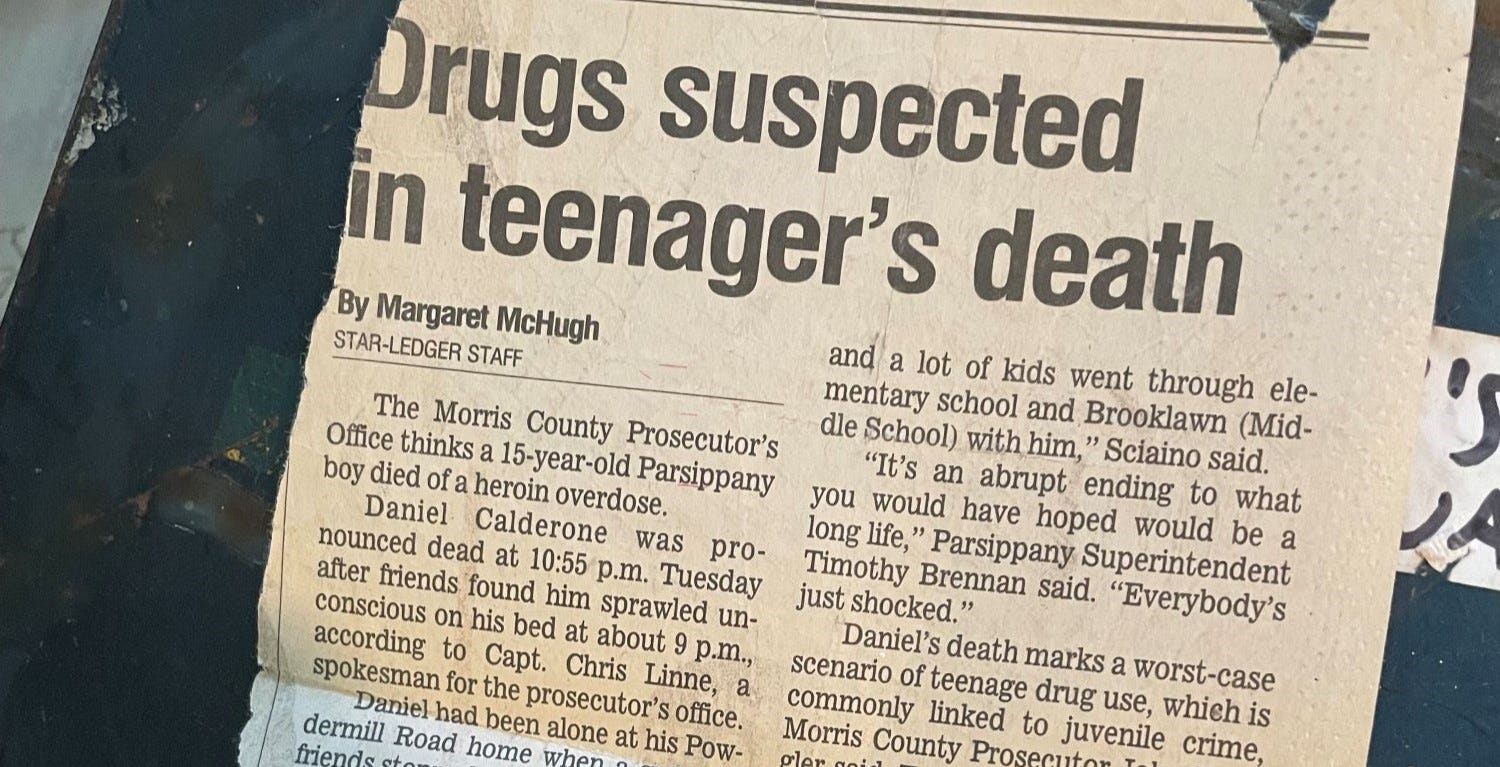
I asked Tony about Dan, the 15-year-old, the first of the folks in my extended circle of friends to die from sniffing heroin.
That’s when I learned that Tony responded when Dan’s grandmother found him dead in his bedroom.
Though he didn’t want me to broadcast the tale, Tony told me he took a Polaroid of the scene to show his stepdaughter, who was flirting with drugs and had been addicted to alcohol. He asked if I would speak with her on the phone, which I did.
She hadn’t had a drink in some time, but that wasn’t a long enough stretch to convince me she would remain sober. Incredulous to me how my advice might matter to someone who matters to someone who matters to me.
Stay in the moment. One day at a time. Find your people. Stay alive.
I held my smartphone to my ear and anxiously tried to say something meaningful. I don’t remember her name or how long we spoke. My memory is unreliable.
In early 2018, I traveled back to my home state to see friends and met up with Tony and his wife for dinner.
Outside the restaurant, I hugged him and, again, said, “Thank you for saving my life.”
I put the twenty-year-old business card in his meaty palm.
“What’s this?” he asked.
I smiled.
I kept it so that when I got myself together, I could find you and tell you I was worth saving after all.

Ellen Eldridge is a narrative writer and mental health care reporter. If you look hard enough, she can be found in Woodstock, Georgia, with her husband, two teenagers and three fur kids.
Object-ives features flash nonfiction essays of 500-999 words on the possessions we can’t stop thinking about.
Recommended reading on possessions:
“One-of-a-kind” by Rebecca Levenberg, A Thousand Miles: Postcards from an Adaptive Traveler
“Can We Do Christmas Every Day?” by Danielle G, Cool. Great. Fine.
“In Vintage Baby Clothes, I Found the Heirlooms I Didn’t Inherit” by Lilah Ramzi, Vogue

Riveting. Harrowing. Thank you for sharing your story, Ellen. So glad you're still here to tell it.
What a story. So happy you lived to give thanks to the guy who helped save you....thoughtful, brave, and sincere.