


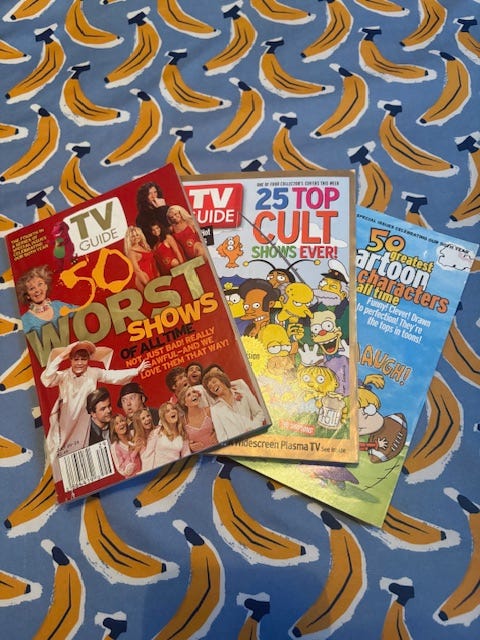
I was raised by magazines. As a child, nothing beat the thrill of the day’s new mail. The glossy sheen of the latest issue gleaming atop a stack of bills and coupons that bared little meaning to my adolescent mind. I’d pore over “spot the difference” spreads in Highlights and collage bedroom walls with celebrity crush-laden pages of Seventeen. I could rattle off the names of dozens of defunct titles I adored, but one subscription outlasted them all: TV Guide. A fresh issue was like catnip to my as of then undiagnosed autistic mind. The magazine was a highly organized, perfectly structured manual that aligned itself with my hyperfixations on pop culture minutiae. I couldn’t get enough.
After all, this was the 90s cable heyday and channel surfing was an art I had no mastery of. I’d randomly stumble onto a Lifetime movie of the week, one already halfway over, without knowing its title, or when it began and when it was ending. Or I’d catch a Nick at Night rerun of Bewitched with a special guest star whose name would forever elude me. Not knowing was beyond inconvenient. It was a maddening, meltdown-worthy frustration, one that could lead to brain-bending rumination and skin-picking fury. One which could be rectified by referring to that life raft of a magazine, the almighty TV Guide.
The gridded schedules of shows spoke to my needs for not only structure and routine, but also expectations and predictability. To know not only the lineup, but the exact plotlines of NBC’s “Must-See TV” Thursday or ABC’s family-friendly TGIF was a balm. Would the week ahead have a Kimmy Gimbler-centric episode of Full House? Was I stuck with a rerun of Seinfeld? Who was the musical guest on SNL, on the off chance I could stay up til midnight that weekend? I took solace in finding the answers in those perfectly packaged pages. It was more than a reference guide. It was a road map.
The annual fall preview issue was a behemoth. Double the usual length, filled with picks and predictions for the television season ahead in an age when the fall held real meaning and significance to the cycle of a show. Laden with splashy art deco graphics and a colorful layout, it marked a time of transition in TV that coincided with the start of a new school year. A season symbolic of new starts, one that could lead to surprise hits and inevitable flops for both the networks and me.
How I envied the treatment those shows got. If only my fall could have a “preview” reassuring me that I’d ace chemistry, like Frasier sweeping the Emmys, or that fifth period lunch wouldn’t be a social disaster tantamount to ill-conceived, short lived Friends spin-off Joey. I craved the power of critical prediction only America’s leading entertainment publication could provide to soothe my anxious mind.
Decades later, several issues still remain on my bookshelf, surviving moves from college dorms, first apartments, and an eventual home of my own. Each one is a reminder that no matter where I end up, I’ll always have a pocket-sized piece of pop culture nostalgia to guide me on my way.

Jessica Gentile is a writer and librarian based in New Jersey. Her work has appeared in The Atlantic, Slate, and Esquire, among other publications.
Object-ives features flash nonfiction essays of 500-999 words on the possessions we can’t stop thinking about.
Recommended reading on possessions:
“The “problem” of too many books” by Laura Fenton, LIVING SMALL
“What an Heirloom Is For” by Alice Trahant Phillips
“Take a picture. It’ll Last Longer.” by Keepology
“My Super Very Much Most Prized Possession” by Shey, Super Very Much
Objects Quarterly Volume IX: Other people’s objects, litter assemblage, creative tools by Rob Walker, The Art of Noticing
First piece of art hung in new apartment (Note), Skylar Allen, Room to Grow
“The Objects We Keep for Love” by Tammy LaGorce, The New York Times (via Objects Quarterly)
“I Tried the “Wheel of Chores,” and It’s the Smartest Decluttering Trick I’ve Ever Tried” by Lizzy Francis, Apartment Therapy
“Smartphones, Dumbphones, and Delusions of Platform-Building” by Maggie Mertens, Scratch
“Dmitri Young built a legendary card collection then sold it all — his tips for collectors” by Caleb Mezzy, The Athletic

Amazing example of how “mundane” objects can be such strong anchors of identity.
When I was under 10, the TV Guide that my parents read in the bathroom was a source of illicit intel on the world beyond our apartment. I have a visceral memory of the cover that announced the Damn Yankees! TV series in 1967. I was 9. "Damn" was a much reviled swear word in my world. I picked up the TV Guide carefully, worried someone would catch me, as if even reading the word was a sin. I felt embarrassed for the people at TV Guide. What kind of world blatantly printed a swear word? I love your sense of the seasons of TV and your personal life! Here is to order in overwhelm! xosbb