


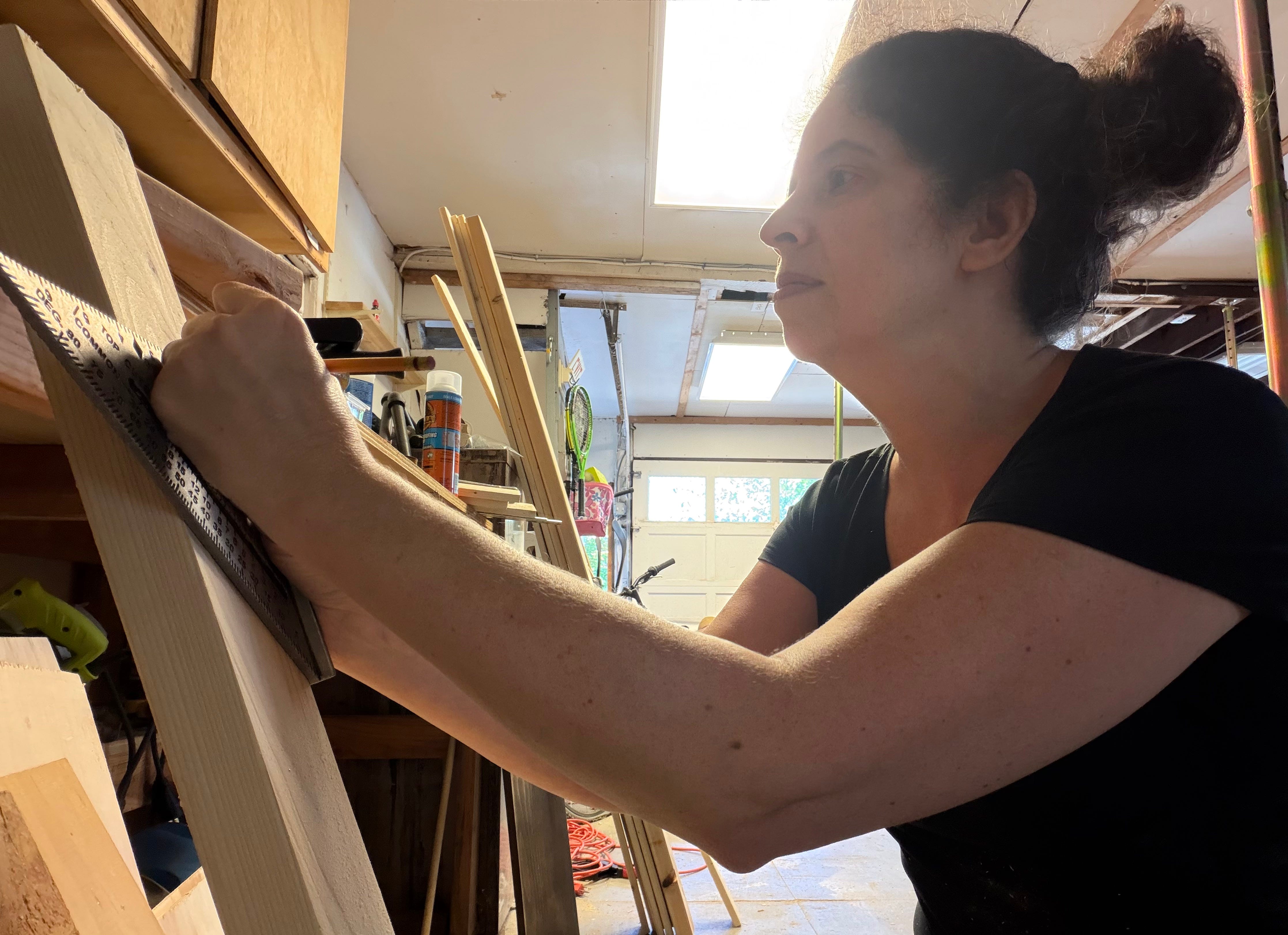
As a kid I dreaded the days Dad called me to the basement to help him with woodworking projects. I’d open the door to a whiff of must and descend our rickety steps as slowly as possible. The thunder of Dad’s work filled the cellar.
As a sensitive bookworm, I struggled with the roar of power tools and Dad’s swears as he built. Usually he didn’t even need me, so I simply stood and watched, wondering why he’d yelled for me to come down. To toughen me up? So he wasn’t the only one working hard on a Saturday morning?
Every now and then Dad asked me to fetch a tool that he couldn’t remember the name of. Everything was a thingamabob, doohickey, or gadget. Even then his memory was poor, and my mind would race as I tried to figure out what tool he wanted, and then retrieve it before he grew agitated.
If I returned with the wrong item, it was inevitable: he yelled or slammed down the tool in his hands and went off to get it himself. I’d try not to cry while small specks of sawdust floated between us. Then he’d say some version of “Fine, you’re done. Leave,” and I’d creep upstairs, feeling both relief and failure.
Mom usually swooped in when Dad’s mood darkened, calming his temper or redirecting his attention to other topics. He didn’t physically hurt us, but still I feared the anger that slammed doors and broke the leg of their bed with a kick. I shrank from the sarcasm and put-downs that rose from Dad’s anger and made me feel smaller than our pet hamster, Marshmallow.
The threat of his outbursts keeps me at an emotional distance even now, 40 years later, while dementia chips away at his memory. Mom has passed, leaving me to stand beside Dad once again and assist, this time offering up lost memories instead of tools. I began helping my sister care for him two years ago, after my family moved back to my hometown.
Our house has a tall, red barn in the backyard. The former owners outfitted it as a woodshop, and when I first saw it, I was surprised to feel drawn in.
Inside, the air carries the sweet smell of pine, and sawdust crunches underfoot. Sun filters through its 100-year-old windows. In that warm light, I’ve discovered my own love of woodworking.
It started with building simple flower boxes because the cedar boxes I liked were too expensive. It felt rewarding to create something that was uniquely ours. Soon I’d made bookshelves, chairs, and even a sofa.
I love running my hand across the smoothness of a sanded board, and relish the promise of a new project, when the knotted boards still lean against my workbench, about to be turned into something beautiful.
When I first began watching DIY videos, many of the tools and techniques felt familiar. I recognized the miter saws along with router bits and tools I’d fetched for Dad, and recalled some of the techniques he used. I wondered: Could he have wanted to spend Saturdays teaching me?
The more I build, the more certain I become that he’d wanted us to enjoy tackling projects together. He just didn’t have the patience or emotional capacity to make it happen. A personality disorder of some kind, Mom once explained. I was young and forgot its name. I never asked when I got older either. It didn’t matter; his words did.
I feel close to Dad when I saw and hammer and drill. At least, I feel close to the part of him who loved working with his hands and wanted to connect with his youngest daughter over a hobby; the father who would’ve laughed at my mistakes and patiently fielded questions.
I feel close to the father he could have been.
And if I’m honest, woodworking makes me feel like the daughter he might have been proud of: competent and skilled.
Now I’m the one asking my teen daughter for an extra hand. I make sure our workspace is one where mistakes are okay and learning is something to enjoy. For our first project, we joined two-by-fours and turned them into a desk for my husband’s home office. When we opened a can of wood stain, the sharp tang was the same I smelled at 13 when Dad stained our deck, his curly hair thick and red with life.
At 86, Dad’s stopped building and has given me part of his tool collection. We talk about my projects often. When he last came by my house, we sat together on the front porch while he shared advice about how to renovate it. Perhaps that companionship is what he wanted all those years ago. Perhaps we’ve both matured enough to make a version of it happen.
Recently I asked him to join me for an upcoming refinishing workshop held nearby. It would be the first time we’ve worked side-by-side since I was in middle school. My invitation felt like forgiveness, and a chance to try again.
His answer was classic Dad. He didn’t say yes. He hasn’t said no. He’s probably forgotten about it altogether. I’ve reached the point where I’m okay with that, too.

Colleen Wright is a freelance writer with personal essays in Chicken Soup for the Soul, Business Insider and more. She’s written for regional parenting magazines for over 20 years. Find her on Substack at Here Goes Everything.

Sadly, we don't choose our parents. That you can forgive him is your gift to yourself.
Moving piece.....
Lovely essay, wonderfully sensory.