


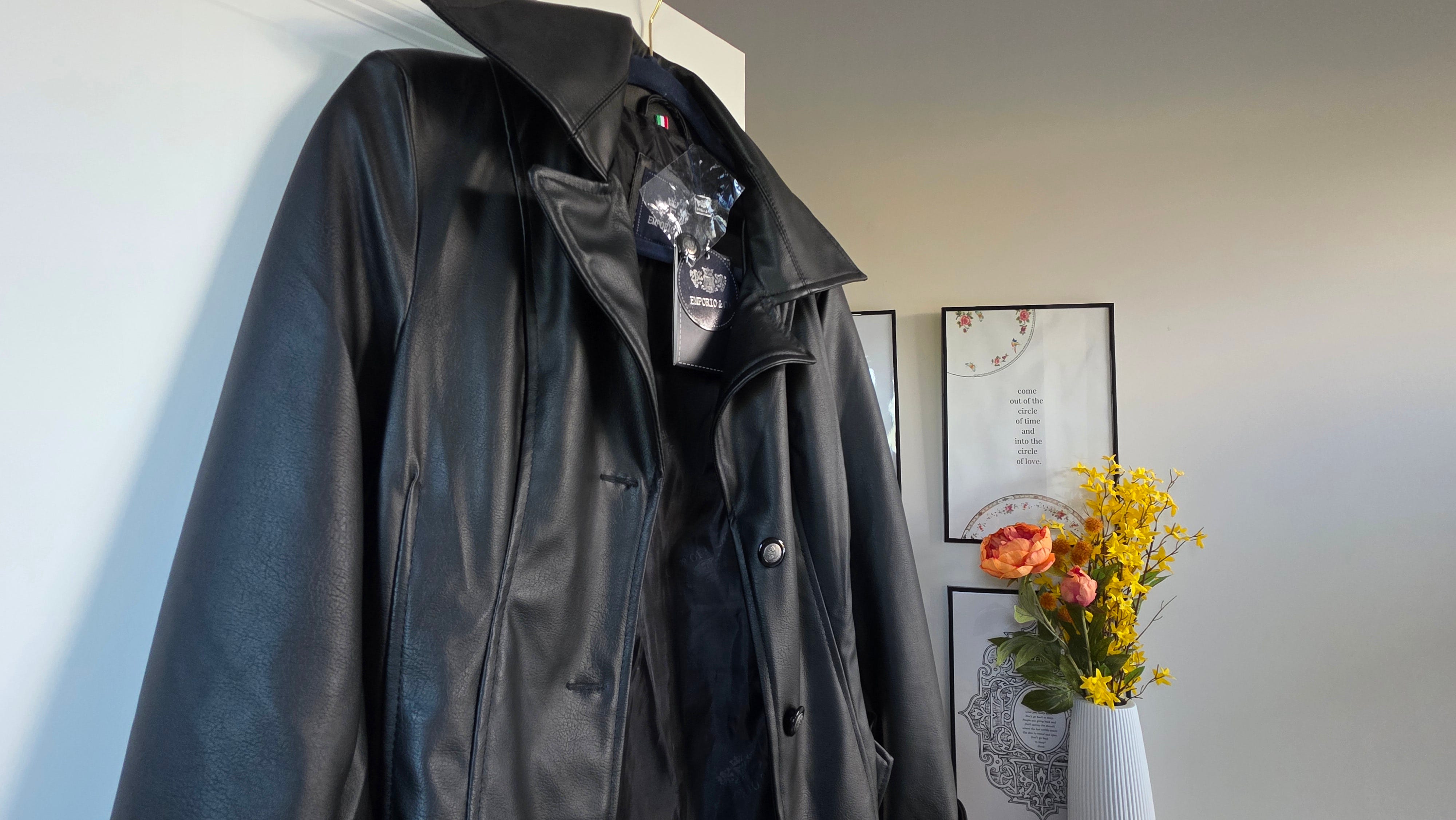
The black jacket hung in my closet for over six months. It didn’t want to go anywhere because though it was brand new and had so much potential, it couldn’t get over its own sordid origin story. Last Black Friday, my father was visiting my city, parading the newly purchased jacket around my living room.
“It sells for $250. Guess what I paid for it?”
“Not a dime over 50 bucks,” I said.
“48 bucks.” He exploded into laughter.
Two days later, on his way back to Toronto, he died in a car accident. He never would end up wearing that jacket. Out of all his belongings, it was the hardest thing to get rid of because it was simultaneously his and not his. And mine, but not mine either.
My father being of diminutive size, and I his closest fit, the jacket naturally came to me. I didn’t have the heart to wear it, so it sat in my closet like a dog at the shelter hoping to find an owner. In the months after the accident, the jacket was unaware of the hurricane of activity around it. After my father’s sudden passing, I went through a rampage of cleaning and donating. Grief makes you want to shed life. The more I purged, the more things kept coming out of crevices. It was as if the rooms in my house had cervices that had been birthing stuff when I wasn’t looking.
In the aftermath of a close loss, you begin to see the transience of life and to a degree, the pointlessness of possession. The knowledge that one day you can be an entity with things to its name and the next, a body that requires an identifying tag, puts ownership into perspective.
It was strange to learn that seventy years of my father’s buying and owning could turn into a single car trip to Salvation Army.
In my parents’ home, the story was similar. My mother returned to her place with a new set of eyes for everything. She was mass-chucking stuff to the curb and giving away her prized possessions—purses, jewelry, clothes—like Halloween candy. My mother, Extreme Hoardress, First of Her Name, Mother-of-Dragon-Eggs-purchased-at-the-flea-market, who still had my first birthday candle and my adult brother’s baby bottles, had now experienced that the shelf-life of this life isn’t written in permanent ink and if it is, whoever wrote it had smudged it to keep us committed to the game instead of quiet-quitting at some point.
My mother hadn’t heard of the idea of Swedish Death Cleaning but that is exactly what she was doing: simplifying her life and affairs so things would be less burdensome for her children one day. These days when we ask if she wants to go shopping for a change of scenery, she waves a hand effusively, rejecting the notion. “I am done,” is what she says. What she means is that the expansion phase of her life has come to an end. She is now a receding wave. And receding waves can try and sweep objects from the beach, but they will have to acquiesce them when they return to the ocean.
I expected that the flurry of decluttering in my own home would leave a kind of void in my heart, like the emptiness that hung in my father’s closet. But what it did was create a sense of unburdening. As if to handle the weight of grief, I needed to drop sandbags—belongings that no longer served me. I also became much more intentional about the acquisition of new things. I now think long and hard before making a purchase and consider whether it will significantly increase my quality of life or if there is something I already own that could do the trick.
When I do buy, I spend money on what brings joy and comfort: teas, books, fresh flowers. And plants. I began collecting perennials for my garden: roses, irises, peonies. Things that find a way to live. And continue giving. And remind me of my father’s kind hands planting roses in spring.
In my cultural and religious upbringing, there is a lovely concept of sadqah jariah, the giving that keeps on giving. The idea is to use your resources on something that keeps generating benefit, and thereby giving you blessings, even after you are gone. Donating to build a water well in drought-prone areas is one. Planting trees that provide shade or fruit is another. Transferring your knowledge to someone is yet another. Even though objects you own will technically be of benefit to someone after you pass, they weren’t purchased with that initial intention.
With this thought, I hope that that the flowers I have planted will continue to spread beauty and joy, even after I am no longer the guardian of this land.
As for the black jacket, it found a home. When my father’s nephew visited from out of town to pay his respects, he discovered the hard way the mercuriality of Canadian weather and found warmth in the arms of a jacket that was simultaneously my father’s and not his, and not mine either.

Ain Khan is an emerging Pakistani-Canadian poet and writer based in Ottawa. Her work has appeared in Rattle, Thimble, DarkWinter Lit, The Republic of Letters, New Verse News and is forthcoming in Contemporary Verse 2.
Object-ives features flash nonfiction essays of 500-999 words on the possessions we can’t stop thinking about.
Recommended reading on possessions:
“Being a Collector: On Owning Objects” by Berto Centofante
“How Did I Get All This Stuff???” by Cecilia Wessinger
“Unmatched Adventures TMNT and Collection Reflections” by Board Gaming with Bapter
“The Necklace Youn Yuh-jung Loved, Lost and Replaced” by Amelia Diamond, The New York Times
“Our Longing for Inconvenience” by Hanif Abdurraqib, The New Yorker
Ahhh, I've recently lost both my parents and they were also extreme hoarders. It took my brother and I the better part of a year to clear out their place. I understand the finding of birthday candles and Playmobil and receipts from the 70s. Leather jackets and Gucci shoes. I'm sorry you lost your father so suddenly but I'm glad you wrote these words. It's a beautiful essay and today when I go out into the world I will carry it with me.
A beautiful piece of writing. I saw it all, from the closet, to mom's giveaways, to the nephew and his new jacket.