


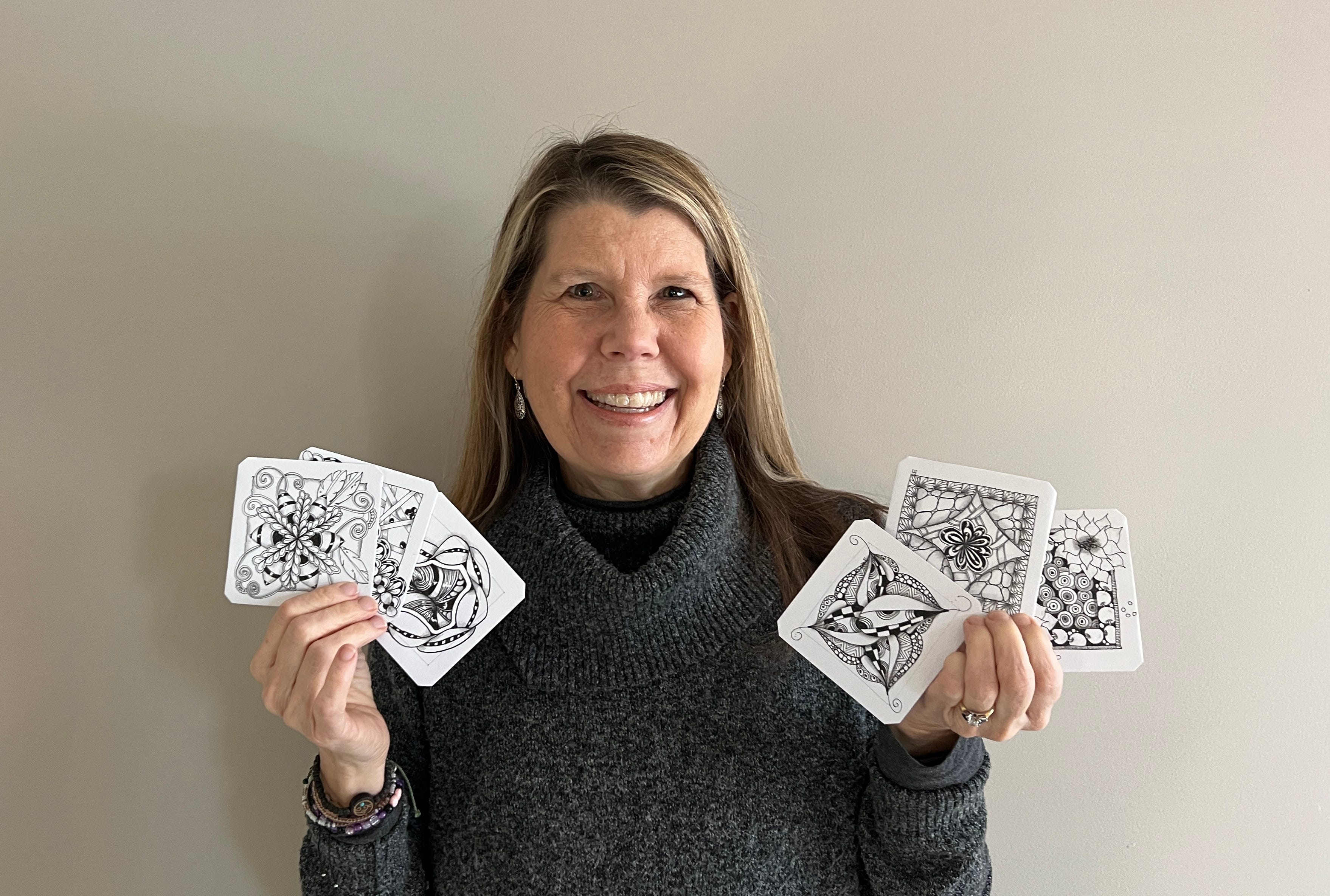
Four years after my 14-year-old daughter died unexpectedly, I started tangling. I kept telling my therapist I should be “over it” by now. She disagreed. My brain, once organized and sharp, was tired of wandering. I wanted to be done. Maybe not “done” with missing my daughter but DONE with the brain-mess. That part needed to go.
I learned about the Zentangle® method from a client. “It’s kind of like doodling, but with a more mindful approach. I think you might like it.” I felt called to go.
I was coaching execs through big decisions, volunteering for theatre at concessions and backstage, planning family vacations. My life kept moving. I did most parts well. Then I’d stare at an open space on my calendar, confused about what to do next despite the lists upon lists of things that needed my time. I wasn’t used to that.
I told my new tax person, “I used to be really good at math and for some reason, now I can barely add two numbers. You’re gonna have to be patient with me.” I hired an assistant because it took inordinate energy to schedule clients through the snarl in my brain. I couldn’t even read a book.
My therapist told me my brain had changed; it was real. “You suffered a trauma, Ellen. You’re right that your brain isn’t working as it used to.” I didn’t believe her. I asked if I could get an MRI to prove it. Secretly, I wanted to believe her. Then it would all make sense and I could cut myself some slack. I feared no one would believe me if I said my brain had changed when my daughter died. That sounded like an excuse.
The founders of the practice created it to bring calm and beauty to all. “There’s no right, no anything, just patterns,” a certified instructor said. Showing up on Sundays and Wednesdays gave me something to do, an anchor around which I could swirl, something solid to come back to through the week. Even when I told my therapist I didn’t know why I kept going, it moved from “something to try” to a calendar block I scheduled around.
It starts with gratitude, something I needed. Then, marks on the page—four dots in four corners of a 4x4 tile of cardstock. Those marks are just that, a start. When I felt stuck, I learned I merely had to begin. I didn’t have to do everything. I could start small. Breaking the blank page was sometimes enough to take me somewhere. On weeks I couldn’t even comprehend an email, I could make four dots.
We connect those dots with lines, forming a border around the tile. One teacher liked to inhale before she started drawing a line and exhale slowly as she drew it. Deep exhales did drop my shoulders. My therapist had been trying to get me to breathe more deeply. This was a magic door to her dreams.
Next we make a string, a simple swirly scratch or a few lines, anything that divides the square into smaller containers for tangles. Tangles are what it’s all about. There are hundreds of them. Small marks that don’t look like anything until they nest together when something beautiful starts to emerge. I had the sense that was happening in me; maybe if I could wander through the fog, something beautiful would show up.
One instructor started class by saying, “Whatever is going faster than slow, let’s slow that all down.” Her words were a permission slip for me, freedom to stop performing my A-game.
Zentangle’s motto is: Anything is possible, one stroke at a time™. That became true as I walked through grief. When I tangled, I learned to hold the card up and look at it from various angles. Perspective shifted. I saw things hidden in different views. Over time I recognized different expressions of grief in my living daughter and in my husband. An instructor said, “Every so often, pause to look at the big picture to see the beauty forming.” Yes, slowly, there was beauty forming in my smaller family of three.
Then shading: the shift from flat, two-dimensional drawings to 3D designs floating in space, optical illusions pulling me deeper into the craft. “Darkening the background helps us see the thing as it is,” my instructor said. That’s probably true about grief. I don’t know what I really am yet, though.
When the leader said, “We are never too far gone to get us back to center,” I softened. I wrote those words on the back of the card, wanting to remember. Maybe grief wasn’t pulling me away from every single thing I thought I knew about myself. Maybe it would drag me somewhere better. I could hope.
We finish the hour and I have a beautiful something that invites me to stare. I rotate the angles and choose my favorite. “How do you know it’s your favorite?” my therapist will ask. “I don’t know.” That answer is my brain’s frequent response when she wants to know about my body—how I feel. I still don’t know.
I put my chop, my initials to say I made this, at that favorite angle. It reminds me I’m a creator, not only a messy-brained mom, missing a daughter. We turn on cameras and share our work. That’s the final step: sharing and appreciating the creation.
After we close Zoom, I show my husband. He holds it. Turns it. Considers something new. I show my living daughter. She gazes deeply. Tells me she likes it—or not. They look at every square. In the middle of the chaos, they pause to see another version of me, one with a little less mess. A better version of what I used to be, emerging from the shading.

Ellen Ranson Moore is a recovering executive and Executive Leadership Coach. She’s at work on a memoir, but not for an hour on Wednesdays and Sundays. She lives in Maryland with her husband and daughter and has 36 Zentangle tiles framed in her guest bathroom, plus hundreds more like breadcrumbs through her grief. @EllenRMoore

🙌🙌🙌
Ellen - this is moving and important. The sudden loss of a child is, at least for me, something I will never "get over." After 34 years of grieving for Maya, my grief has softened. But it still ebbs and flows. I'm so glad you found "tangling" and shared the experience. I color intricate mandalas in the Angie Grace coloring books. I have two books full! It brings me a sense of integration and peace. Finding a way through grief is a spiritual practice we all need to learn. You've given us a lovely route to try!